
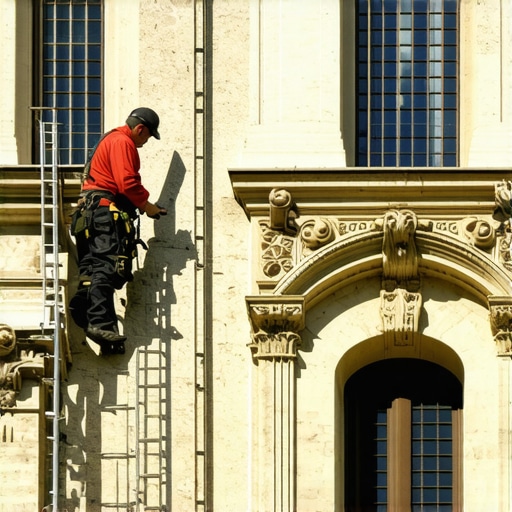
The Forensic Reality of Decaying Stone
The homeowner thought it was just a hairline crack, a minor blemish on a century-old legacy. But when I put my scope inside that fissure, I saw the structural steel lintel was rusted to dust, expanding with the force of oxidized iron and pushing the stone out by three inches. This wasn’t a cosmetic fix; it was a masonry rescue after disaster. You see, a facade is a living thing. It breathes, it moves, and it reacts to the atmosphere. When you look at a 100-year-old stone facade, you aren’t just looking at rocks; you are looking at a delicate balance of moisture management and load-bearing physics that most modern contractors don’t have the patience to understand.
The Physics of the Sacrificial Joint
The biggest mistake in stone facade restoration is the use of modern Portland cement. Modern masonry cement is hard, rigid, and waterproof. That sounds good on paper, but for a historic structure, it is a death sentence. Old stone is often softer than the cement people try to patch it with. In the masonry world, we follow the sacrificial principle: the mortar must be softer and more permeable than the stone itself. If moisture gets trapped behind a hard, non-permeable cement joint, it can’t escape. When the temperature drops and that water freezes, it expands by 9%, and since the cement won’t budge, it blows the face of the historic stone clean off. That is what we call spalling, and it is a crime against craftsmanship.
“Water penetration is the single greatest threat to masonry durability, and the selection of mortar must prioritize vapor permeability over compressive strength in historic contexts.” – BIA Technical Note 7
When providing re-pointing services, we don’t just grab a bag of Type S from a big-box store. We mix a custom mud using hydraulic lime or lime putty. This ensures the wall remains breathable. We micro-zoom into the sand gradation, matching the specific grit and color of the original 1920s work. We look for the “tooth” of the stone—the microscopic texture that allows the mortar to grab hold. Without that mechanical bond, your tuckpointing brick walls or stone facades will fail within five years.
The Art of the Masonry Birdsmouth Cut and Detail Work
Restoration isn’t just about filling holes; it’s about geometry. During this project, we encountered several complex corners where the original masons used masonry birdsmouth cuts to wrap the stone around structural columns. To replicate this without losing detail, we have to use hand chisels and slow-speed grinders. If you go in there with a heavy-duty demo hammer, you’ll shatter the crystalline structure of the stone. We butter each edge with precision, ensuring that the suction of the dry stone doesn’t pull the water out of our mortar too fast. If the stone “drinks” the water from the mud too quickly, the mortar won’t hydrate properly, leading to a “flash set” that crumbles under a fingernail.
Tuckpointing vs. Repointing: Know the Difference
People use these terms interchangeably, but they are different animals. Repointing is the process of removing old, decayed mortar and replacing it with new mud. Tuckpointing is a decorative technique where we use two different colors of mortar to create the illusion of perfectly fine joints. One color matches the stone or brick, and a thin line of contrasting “fillet” is applied in the center. This is where tuckpointing cost estimation gets tricky. It requires ten times the labor of a standard repoint because you are essentially drawing a grid by hand with a slicker and a hawk. It is the pinnacle of the craft, often used to hide the uneven edges of handmade historic materials.
“The strength of a masonry wall is not solely dependent on the compressive strength of the mortar, but rather on the elastic bond and interaction between the mortar and the masonry unit.” – ASTM C270 Standards
The Science of Sustainable Masonry Materials
We are seeing a return to sustainable masonry materials like natural hydraulic lime (NHL). Unlike modern cement, which releases massive amounts of CO2 during production, lime mortar actually re-absorbs carbon dioxide from the air as it cures through a process called carbonation. This process can take weeks, even months, to fully complete. During this time, we have to protect the work from direct sun and wind to prevent it from drying out too fast. We use damp burlap to keep the humidity high, allowing the lime to slowly turn back into stone. This is how you get a 500-year lifespan out of a wall instead of a 20-year lifespan.
Addressing the Skeleton: Chimneys and Fire Safety
A facade restoration often extends to the roofline. On this project, the chimney was a focal point. Beyond the stone aesthetics, we had to ensure a fire-rated masonry installation. This involves checking the flue liners for cracks and performing chimney damper repair to ensure the home remains airtight. A chimney is a thermal engine; if the masonry is compromised, it can draw heat into the wall cavities, leading to structural fires. We use refractory mortars and high-temperature sealants that can withstand the constant thermal expansion and contraction of the heating cycle.
Masonry Waterproofing Solutions: Don’t Seal the Breath out of It
One of the biggest scams in the industry is the “waterproof sealant.” Many contractors will spray a silicone-based film over a stone facade and call it a day. This is a disaster. It traps moisture inside the wall. If you want real masonry waterproofing solutions, you use silane or siloxane-based penetrants. These don’t form a film; they change the surface tension of the stone at a molecular level, making it hydrophobic while still allowing water vapor to pass through from the inside out. It’s the difference between wearing a plastic poncho and a high-tech breathable rain jacket.
The Master Mason’s Verdict on Costs
When homeowners look at a tuckpointing cost estimation, they often balk at the price. They compare it to a quote from a guy with a bucket and a ladder who says he can do it in a weekend. But masonry is about the long game. If you hire a hack who uses the wrong mud and cuts corners on the prep work, you aren’t just wasting money; you are actively destroying your property’s value. You’ll be back in five years with honeycombing in your joints and a cold joint in your concrete work. Do it once, do it right, and respect the stone. That is the only way to preserve a 100-year-old legacy for the next century. This job requires more than just a trowel; it requires a forensic understanding of how the earth and the atmosphere are trying to pull your house apart, and the skill to stop them.