
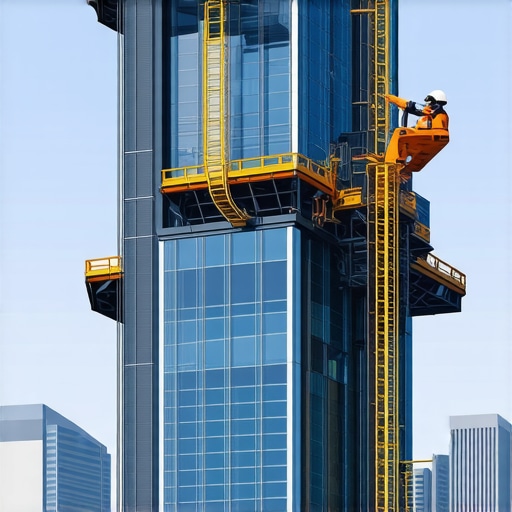
The property manager told me it was just a hairline crack in the mortar, a bit of cosmetic fatigue high up on the south elevation. But when I got the boom lift up there and put my borescope inside the cavity, I saw the truth: the structural steel was rusted to dust, held together by nothing but the grace of gravity and a few grains of sand. This is the reality of professional masonry restoration in the high-rise environment. What looks like a minor blemish from the street is often a silent explosion of oxidized iron, a phenomenon we call rust jacking that can literally tear a building apart from the inside out.
The Physics of Failure: Why Lintels Explode
When we talk about brick lintel replacement, we aren’t just swapping out a piece of metal. We are performing surgery on a structural system that is constantly under tension. In a high-rise, window lintels are the unsung heroes, carrying the massive weight of the masonry above the opening and transferring it to the jambs. But steel has an inherent flaw when exposed to the elements. When water penetrates the masonry—and it always does—the steel begins to oxidize. As iron turns to iron oxide, it expands up to ten times its original volume. This isn’t a slow, gentle expansion; it is a mechanical force that generates thousands of pounds of pressure per square inch. This is why you see those ‘eyebrow’ cracks or the dreaded soldier course sagging. The steel is literally growing, and the brick, which has zero tensile strength, has no choice but to snap.
“Corrosion of embedded steel is the primary cause of masonry distress in modern building envelopes, requiring meticulous attention to moisture management.” – ASTM C1194 Standards
In our structural masonry inspection work, we see this most frequently in climates where the freeze-thaw cycle is aggressive. Water gets trapped behind the brick, the steel rusts, the water freezes and expands by another 9%, and suddenly you have a 20-pound chunk of masonry hanging over a sidewalk. It’s a liability nightmare that a simple concrete patch won’t fix. You can’t just butter some mud over a crack and expect the laws of physics to take a day off. You have to address the vascular system of the wall.
The Smarter Method: Beyond the ‘Lick-and-Stick’ Approach
The old-school way was to just rip out the old steel, throw in a new piece of red-primed angle iron, and slap the bricks back in. That’s a ten-year fix at best. A smarter, forensic approach to historic masonry preservation involves a multi-layered defense. First, we look at the material. We don’t use raw steel anymore. We use hot-dipped galvanized or, ideally, 316-grade stainless steel. But even the best steel will fail if you don’t give the water a way out. This is where the industry fails most often. A proper brick lintel replacement requires a comprehensive flashing system. We install high-performance membrane flashing that extends past the lintel and is tucked into the backup wall, creating a slide for the water to exit through weep holes. Without weeps, you’re just building a swimming pool inside your wall.
The Chemistry of the ‘Mud’
As a third-generation mason, the smell of damp lime and Portland is in my blood. But I’ve seen too many ‘handymen’ use Type S mortar on a 1920s high-rise. That is a death sentence for the brick. High-rise masonry, especially in historic masonry preservation, requires a softer touch. The mortar must be the sacrificial lamb. It needs to be softer than the brick so that when the building moves—and high-rises move constantly due to wind load and thermal expansion—the mortar cracks, not the brick. We mix our mud with a specific suction rate in mind. If the brick is too dry, it sucks the moisture out of the mortar too fast, a ‘flash set’ that leaves the joint brittle and crumbly. We call it ‘burning the joint,’ and it’s the hallmark of an amateur.
“Flashing and weeps are not optional; they are the vascular system of a functional masonry wall, essential for preventing hydrostatic pressure build-up.” – BIA Technical Note 18A
This same attention to detail applies to other high-heat or high-stress areas. Whether we are doing a chimney heat shield installation or a fire-rated masonry installation, the physics of thermal movement remain the same. Materials expand at different rates. If you don’t leave room for that steel to breathe, it will find its own room by shattering your masonry.
The Critical Role of the Chimney and Roofline
In many high-rise restorations, the lintels are just the beginning. The chimney stack is often the most abused part of the structure, take the brunt of the wind and rain. We often find that a chimney leak detection reveals that the water causing lintel failure ten floors down actually started at a cracked crown. That is why a chimney cap replacement is often part of a holistic structural plan. If the top of the straw is open, the whole drink gets wet. We treat the building as a single organism. You can’t fix the feet if the head is leaking. Even down at the ground level, brick paver driveway repair requires the same understanding of drainage and compaction. If the base isn’t right, the surface is just a lie.
The Execution: Slickers, Hawks, and Soldier Courses
When we get down to the actual work, it’s a tactile process. We shore up the masonry above the window using needle beams or heavy-duty props. We carefully remove the soldier course—those bricks standing vertically over the window—and clean every one of them. We don’t throw away historic brick; you can’t match that 80-year-old patina with modern kiln-fired junk. We grind out the joints to a depth of at least one inch to ensure the new mortar has a proper ‘tooth’ to grab onto. We ‘butter’ the ends of the bricks with just the right amount of mud, ensuring there are no ‘cold joints’ where water can seep in. Finally, we use a slicker to strike the joints, compacting the mortar to create a weather-tight seal that looks like a ribbon of silk across the facade.
Don’t Ignore the Warning Signs
If you see a crack, don’t wait. That hairline fracture is a telegram from the structural steel telling you it’s drowning. By the time the brick starts spalling—popping its face off like a scab—the internal damage is already done. A structural masonry inspection today is the difference between a controlled repair and a multi-million dollar emergency scaffold project. In this business, you either do it once and do it right, or you do it twice and pay for the privilege of your own mistake. We build for the next century, not the next fiscal quarter. Real masonry isn’t about what you see on the surface; it’s about the physics of what’s happening behind the wall, where the steel meets the stone and the water tries to win. We don’t let the water win.