
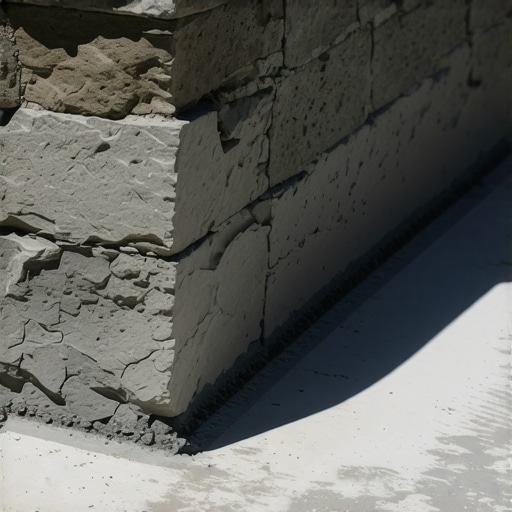
The Forensic Scene: When the Crown Falls
The call came in on a Tuesday, right after a heavy October frost. The homeowner, a man who spent his life in high-frequency trading and expected things to stay where they were put, was staring at his front entrance in disbelief. A three-hundred-pound piece of Indiana limestone, the ‘cap’ of his entryway foundation wall, was sitting on the grass like a discarded suitcase. He thought it was just a hairline crack he’d seen a month prior. But when I pulled my borescope into the cavity where the stone used to sit, the truth was uglier than a rusted rebar. I saw that the structural steel underneath was nothing but orange dust and the ‘adhesive’ used by the original contractor was nothing more than a cheap, dried-out construction glue that never had a prayer against the physics of a Northern winter. This wasn’t a masonry failure; it was a forensic crime scene. This is where we start. You don’t just ‘glue’ stone to concrete. You engineer a bond that survives the relentless expansion of frozen molecules and the brutal chemistry of alkalines.
The Physics of the Interface
To understand why most stone caps fail, you have to micro-zoom into the interface—that fraction of a millimeter where the stone meets the mud. Concrete is a porous, breathing animal. Stone is a dense, stubborn mass. When you slap a stone cap onto a foundation, you are trying to marry two materials with completely different rates of thermal expansion. In a North American freeze-thaw environment, water is your primary antagonist. Water expands 9% when it turns to ice. If your adhesive or mortar is too rigid, or if it has microscopic voids (honeycombing), that water finds a home. When it freezes, it acts like a hydraulic jack, slowly prying the stone away from the substrate. This is why professional masonry restoration demands more than just a bucket of premix.
“Water penetration is the single greatest threat to masonry durability. Without proper bonding and moisture management, even the highest quality stone will eventually detach from its substrate.” – BIA Technical Note 7
We look for the ‘tooth’ of the surface. If the concrete foundation was poured into a smooth form and never prepped, it has a ‘laitance’—a weak, milky layer of cement paste that has zero structural integrity. Bonding to laitance is like taping a heavy picture frame to peeling wallpaper. You have to grind it back, expose the aggregate, and create a surface profile that allows advanced masonry adhesives to bite into the matrix. We call this achieving a mechanical interlock. Without it, you’re just waiting for the next deep freeze to send your stone to the yard.
Advanced Adhesives vs. Traditional Mud
The old-timers—my grandfather included—would swear by a rich Type S mortar. And for a century, that worked. But those guys were building walls four feet thick where the weight did the work. Modern architecture uses thin stone veneers and caps that rely entirely on the bond. Today, we use polymer-modified mortars and epoxy-based adhesives that are engineered at a molecular level. These materials aren’t just ‘sticky’; they are flexible. They have ‘give’ that allows for the differential movement between the stone and the concrete. When we talk about mortar matching services, we aren’t just talking about the color; we’re talking about matching the compressive strength and the modulus of elasticity. If you put a mortar that is too hard (like a high-Portland mix) against a softer stone, the stone will be the one to shatter. The mortar must be the sacrificial element, or the adhesive must be resilient enough to absorb the stress of the building’s micro-movements.
The Hidden Killers: Drainage and Soil
Sometimes, a cap fails because the ground beneath it is moving. This is where structural masonry inspection transitions into geotechnical analysis. If the foundation is settling, no adhesive in the world will save your stone. In cases of significant subsidence, we look toward foundation helical pier installation to stabilize the entire mass. But more often, the culprit is hydrostatic pressure. Water builds up behind the wall, unable to escape. It pushes through the concrete, bringing salts with it—a process called efflorescence—which crystallizes behind the adhesive bond and pops the stone off. This is why a retaining wall drainage upgrade is usually the first thing I recommend before I even touch a trowel. You have to give the water a path of least resistance that doesn’t involve your masonry joints.
“The selection of mortar and adhesives must account for the physical properties of the masonry units and the environmental exposure conditions to ensure a lasting bond.” – ASTM C270 Standard Specification
When dealing with commercial parapet wall repair, the stakes are even higher. You have wind uplift and extreme thermal cycling on both sides of the wall. Here, we don’t just ‘butter’ the stone. We use a full-bed contact method, ensuring zero voids. We use a ‘hawk’ and a ‘slicker’ to pack the joints tight, but we also ensure that masonry joint sand repair is done with high-performance polymeric sands that resist wash-out while remaining breathable. A wall that can’t breathe is a wall that will eventually explode.
The Process of a Master Bond
How do we do it right? First, we clean. If there’s any dirt, oil, or old ‘handyman special’ glue, the new bond will fail. We use a diamond grinder to create that ‘tooth.’ Then, we damp the stone—not soak it, just damp it—to prevent it from sucking the moisture out of the mortar too fast. If the stone is dry, it ‘burns’ the mortar, stealing the water needed for hydration and leaving you with a brittle, dusty mess. Then we apply a ‘scratch coat’ of a high-bond-strength polymer. We ‘butter’ the back of the stone cap, ensuring 100% coverage. We don’t want ‘ribbons’ of glue; we want a continuous vacuum seal. For larger projects, we might even integrate retaining wall geogrid installation to tie the entire structural mass together, ensuring the face and the cap move as one unit. This is the difference between a ‘job’ and a legacy. You do it once, or you do it twice. And in my world, doing it twice means you weren’t a mason to begin with.