
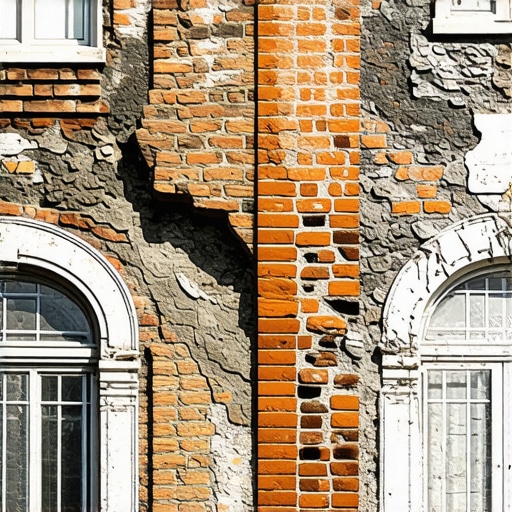
The Forensic Scene: A Facade Stripped of Its Soul
I walked up to a 1910 Queen Anne in a historic district last October where the owner was beaming with pride. He’d just spent twelve thousand dollars having the ‘grime’ removed from his exterior. As I ran my hand over the wall, my palm didn’t meet the smooth, hard finish of a healthy brick; it felt like I was touching a pile of compressed cinnamon. The contractor he hired—a guy with a diesel compressor and a ‘can-do’ attitude—had effectively lobotomized the building. When I put my digital scope into a weep hole, I saw the terrifying reality: the structural core of the wall was already turning to powder because the protective fire-skin was gone. The steel lintels over the windows were already showing signs of weeping rust. This wasn’t a cleaning; it was an execution.
The Physics of the ‘Fire-Skin’
To understand why sandblasting is a crime against masonry, you have to understand the kiln. Before 1940, bricks were often fired in periodic kilns where the heat wasn’t perfectly uniform. This process created a ‘fire-skin’ or ‘vitrified crust’—a thin, dense outer layer where the silica and alumina fused together under peak temperatures. This skin is the brick’s only defense against the elements. It is the ‘enamel’ on the tooth. Below that skin lies the ‘salmon’ or ‘core’ of the brick, which is significantly more porous and softer. Sandblasting uses high-velocity kinetic energy to literally blast that protective enamel into the atmosphere. Once it is gone, it can never be replaced. You are left with a sponge that will soak up every drop of driving rain through capillary suction.
“The removal of the hard outer skin of the brick by sandblasting or other abrasive methods increases the water absorption of the brick and accelerates its deterioration.” – BIA Technical Note 20
The Micro-Physics of Freeze-Thaw Damage Restoration
In our climate, water is the primary agent of decay. When you strip a brick of its skin, you invite the 9% expansion of freezing water into the very heart of the masonry. During the winter, liquid water enters the now-exposed pores of the soft brick core. When the temperature drops, that water crystallizes and expands. Because the brick is now weakened and lacks its dense outer shell, the internal pressure causes the face to pop off in a process we call spalling. This is why freeze-thaw damage restoration usually begins with a post-mortem of a previous contractor’s ‘cleaning’ job. If the damage is severe enough, particularly in load-bearing elements, we have to look into brick arch restoration or even chimney rebuild services because the structural integrity of the individual units has been compromised beyond the point of chemical stabilization.
The Portland Cement Trap
Many ‘handymen’ who sandblast also decide to ‘fix’ the mortar joints at the same time using modern Type S or Type M Portland cement. This is a recipe for a structural collapse. Historic bricks are soft and need to ‘breathe.’ They need a sacrificial mortar—something like a Type O or a pure lime putty—that is softer than the brick itself. Modern cement is harder than the historic brick. When the wall expands in the sun, the hard cement doesn’t give; instead, it crushes the edges of the soft, sandblasted bricks. We use mortar matching services to ensure the chemistry of the new ‘mud’ matches the physical properties of the old units. Without this, you’re just building a ticking time bomb. [image_placeholder_1]
Professional Alternatives: The Master Mason’s Approach
If you need to clean a historic building, you don’t reach for the sandblaster. You reach for chemistry and low-pressure water. We use alkaline or acidic poultices that dwell on the surface, breaking the molecular bond of the soot and carbon without touching the silica structure of the brick itself. For heavy atmospheric staining, steam cleaning at low PSI provides enough thermal energy to liquefy oils without the mechanical abrasion that kills masonry. When the color is permanently damaged or we’ve had to replace units with newer ones that don’t match, we utilize masonry staining. This is a breathable, mineral-based pigment that bonds with the masonry rather than sitting on top of it like a ‘lick-and-stick’ paint. It maintains the vapor permeability of the wall while restoring the visual ‘Soldier Course’ or ‘Header’ patterns that give the building its character.
“Mortar should always be weaker than the masonry units so that any stress-induced cracking occurs in the mortar joints where it can be easily repaired.” – ASTM C270 Standards
The Modern Integration: BIM and Stability
On larger, complex restorations, we don’t guess. We use BIM masonry projects to create a digital twin of the structure. This allows us to map every crack and every failed joint. If the sandblasting has led to significant water ingress that has compromised the soil beneath the footings, we might even need to perform foundation slab jacking or retaining wall batter correction to stabilize the entire mass before we even think about the aesthetics. We look at the ‘tooth’ of the stone and the ‘suction’ of the brick. If a brick doesn’t ‘ring’ when tapped with a trowel, it’s dead. We use modular retaining walls for landscaping, but for the historic house, we stick to the old ways, refined by modern science.
The Fix: Do It Once, or Do It Twice
Stop looking for the cheap fix. A ‘slicker’ or a ‘hawk’ in the hands of a master is worth more than a thousand-gallon air compressor. If you’ve already been victimized by a sandblaster, the only path forward is a deep forensic audit. We check for ‘honeycombing’ in the mortar and ‘cold joints’ in previous repairs. We look for the ‘butter’—the way the mortar was applied—to see if it’s actually bonding. Don’t let a ‘handyman’ with a pressure washer turn your historic asset into a pile of red dust. Use brick veneer installation for your new garage if you want, but treat the original masonry with the respect it earned over the last century.