
The Forensic Scene: When the Microscopic Becomes Catastrophic
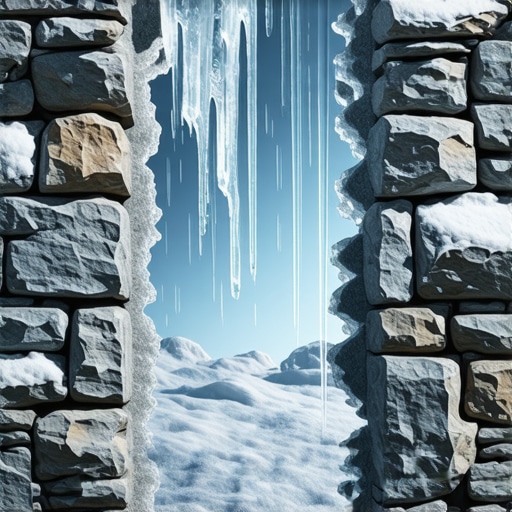
I remember standing in front of a massive limestone estate last February. The homeowner thought it was just a hairline crack running horizontally through the mortar joint near the water table. But when I put my digital scope inside that ‘minor’ fissure, I saw the structural steel lintel was rusted to a crumbling red dust, expanding and pushing the facade outward like a slow-motion explosion. This wasn’t a cosmetic issue; it was a structural masonry inspection that revealed a building gasping for air. Most people see a wall as a solid, immovable object. To a mason, it’s a living, breathing lung made of minerals and voids. When winter hits, that lung gets filled with fluid, and if it can’t exhale, the physics of freezing will rip it to pieces from the core. You don’t see the damage when it happens; you see it months later when the ‘face’ of your stone starts falling off in thin, jagged wafers.
“Water penetration is the single greatest threat to masonry durability.” – BIA Technical Note 7
The Molecular Violence of the Freeze-Thaw Cycle
To understand why your stone veneer repair bill is so high, we have to talk about the 9% rule. When water transitions from a liquid to a solid at 32 degrees Fahrenheit, its volume increases by approximately 9 percent. In a laboratory, this expansion exerts a pressure exceeding 30,000 psi. There is no stone on earth, no matter how dense, that can withstand that internal force if the water is trapped within its pore structure. This is the heart of brick spalling prevention. We look at the ‘suction’ or the Initial Rate of Absorption (IRA) of the unit. A brick or stone that is too dense won’t bond with the mud, but one that is too porous acts like a sponge. When you have a cold joint—that’s a gap where two layers of concrete or mortar didn’t bond perfectly—water finds a home. When the mercury drops, that water expands, and it doesn’t care about your architectural aesthetics. It pushes. It shears. It shatters. This is why masonry waterproofing solutions aren’t just about ‘sealing’ a wall; they are about managing how the wall breathes.
The Tragedy of Lick-and-Stick Stone Veneer
Modern construction has a disease, and it’s called ‘lick-and-stick’ stone veneer. I see it every day: thin slices of cultured stone slapped onto a substrate with nothing but a prayer and some cheap thin-set. These systems often lack a proper drainage plane. When I perform a stone veneer repair, I’m usually peeling back a layer of moldy OSB because water got behind the stone and had nowhere to go. Unlike traditional thick-set masonry, these veneers don’t have the thermal mass or the air gap to dry out. In winter, the moisture gets trapped behind the veneer, freezes, and pops the stone right off the wire lath. We call this ‘delamination,’ but it’s really just a failure of physics. If you don’t have stone coping installation at the top of the wall to shed water away from the face, you’re just inviting the freeze-thaw demon to live in your cavity walls.
The Anatomy of a Failing Chimney and Smokestack
Look up. Your chimney is the most exposed part of your home’s masonry, taking a beating from all four directions. A common failure point is the lack of a proper chimney cap replacement. If the ‘crown’—that concrete slab at the top—is cracked, water pours into the center of the chimney. This leads to the flue tiles cracking and the exterior bricks ‘spalling’ or popping their faces off. For my industrial clients, commercial smokestack repair involves even more complex thermodynamics. You have hot gases on the inside and freezing temperatures on the outside. This thermal gradient creates massive stress. If the mortar isn’t specified correctly, the smokestack will develop vertical cracks as the internal moisture vaporizes and then re-condenses into ice during the night. We often use sustainable masonry materials like hydraulic lime to allow these structures to shift and breathe without fracturing the units themselves.
“Mortar should always be weaker than the masonry units it binds, acting as a sacrificial element to accommodate movement and moisture.” – ASTM C270 Standards
Foundation Wall Bowing Repair: The Pressure from Below
When the ground freezes, it doesn’t just get cold; it heaves. Hydrostatic pressure is a relentless force. If your gutters are clogged or your grading is wrong, water saturates the soil against your foundation. When that soil freezes, it expands laterally. This is when you see a horizontal crack mid-way up the wall, a clear sign that you need foundation wall bowing repair. I’ve seen 12-inch thick block walls bowed in like a sail because of ice lenses in the clay soil. The fix isn’t just slapping some ‘mud’ in the crack. You have to address the water. Sometimes that means retaining wall block replacement with better drainage aggregates or installing carbon fiber straps to resist the tension. If you’re using a ‘hawk’ and a ‘slicker’ to just point the surface, you’re putting a band-aid on a gunshot wound. You need to relieve the pressure.
The Master’s Solution: Sustainable Resilience
So how do we stop the rot? It starts with the ‘hat’ and the ‘boots.’ The ‘hat’ is your stone coping installation or chimney cap. It must have a drip edge to kick water away from the wall. The ‘boots’ are your flashing and weep holes at the base. We use sustainable masonry materials like natural hydraulic lime (NHL) because they don’t contain the harsh salts found in Portland cement. Portland is too hard for historic stone; it’s like putting a piece of steel between two pieces of glass. Eventually, the glass breaks. Lime is ‘sacrificial.’ It allows moisture to evaporate through the mortar joint rather than through the face of the stone. This is the secret to brick spalling prevention. You have to let the wall ‘sweat.’ When we ‘butter’ a joint, we aren’t just filling a hole; we are creating a capillary path for water to escape before it has the chance to turn into ice and tear the building apart from the inside. Don’t trust a ‘handyman’ with a bag of pre-mixed concrete. Masonry is a science of moisture management. Do it once, or do it twice—the choice is usually written in the cracks of your wall.