
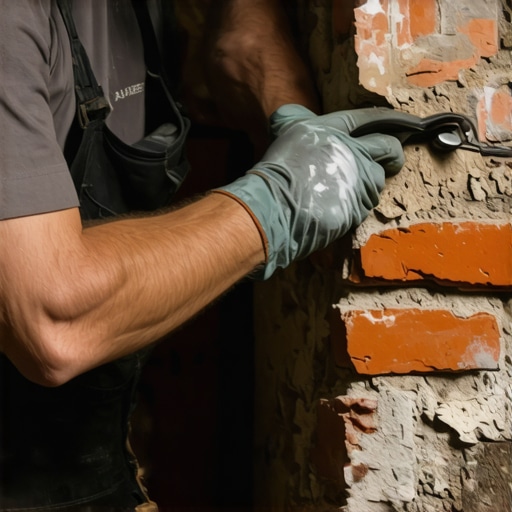
You see it every spring. You walk out onto your porch, and there it is: a fine red dust and chunks of brick face lying on the concrete like shrapnel. Most homeowners ignore it, thinking it is just the house ‘settling.’ Most handymen will tell you to just slap some hardware-store sealant on it and call it a day. They are wrong. What you are looking at is a forensic crime scene, a slow-motion explosion caused by the fundamental laws of physics and the chemical failure of the masonry assembly. When the ‘fire-skin’—that hard, vitrified outer layer of the brick—starts to peel away, the brick is effectively ‘exfoliating’ itself to death. This is spalling, and if you do not understand the suction and the vapor drive of your wall, you are just throwing good money after bad mud.
The Lesson of the Ringing Brick
Years ago, I worked under an old-timer named Sal who had been buttering joints since the Truman administration. He used to take a masonry hammer and walk along a wall, tapping each unit. If a brick didn’t ‘ring’ with a high-pitched, metallic ‘tink,’ he’d mark it with a wax crayon for removal. ‘If it thuds, it’s a sponge,’ he’d growl. ‘And a sponge in a Chicago winter is just a bomb with a slow fuse.’ He was teaching me about the internal integrity of the clay body. A brick that has lost its internal bond or has become saturated beyond its critical pore capacity is a brick that is about to fail. He knew instinctively what the laboratory guys call the saturation coefficient. If the brick’s pore structure is too open, it sucks in water through capillary action, and when that water hits 32 degrees Fahrenheit, it’s game over.
“Water penetration is the single greatest threat to masonry durability.” – BIA Technical Note 7
The Physics of the Pop: Why Bricks Flake
To fix spalling, you have to understand the ‘why.’ In cold climates, the primary culprit is the freeze-thaw cycle. Water is a unique beast; when it turns to ice, it expands by approximately 9% in volume. If that water is trapped inside the micro-capillary pores of a clay brick, that 9% expansion generates thousands of pounds of internal pressure. If the brick is stronger than the ice, the water is forced into other pores. But if the brick is soft—common in pre-1940s Chicago or Northeast common bricks—the ice wins. It shears the face of the brick right off.
However, the real villain in this story isn’t just the water; it is often the mortar. I see it every week: a beautiful 100-year-old home that has been ‘repointed’ with modern Type S Portland cement. This is a masonry death sentence. Historic bricks were fired at lower temperatures and are much softer and more porous than modern units. They need to breathe. When you pack those joints with hard, impermeable cement, you create a ‘dam.’ Moisture gets trapped behind the hard mortar, can’t escape through the joints, and is forced to exit through the face of the brick. This leads to sub-florescence—where salt crystals grow inside the brick pores—creating even more mechanical pressure. This is where sustainable block cutting and sourcing compatible reclaimed units become vital for a proper brick infill panel repair.
[image_placeholder]
The Forensic Inspection: Identifying the Root Cause
Before you mix any mud, you need to look at the ‘digital twin’ of your problem—metaphorically or literally. In high-end restoration, we use digital twin masonry projects to map out moisture migration patterns across a facade. For the average residential fix, you need to check your drainage. Is there a leaking gutter? Does the grade of the soil slope toward the foundation? Is there masonry joint sand repair needed on the adjacent patio that is allowing water to pool against the base of the wall? If you don’t stop the water source, your emergency masonry repair will fail by next season.
Look at the pattern of the spalling. Is it localized to a soldier course above a window? That suggests a failure in the flashing. Is it at the base of the wall? That’s rising damp or splash-back from the ground. If the spalling is widespread, you might be looking at poor-quality bricks from the original kiln run, often called ‘salmon bricks’ because they were under-fired and remained soft and pinkish-orange.
The Repair Protocol: From Mud to Finish
When it comes to a permanent fix for spalling brickwork, the solution is rarely a patch. You cannot ‘paste’ the face of a brick back on. You must perform a brick infill panel repair. This involves grinding out the failed units and replacing them. But you don’t just shove a new brick in with any old mortar. You need to match the Modulus of Elasticity and the vapor permeability of the original wall.
“Mortar should be weaker than the masonry units so that any cracks occur in the mortar joints where they can be easily repaired.” – ASTM C270 Standards
For modern structures, fiber-reinforced mortars offer incredible bond strength and crack resistance. For historic homes, we use lime-based mortars (Type O or even pure Lime Putty). We start by sustainable block cutting to ensure the replacement bricks fit the original masonry birdsmouth cuts or decorative details. We ‘butter’ the ends of the new brick, ensuring 100% coverage to avoid honeycombing or voids where water could sit. When we strike the joint, we use a slicker or a jointer tool to compress the mortar, which creates a ‘weather-struck’ profile that sheds water effectively.
Modern Tech Meets Old World Craft
We are entering a new era of masonry. For highly ornate historic elements that have spalled away, 3D printed masonry repairs are becoming a reality, allowing us to recreate complex geometries that would be too expensive to hand-carve. Similarly, stone wall repair has been revolutionized by injection resins that can stabilize the core of a wall without dismantling the entire structure. Even a brick patio restoration now benefits from polymeric sands that prevent the ‘wavy’ sinking caused by washout, ensuring the base remains stable for decades.
If you are facing a crumbling facade, don’t reach for a bucket of ‘patching compound’ from the big-box store. That’s just a bandage on a gunshot wound. You need to respect the chemistry of the clay and the physics of the water. Do it right, use the proper mud, and ensure your wall can breathe. Otherwise, you’ll be sweeping up red dust again next year.