
The Sound of Eight Tons of Mud Moving at Midnight
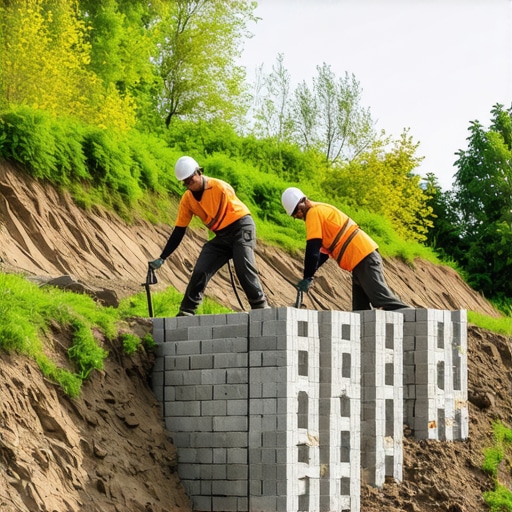
I stood looking at a $50,000 retaining wall that lay in a pile of rubble because the contractor forgot one thing: drainage. It was a cold April morning, and the ground was doing what it always does when the frost breaks—it was turning into a heavy, hydraulic slurry that no amount of ‘lick-and-stick’ masonry could ever hope to contain. The homeowner was white as a sheet, staring at the modular blocks that had been tossed like dice across his lawn. He thought he’d bought a wall; what he’d actually bought was a dam, and the water eventually won. This is the reality of failing retaining wall repair: by the time you see the tilt, the physics have already beaten you. As a third-generation mason, I’ve seen this scene play out more times than I care to count. People see these modular blocks at the big-box store and think it’s a weekend DIY project. It isn’t. You aren’t just stacking stone; you are engaging in a high-stakes wrestling match with gravity and hydrostatic pressure.
“Water penetration is the single greatest threat to masonry durability. Without proper management of hydrostatic pressure, structural failure is not a matter of if, but when.” – BIA Technical Note 7
The Micro-Physics of the Spring Thaw
In the trade, we talk about the ‘tooth’ of the stone and the ‘suction’ of the base, but in the spring, it’s all about the 9% expansion of water. When the ground freezes, water crystals expand, shoving soil particles apart. When that ice melts, you’re left with a void that fills with liquid mud—a process called pore water pressure. If your wall is built against a hillside without a clear exit for that water, that pressure can reach hundreds of pounds per square foot. We’re talking about professional masonry restoration on a forensic level here. You have to understand the ‘angle of repose.’ Every soil type has a natural slope where it stays put. When you cut into that slope to put in a patio or a driveway, you’ve created a debt to gravity that must be paid in structural integrity. If you’re dealing with a historic property, you might even be looking at historic brickwork repointing nearby that is being compromised by this same soil movement. The earth moves, the foundation shifts, and suddenly you need foundation helical pier installation just to keep the house from following the wall down the hill.
The Anatomy of a Permanent Wall: Base and Compaction
It starts with the trench. Forget your shovel; you need a machine that can dig deep enough to reach undisturbed subgrade. You need at least six inches of crushed, angular stone—not round pea gravel. Round gravel is like trying to build a foundation on ball bearings. You want ‘crushed run’ that locks together. This is the ‘base’ physics. You hit it with a jumping jack compactor until the ground rings. If you don’t hear that high-pitched ‘clack’ of the machine, you haven’t hit 95% Proctor density. You’re just playing in the dirt. When you lay that first course of modular blocks, you ‘butter’ the joints if you’re using a wet-set system, but for dry-stack modulars, it’s all about the ‘shear key.’ Each block has a lip or a pin that forces a ‘batter’—a slight lean back into the hill. A wall that stands perfectly vertical is a wall that is waiting to fall over. You need that 1:12 ratio of setback to ensure gravity is working for you, not against you.
“The stability of a segmental retaining wall depends entirely on the internal friction of the soil and the structural setback of the units.” – ASTM D6638
The Drainage Matrix: More Than Just a Pipe
Behind the wall is where the real masonry happens. You need a ‘chimney’ of clean stone—at least 12 inches wide—running the full height of the wall. This acts as a vertical drain. At the bottom, you have your perforated pipe, ‘daylighting’ at the ends or through weep holes. If I don’t see water pouring out of those holes during a spring rain, I know the wall is failing. This is often where I see chimney structural repair becoming necessary as well. If the hillside is shifting, the house is shifting, and the first place that shows up is the chimney flashing. We often find that chimney flashing repair is just a symptom of a much larger geotechnical failure. People ask about tuckpointing cost estimation when they see cracks in their brickwork, but they don’t realize the root cause is the hill moving ten feet away.
Sustainable Materials and Modern Mud
We are seeing a shift toward sustainable masonry materials, including sustainable tuckpointing mortars that use lime-based binders instead of high-Portland mixes. For historic pointing styles, like the ‘grapevine’ or ‘beaded’ joint, using the right ‘mud’ is critical. If you use a modern, hard mortar on old, soft bricks, the brick will ‘spall’—the face will literally pop off because the mortar is harder than the stone. This is the ‘sacrificial principle’ of masonry: the mortar must be the weakest link so it can be replaced every fifty years without destroying the heritage stone. When we talk about professional masonry restoration, we are talking about matching the ‘breathability’ of the original structure. If you seal a wall that needs to breathe, you are just trapping the enemy inside.
The Final Course: Capping and Ethics
The last thing you do is the cap. You ‘butter’ the underside of those capstones with a high-strength adhesive or a specialized mortar. You want a ‘soldier course’ or a clean cap that prevents water from entering the hollow cores of the blocks. I’ve seen too many ‘handyman specials’ where the caps are just sitting there, loose. That’s how moisture gets into the core, freezes, and cracks the block from the inside out—a phenomenon called ‘honeycombing’ in concrete. Do it once, or do it twice. That’s the mason’s motto. If you’re looking at a tuckpointing cost estimation that seems too good to be true, it’s because the guy doesn’t own a ‘slicker’ or a ‘hawk’ and doesn’t know the difference between Type N and Type S mortar. He’s going to give you a ‘cold joint’ and disappear before the first frost hits. Real masonry is about the long game. It’s about building something that your grandson will look at and say, ‘Yeah, the old man knew his mud.'”