
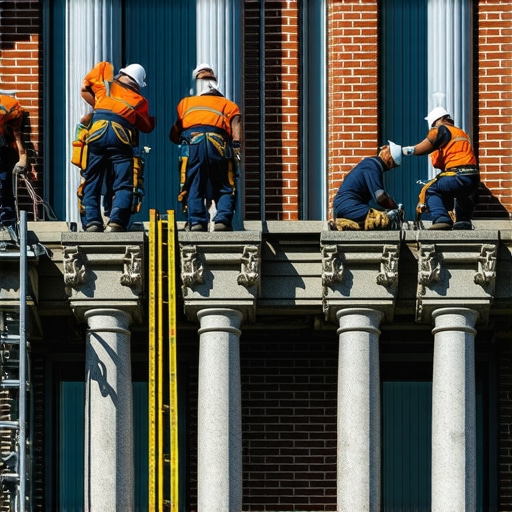
The Forensic Scene: When Your Foundation Whispers Its Own Demise
I walked up to a job site last Tuesday where the homeowner greeted me with a shrug. She pointed at a massive, triple-wythe brick column supporting a heavy wrap-around porch and said, ‘It just feels a little loose when the wind blows.’ I didn’t need a plumb bob to tell me we were in trouble. I placed my palm against the cool, salt-crusted face of the brick and gave it a firm shove. The entire structure groaned. It didn’t just shift; it exhibited a rhythmic, sickening sway that told me the core was no longer a core, but a pile of internal rubble. I pulled my borescope from my kit and inserted it into a 1/4-inch vertical crack. What I saw inside was the masonry equivalent of a ghost story: the structural steel reinforcement, which should have been the column’s spine, had oxidized into a brittle, orange powder. The ‘wobble’ wasn’t just a quirk of an old house; it was a structural scream for help. When masonry loses its internal bond, you aren’t looking at a wall anymore; you’re looking at a vertical pile of heavy debris held together by habit and hope. This is where the forensic structural inspector earns their keep, identifying why a 3,000-pound pillar is suddenly acting like a stack of loose playing cards.
“Water penetration is the single greatest threat to masonry durability. It triggers the corrosion of embedded metals and the dissolution of the mortar matrix.” – BIA Technical Note 7
The Physics of the Sway: Why Columns Lose Their Grip
To understand a wobbly column, you have to understand the physics of the ‘eccentric load.’ In a perfect world, a brick column carries weight straight down through its center—a state of pure compression. But soil doesn’t stay still. In regions where the freeze-thaw cycle is a seasonal reality, the earth beneath a footing expands by 9% every time the groundwater turns to ice. This heaving tilts the footing by a fraction of a degree. Suddenly, that 2,000-pound load is no longer centered. It’s pushing toward the edge of the brick, creating tension on the opposite side. Brick is a king in compression but a peasant in tension. As soon as that column starts to ‘lean,’ the mortar joints on the tension side begin to micro-crack. This is the entry point for the enemy. Once moisture finds its way into those hairline fractures, the cracked brick wall repair becomes a race against the elements. If you’re dealing with older structures, the problem is compounded by the material science of the early 20th century. My grandfather used to say that a brick needs to breathe, and he was right. Old bricks were fired at lower temperatures, making them porous and soft. When a modern handyman comes along and slaps hard Portland cement over these soft bricks—a process I call ‘the death shroud’—he traps moisture inside. The moisture has nowhere to go but into the brick itself, leading to brick efflorescence removal issues and, eventually, the catastrophic spalling that precedes a collapse.
The Chemistry of Restoration: Beyond the ‘Mud’
When we talk about tuckpointing brick walls or columns, we aren’t just ‘filling holes.’ We are performing a chemical balancing act. Modern Type S or Type M mortars are incredibly strong—too strong. They have high compressive strengths that can reach 2,500 PSI. If you use that on a 100-year-old column, you’re creating a rigid ‘cage’ that will eventually crush the softer brick as the house moves. This is why I advocate for sustainable tuckpointing mortars, specifically those formulated with Natural Hydraulic Lime (NHL). These mortars are ‘sacrificial.’ They are designed to be slightly weaker and more vapor-permeable than the brick itself. If there is stress or moisture, the mortar takes the hit, not the brick. For structural stabilization of a wobbly column, we often look toward fiber-reinforced mortars. These aren’t your standard bags of ‘mud.’ They contain microscopic synthetic or alkali-resistant glass fibers that provide a secondary level of tensile strength, acting like a mesh of internal rebar within the joint itself. This helps prevent the ‘stair-step’ cracking common in settling columns. If the column has shifted significantly, we might employ self-leveling masonry lifts—specialized hydraulic equipment that can subtly reposition a leaning structure before we begin the retaining wall installation or column rebuilding process.
The Anatomy of the Fix: The ‘Cure’ vs. The ‘Band-Aid’
If you see a guy with a caulk gun standing near a cracked column, fire him. Injecting epoxy into a structural masonry crack is a ‘Band-Aid’ that ignores the underlying pathology. A real forensic fix starts with the chimney cap replacement logic—you have to stop the water at the top. Most wobbly columns fail because the top cap (the ‘crown’) has cracked, allowing water to pour down the hollow center of the column like a funnel. We start by removing the old, degraded cap and installing a new, overhanging cast-stone or copper cap with a proper drip edge. This diverts the ‘run-off’ away from the brick face. Next, we address the masonry birdsmouth cuts at the base. These specialized angled cuts allow us to integrate new, reinforced brickwork into the existing pattern without creating a ‘cold joint’—a weak point where new and old mortar don’t bond. If the column is part of a larger system, such as a failing retaining wall repair, we must address the hydrostatic pressure. We drill ‘weep holes’ and install drainage mats to ensure that water isn’t pushing the wall from behind. For the actual rebuilding, we ‘butter’ the bricks with a steady hand, ensuring a full bed of mortar with no ‘honeycombing’—those air pockets that act as reservoirs for winter ice. We finish the joints with a ‘slicker’ or a jointer tool to compress the mortar, creating a dense, water-resistant skin.
“Mortar should be designed to be weaker than the masonry units it binds, ensuring that any structural movement is accommodated within the joints rather than through the units themselves.” – ASTM C270 Standard Specification
The Soldier Course and the Final Strike
The aesthetic finish is just as important as the structural core. We often use a soldier course—bricks laid vertically on their ends—at the top or bottom of a column to provide a decorative yet functional transition. But before we pack up our ‘hawk’ and trowels, we have to deal with the chemistry of brick efflorescence removal. That white, powdery salt that appears on new or repaired brick isn’t just an eyesore; it’s a sign that the wall is ‘crying’ salt as it dries. We use mild, buffered acids to neutralize these salts without etching the face of the brick. Finally, we look at the ‘tooth’ of the repair. If the new mortar doesn’t match the original in color and texture, the repair will look like a scar. We match the sand grit—sometimes even adding crushed oyster shells or local clay—to ensure the tuckpointing brick walls process looks seamless to the untrained eye, but remains a testament to master craftsmanship to those who know what to look for. Don’t wait until your column is leaning at a 10-degree angle. By the time you can see the lean, the internal failure is already 80% complete. A wobbly brick column is a ticking clock; the only question is whether you’ll fix it with a trowel today or a bulldozer tomorrow.