
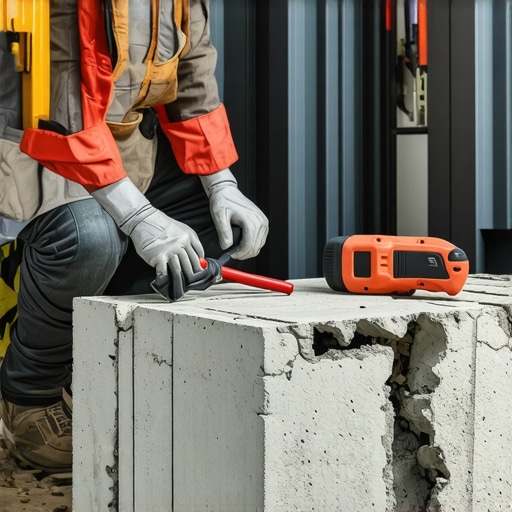
I walked into a basement last November that smelled like old copper and wet dirt, a scent every forensic inspector knows too well. The homeowner pointed to a thin, vertical line running from the floor to the joists and called it a hairline crack. To the untrained eye, it was a cosmetic nuisance. To me, after forty years of smelling the damp and feeling the grit of failing masonry, it was a siren song of structural collapse. I took my specialized scope, drilled a quarter-inch pilot hole into the hollow core of the concrete masonry unit (CMU), and slid the lens inside. What I saw wasn’t just a crack; I saw that the original builder had neglected to grout the cells or install the specified rebar. The horizontal reinforcement was a myth, and the wall was bowing inward under the silent, relentless pressure of five tons of saturated clay soil. It was a forensic scene of negligence, hidden behind a coat of cheap ‘waterproofing’ paint that was now bubbling like a chemical burn.
The Physics of Failure: Why Concrete Blocks Snap
Concrete block foundations are essentially a series of individual masonry units held together by the ‘tooth’ of the mortar. Unlike a poured concrete wall, which acts as a monolithic slab, a block wall is only as strong as its weakest joint. When we talk about foundation crack repair, we aren’t just filling a gap; we are fighting the laws of physics. The primary antagonist is hydrostatic pressure. Imagine the soil surrounding your home as a giant sponge. During heavy rains or the spring thaw, that sponge holds thousands of gallons of water. Since water cannot be compressed, it exerts an outward force in all directions. Against a hollow 8-inch block wall, this pressure can exceed the shear strength of the high-performance mortar mixes used to bond the units together. This is where you see the classic ‘stair-step’ pattern. This isn’t just settling; it is the wall screaming under a load it wasn’t designed to carry alone.
“Water penetration is the single greatest threat to masonry durability. The control of moisture through proper drainage and material selection is the cornerstone of structural longevity.” – BIA Technical Note 7
In northern climates, the enemy is amplified by the freeze-thaw cycle. Water expands by roughly 9% when it turns to ice. If moisture gets trapped inside the hollow cores of those blocks because of poor flush pointing services or failed exterior parging, that expansion happens inside the wall. It’s like a slow-motion explosion. The face of the block begins to flake off—a process we call spalling—until the structural integrity of the shell is compromised. This is why spalled concrete steps repair and foundation work are essentially the same battle on different scales. You have to manage the moisture or the masonry will eventually return to the earth.
The Chemistry of the Fix: Beyond the Surface
Most handymen will tell you to just ‘butter’ some new mud into the crack and call it a day. That is a recipe for a callback in six months. Real crumbling mortar joint repair requires an understanding of the material’s ‘suction’ and the chemistry of the bond. When I’m mixing a batch of mud for a structural repair, I’m looking for more than just stickiness. I’m looking for a chemical marriage between the old block and the new repair material. If you use a high-strength Portland cement on a soft, aging block, the cement will be too rigid. When the house naturally breathes and shifts, the hard cement will tear the face off the soft block. This is the ‘sacrificial’ principle we use in historic masonry preservation: the mortar must always be slightly softer than the masonry units it holds.
For a true fix, we look at carbon fiber reinforcement or helical piers. Carbon fiber is a marvel of modern masonry; it has a tensile strength ten times that of steel. By bonding these straps to the face of the block wall with high-viscosity epoxy, we create a tension membrane that stops the bowing in its tracks. We aren’t just patching a hole; we are re-engineering the wall’s load-bearing capacity. It’s the difference between a band-aid and a skin graft. The same logic applies to brick arch restoration. You don’t just shove some mortar in the gaps. You have to understand how the ‘key’ stone is distributing weight down through the ‘soldiers’ and into the abutments. If your mortar doesn’t have the right ‘tooth,’ the whole system fails the moment the temperature drops.
“Mortar shall be specified by either proportion or property specifications… The selection of mortar should be based on the physical properties of the masonry units and the environmental exposure.” – ASTM C270 Standards
The Hardscape Connection and the Truth About Moisture
Often, the reason your foundation is cracking has nothing to do with the blocks themselves and everything to do with what’s happening ten feet away. I’ve seen outdoor masonry fountain restoration projects where the fountain’s slow leak saturated the soil next to the house, leading to a foundation failure that cost $40,000 to fix. Similarly, a poorly graded brick paver driveway repair can direct thousands of gallons of runoff directly into the foundation’s ‘cold joint’—that spot where the wall meets the footing. If that joint isn’t sealed, the water enters the hollow core of the blocks, and the cycle of destruction begins. Even stone veneer repair is frequently a symptom of moisture being trapped behind a non-breathable barrier, forcing water into the backup wall.
The secret to fixing a cracked foundation isn’t found in a tube of caulk from a big-box store. It’s found in the management of water and the respect for material science. You have to excavate, you have to manage the drainage, and you have to use a repair mortar that is chemically compatible with the substrate. Whether I’m performing historic masonry preservation on a 19th-century chimney or stabilizing a 1970s block basement, the rules of the ‘Old World’ still apply: work with the materials, not against them. Don’t let a ‘lick-and-stick’ contractor tell you that a crack is just cosmetic. If the wall is moving, the house is dying. You fix it once, you fix it right, or you wait for the day the dirt decides to move in with you.