The Anatomy of a Slow-Motion Disaster
I recently stepped onto a slate roof in a historic district, the kind where the houses have stood for a century and should stand for another. The homeowner was frantic because a $30,000 plaster ceiling in the master bedroom looked like a topographical map of the Everglades. They had called three ‘roofing specialists’ who all slapped beads of silicone and tubes of ‘wet-patch’ around the chimney base. The leaks didn’t stop. When I climbed up there, I didn’t look at the shingles first. I looked at the flashing. The previous guy had used galvanized steel—a cheap, rigid, brittle insult to the craft. The homeowner thought it was just a hairline crack in the mortar. But when I put my scope inside the chase, I saw the structural steel was rusted to dust, and the wood framing had the consistency of wet cake. This is what happens when you treat a chimney like a minor detail instead of a complex thermal engine. Most modern contractors don’t understand the physics of a masonry stack. They don’t understand that a chimney is a living thing that breathes, expands, and contracts. When you use cheap materials like aluminum or galvanized steel, you are essentially putting a plastic heart in a marathon runner. It’s going to fail.
The Metallurgy of Longevity: Why Lead Reigns Supreme
In the world of professional masonry restoration, we don’t look at what’s cheapest today; we look at what will be there in 2124. Lead is the undisputed heavyweight champion of the flashing world for one primary reason: its atomic malleability. When I talk about the ‘tooth’ of a material, I’m talking about how it bites into the masonry. Lead is a soft metal. It doesn’t fight the brick; it listens to it. As the sun beats down on a chimney, the brickwork expands. Lead has the unique ability to be ‘dressed’ or beaten into the irregular profile of a handmade brick or a stone balustrade restoration project without cracking. It flows into the nooks and crannies, creating a mechanical bond that rigid metals can’t dream of. Furthermore, lead creates its own protective layer—a carbonate film that shields it from the acidity of rainwater and the caustic nature of certain mortars. Unlike aluminum, which oxidizes into a white powder and disappears, lead just gets tougher with age.
“Water penetration is the single greatest threat to masonry durability. The transition between the vertical masonry surface and the roof plane requires a material capable of enduring extreme thermal cycling without fatigue.” – BIA Technical Note 7
The Copper Connection: Thermal Expansion and The Patina Shield
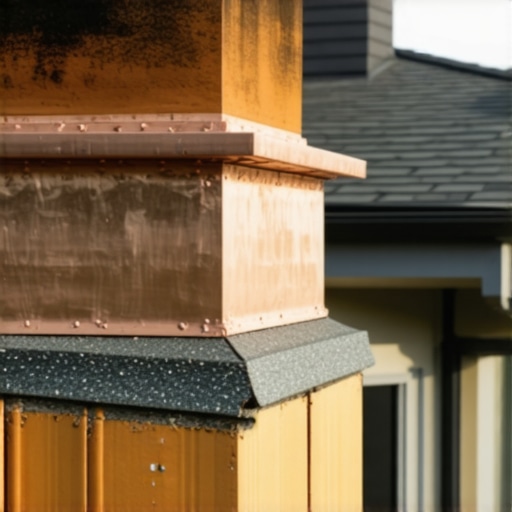
If lead is the king, copper is the queen. Copper flashing is a masterclass in material science. The reason we use copper for high-end chimney rebuild services is its coefficient of thermal expansion. It moves at a rate that closely mimics high-quality masonry. When I’m ‘buttering’ a joint for a chimney cap, I need to know that the metal won’t shear the ‘mud’ right out of the raggle. Copper forms a patina—that beautiful green verdigris—which isn’t just for show. That patina is a self-healing concrete-like barrier of copper carbonate. If the surface gets scratched, the metal ‘heals’ itself by re-oxidizing. This is the same principle we see in self-healing concrete foundations, where the material reacts to the environment to seal its own wounds. When you combine copper with re-pointing services using a soft lime mortar, you create a system that can handle the 9% expansion of freezing water without popping the faces off your bricks. Modern ‘lick-and-stick’ stone veneer jobs use thin aluminum that crinkles like a soda can under thermal stress, but a copper counter-flashing, properly stepped and let into a deep raggle, is a generational investment.
The Physics of the ‘Raggle’ and the ‘Slicker’
Most ‘handyman specials’ involve nailing a piece of metal to the side of a brick and covering the top with a concrete patch. That is a crime against physics. A true master mason cuts a ‘raggle’—a deep groove into the mortar joint—and folds the flashing into the chimney. We then ‘butter’ the joint with a specific mix of mortar. If we are working on a pre-1940s home, we avoid modern Portland cement like the plague. Portland is too hard; it’s brittle. We use Type N or Type O lime-based mortars that allow for ‘breathability.’ When you use a slicker tool to strike that joint, you are compressing the mortar, forcing the lime binders to the surface to create a weather-tight seal. This process, combined with brickwork sealants application on the surrounding masonry, ensures that hydrostatic pressure doesn’t force water behind the metal.
“Flashings shall be installed at wall and roof intersections, at interruptions within the masonry, and at built-in items to divert water to the outside.” – ASTM C1405 Standard Specification
The Chimney Damper and Internal Moisture Control
Water doesn’t just come from the outside. A massive amount of chimney failure comes from the inside out. This is where chimney damper repair becomes a forensic necessity. An old, rusted-out throat damper allows moist air from the house to rise into the cold flue. That moisture condenses on the cold bricks, leading to internal spalling. When I’m performing concrete block foundation repair on a home with a central chimney, I often find that the ‘rising damp’ in the basement is actually water that has traveled down the entire height of the chimney because the flashing was failing at the top and the damper was stuck open at the bottom. By using sustainable masonry materials, like reclaimed clay bricks and natural hydraulic lime, we can ensure the chimney manages this moisture correctly. Unlike modern synthetic wraps that trap water and cause rot, these traditional materials allow for vapor permeability, which is the cornerstone of professional masonry restoration.
Conclusion: The Cost of Doing It Twice
In this industry, there are two ways to do a job: the right way, and the way that keeps me in business fixing other people’s mistakes. When you see a contractor reach for a roll of aluminum flashing and a tube of caulk, you’re looking at a five-year solution for a hundred-year problem. Lead and copper are the kings because they respect the masonry. They work with the brick, not against it. Whether it’s a stone balustrade restoration or a standard re-pointing services call, the goal is always the same: permanent protection. Don’t let a ‘handyman’ turn your chimney into a funnel. Invest in the heavy metals, the soft mortars, and the craftsmen who still know how to ‘ring’ a brick. Do it once, or do it twice—the choice is yours, but the physics won’t lie to you.