
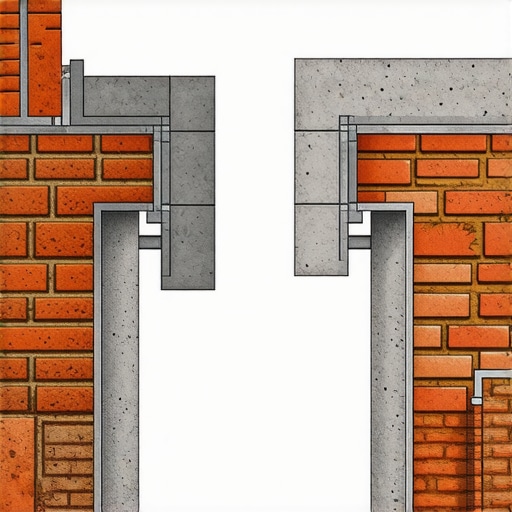
The Deception of the Hairline Crack
The homeowner called me out because they thought it was just a hairline crack in a garden wall. They’d seen it before on their old clay-brick carriage house and assumed it was just ‘settling.’ But when I slid my fiber-optic scope into the void behind the veneer, the reality was a forensic nightmare. The structural steel was already rusted to a fine orange dust, and the wall was literally pushing itself off the shelf angle. This wasn’t settling. It was a physics-based collision between two materials that speak different languages: traditional clay and modern modular units. I’ve spent forty years smelling damp lime and cleaning the grit of old-world mud out from under my fingernails, and if there is one thing I’ve learned, it’s that masonry is a living, breathing organism. If you don’t give it room to move, it will make its own room, usually by exploding.
The Fundamental Physics of Clay vs. Concrete
To understand why a modular unit—often a concrete masonry unit (CMU) or a high-density modular brick—needs different joint logic than a traditional clay unit, you have to look at the molecular level. Traditional clay bricks are born in fire. When they come out of the kiln, they are at their smallest, thirstiest state. Over the next fifty to one hundred years, they will undergo ‘irreversible moisture expansion.’ They literally drink humidity from the air and grow. In contrast, modular concrete units are the opposite. They are at their largest when they are cast. As they cure and age, they undergo drying shrinkage. If you build a long wall mixing these two without a deep understanding of their diverging paths, you are creating a ticking time bomb of shear stress.
“Water penetration is the single greatest threat to masonry durability, and it is almost always exacerbated by the failure to provide adequate movement joints.” – BIA Technical Note 7
The ‘Suction’ and the ‘Tooth’
When I’m buttering a joint, I can feel the ‘suction’ of the brick. Traditional clay has a voracious appetite for the water in your mud. This creates a mechanical bond—a ‘tooth’—that locks the mortar into the pores of the clay. Modular concrete units, especially those with modern metallic masonry finishes, have a much tighter surface tension. They don’t suck the mud in; they let it sit on the surface. This is why concrete pump masonry mixes are so finicky. If the mix is too wet, the modular units float; if it’s too dry, you get honeycombing and a cold joint that will snap at the first sign of a freeze-thaw cycle. In the north, where the thermometer swings forty degrees in a day, that 9% water expansion inside a poorly bonded joint is what leads to the need for aggressive brick spalling prevention. You aren’t just laying blocks; you are managing hydraulic pressure.
The Logic of the Vertical Control Joint
On a commercial smokestack repair I handled last winter, the issue was thermal expansion. You have a structure that’s essentially a giant radiator. For modular masonry, we use control joints to manage shrinkage. For clay, we use expansion joints to manage growth. The difference isn’t just semantic. A control joint in a modular retaining wall is a pre-planned crack. We want the wall to break there, neatly, rather than zigzagging through the face of the units. When we integrate BIM masonry projects into our workflow, we can map these stress points in a digital twin masonry project before a single trowel of mud is even mixed. This precision allows us to place joints exactly where the physics of the building demand them, rather than just every 20 feet because ‘that’s how grandpa did it.’
The Modern Menace: Lick-and-Stick and Modular Failure
I see it every day in new developments—modular units slapped onto a substrate with no regard for the drainage plane or thermal movement. They treat masonry like wallpaper. But masonry is heavy. It’s dense. And in outdoor masonry fountain restoration, we see the worst of it. The constant saturation of the modular units leads to efflorescence and subflorescence—where salts crystalize *inside* the brick. If the joint isn’t flexible, the face of the stone just pops off. We call it ‘face-spalling.’ To fix it, you can’t just slap more mud in the crack. You have to understand the brickwork pointing styles that allow for vapor permeability. You need a soft mortar—a sacrificial lamb—that is weaker than the brick itself so that the mortar fails, not the expensive modular unit.
“The use of expansion joints is essential to prevent the buildup of internal stresses that lead to cracking and structural instability.” – ASTM C140 Standard
Hydrostatic Pressure and the Modular Retaining Wall
If you’re building modular retaining walls, you’re fighting the weight of the earth and the weight of the water behind it. I’ve seen 30-foot walls bow like a longbow because the contractor didn’t understand that modular units don’t have the same lateral ‘interlock’ as old-world rough-hewn stone. You need clear, unobstructed drainage. Without it, the wall becomes a dam. And dams that aren’t designed to be dams eventually fail. This is where masonry cleaning becomes a forensic tool. When I see white salt streaks (efflorescence) bleeding out of a joint, it’s the wall screaming at me that there’s water trapped behind it. It’s not a cosmetic issue; it’s a structural warning light.
The Slicker and the Hawk: Craftsmanship in the Digital Age
Even with digital twin masonry projects, the final result comes down to the man on the wall with a hawk and a slicker. You can have the most advanced modular units in the world, but if the mason ‘burns’ the joint by striking it when it’s too wet, he brings all the lime to the surface and creates a brittle, shiny skin that will flake off in three years. You have to wait for the mud to be ‘thumbprint hard.’ That’s the tactile reality of the trade. Whether you are doing a commercial smokestack repair or a small residential patio, the physics of the bond remain the same. You respect the material, or the material will humiliate you. We aren’t just stacking rectangles; we are balancing the forces of nature with the limits of chemistry. Do it once, do it right, and that wall will be there long after we’re all dust. Do it cheap, and I’ll be seeing you in three years for a forensic inspection of your rubble pile.{“@context”:”https://schema.org”,”@type”:”HowTo”,”name”:”How to Properly Calculate Expansion Joints for Modular Masonry”,”step”:[{“@type”:”HowToStep”,”text”:”Determine the material type: Clay expands, while concrete modular units shrink.”},{“@type”:”HowToStep”,”text”:”Calculate the Thermal Coefficient of Expansion based on your local climate (Freeze-Thaw vs. High Heat).”},{“@type”:”HowToStep”,”text”:”Identify structural ‘soft spots’ such as window openings, corners, and offsets.”},{“@type”:”HowToStep”,”text”:”Install backer rods and high-grade elastomeric sealant to allow for 25-50% movement in the joint.”}],”totalTime”:”PT2H”}