The Forensic Scene: A Scab on the Face of History
I was called out to an old textile mill turned luxury loft in a coastal New England town. The developer was livid. Six months after a massive renovation, the ‘new’ brick sections—the infills where they had closed up old loading bays—were literally spitting their faces off. I walked up to the wall, pulled out my inspection pick, and gave a light tug on a joint. A three-foot section of mortar fell away like dry sand. Beneath it, the faces of the 19th-century bricks were crumbling into a fine red powder. It wasn’t ‘settlement’ and it wasn’t ‘bad bricks.’ It was a chemical execution. The contractor had used a high-strength, Type S Portland cement on a wall built with soft, lime-fired clay. They had created a ‘hard’ patch on a ‘soft’ lung, and the building was trying to breathe through its own ribs. This is the reality of historic infill: if you don’t respect the physics of the original wall, the wall will eventually reject your repair like an incompatible organ transplant. Whether you are dealing with a commercial smokestack repair or a simple chimney cap replacement, the rules of material compatibility are absolute.
“Mortar should always be weaker than the masonry units it binds, ensuring that any stress-induced cracking occurs in the mortar joints where it can be easily repaired, rather than in the masonry units themselves.” – BIA Technical Note 7B
The Physics of the Pore: Why ‘Hard’ is the Enemy of ‘Old’
To understand why most modern repairs fail, we have to micro-zoom into the capillary structure of a brick. An old, hand-molded brick from the early 1900s is effectively a dense sponge. It has a high rate of absorption, or ‘suction.’ When it rains, the brick drinks. When the sun comes out, the brick exhales that moisture through its pores. In a historic wall, the mortar acts as the wick. Traditional lime mortar is highly permeable; it allows water vapor to pass through it effortlessly. When you introduce a modern concrete patch or a dense, Portland-heavy high-performance mortar mix into a historic infill, you create a dam. Water enters the old brick, travels toward the surface to evaporate, and hits that wall of hard, non-breathable cement. The water gets trapped just behind the surface of the brick. When the temperature drops and that water freezes, it expands by 9%, blowing the face off the brick in a process we call spalling. I’ve seen stone balustrade restoration projects ruined in a single winter because someone thought ‘stronger’ meant ‘better.’
The Anatomy of the Extraction: Removing the Failed Tissue
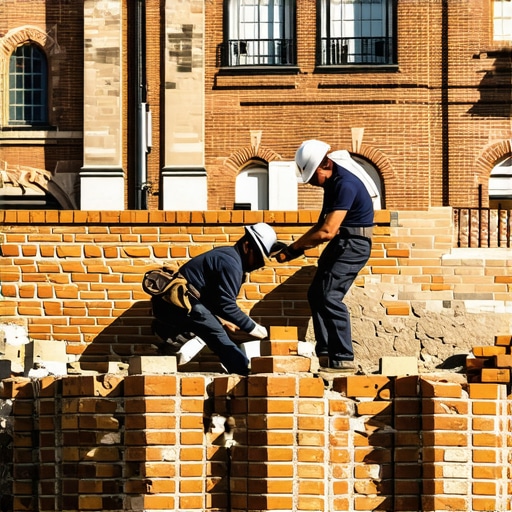
The first step in a proper historic infill isn’t reaching for the trowel; it’s the surgical removal of the damaged or ‘foreign’ material. You don’t just bash away with a sledgehammer. That creates vibration-induced micro-fractures in the surrounding ‘soldier course’ or the Flemish bond pattern you’re trying to preserve. We use a method called ‘stitching.’ Using a small, pneumatic chisel or a steady hand with a plugging chisel, you grind out the vertical ‘head’ joints first, then the horizontal ‘bed’ joints. You have to be careful not to ‘honeycomb’ the backup wythe—the hidden layer of brick behind the facade. Once the failed bricks are out, you’re left with a ‘toothed’ opening. This is where the sustainable block cutting skills come into play. You need to ensure the new opening is clean, square, and free of any residual Portland crust. If you leave even a thin film of old, hard cement on the ‘tooth’ of the original masonry, your new mud won’t bond. It creates a cold joint that will leak air and water from day one.
The Chemistry of the Mud: Mixing for the Ages
When I’m mixing a batch for a historic pointing style or a deep infill, I’m not just looking for color; I’m looking for the ‘Young’s Modulus’ of the material—its elasticity. For a pre-1940s building, you’re usually looking at a Type O or a K mortar, or better yet, a straight Lime Putty and sand mix. The sand is the ‘skeleton’ of the mortar. Most hacks use ‘play sand’ or ‘bank sand’ that’s too fine and round. You need sharp, well-graded aggregate with varying particle sizes. This creates a mechanical interlock that gives the mortar its strength without needing high levels of cement. You ‘butter’ the brick—applying the mortar to the top, bottom, and sides—before sliding it into the hole. But here’s the trick: the brick must be ‘surface saturated dry.’ If you put a bone-dry historic brick into fresh mud, it will suck the water out of the mortar so fast the bond will ‘flash set’ and crumble. You have to mist the wall until the brick stops ‘drinking,’ then wait for the surface sheen to disappear. Only then do you lay your course.
“The selection of mortar for restoration must prioritize vapor permeability and lower compressive strength than the original masonry units to prevent irreversible structural damage.” – ASTM C270 Standard Specification
The Mechanics of the Strike: Achieving the ‘Old World’ Finish
Once the brick is set, the clock starts. You don’t tool the joint immediately. If you ‘slick’ it while it’s too wet, you pull the ‘fines’—the small cement and lime particles—to the surface, creating a smear that will look like a shiny scar once it dries. You wait until the mortar is ‘thumb-print hard.’ Then you take your slicker or your jointing tool and you firmly compress the mud into the joint. This compaction is vital; it closes the micro-pores and ensures the mortar is tight against the ‘tooth’ of the brick. On high-end brick patio restoration or facade work, we often use a ‘weathered’ or ‘struck’ joint to shed water away from the bed. If you’re doing a chimney cap replacement, that strike is your first line of defense against the freeze-thaw cycle. I’ve seen masonry rescue after disaster teams save entire historic districts just by knowing how to properly tool a joint to prevent water ingress.
The Final Word on Value vs. Expediency
In the world of green roofing masonry integration and modern ‘lick-and-stick’ veneers, it’s easy to forget that masonry is meant to last centuries, not decades. A cheap repair is the most expensive thing you can buy because it destroys the base material. When you see a concrete patch on a 100-year-old wall, you aren’t seeing a repair; you’re seeing a countdown to a collapse. A master mason knows that we don’t own these buildings; we’re just their mechanics for a generation. Whether you’re working on a commercial smokestack repair or just replacing a few spalled units on a bungalow, do it with the right mud, the right suction, and a deep respect for the chemistry of the stone. Anything else is just a handyman special waiting to fail.”, “image”: {“imagePrompt”: “A close-up, gritty photo of a master mason’s weathered hands using a steel trowel to ‘butter’ a reclaimed 19th-century red brick with a textured, off-white lime mortar. In the background, a partially toothed-out historic brick wall is visible, showing the clean extraction of old units. The lighting is natural, highlighting the tactile grains of the sand in the mortar mix.”, “imageTitle”: “Master Mason Buttering Historic Brick”, “imageAlt”: “A professional mason applying lime mortar to a reclaimed brick for a historic restoration project.”}, “categoryId”: 12, “postTime”: “2023-10-27T10:00:00Z”}