
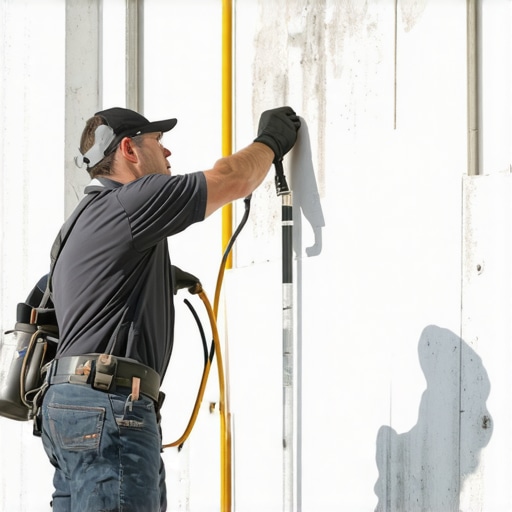
The Ghost in the Wall: A Forensic Inspection
The facility manager thought it was just a bit of dust, a localized nuisance he could pressure wash away before the board of directors arrived for the quarterly walkthrough. But when I put my scope inside the cavity of that three-story concrete masonry unit (CMU) complex, I didn’t see dust. I saw a structural crime scene. The structural steel lintels were beginning to flake into rust-red wafers, and the backside of the face brick was coated in a crystalline growth so thick it looked like winter frost in July. This wasn’t a cleaning issue; it was a systemic failure of moisture management. Efflorescence is the masonry industry’s way of screaming that the building is sick. It is the visible residue of salt deposits left behind as water migrates through the porous substrate and evaporates. To the untrained eye, it’s a white powder. To a third-generation mason, it’s the trail of a killer.
“Efflorescence is the result of water moving through masonry, dissolving salts, and depositing them on the surface upon evaporation.” – BIA Technical Note 23
The Micro-Physics of Crystalline Growth
To understand concrete masonry unit restoration, you have to understand the ‘tooth’ of the material. Concrete block is essentially a hard sponge. When you have a commercial wall under constant vapor drive—where the interior is cooled to 68 degrees and the exterior is baking in 90-degree humidity—the wall becomes a highway for moisture. This is the capillary suction effect. As water travels through the CMU, it dissolves calcium hydroxide, a byproduct of the hydration of portland cement. When this solution reaches the surface, it reacts with the carbon dioxide in the air to form calcium carbonate. That’s your white dust. It’s a chemical bond that grows like a parasite on your facade.
The Illusion of the Quick Fix
I’ve seen too many contractors try to ‘fix’ this with a bucket of acid and a power washer. That is a death sentence for the wall. Acid opens the pores even wider, and the high-pressure water just pushes more moisture back into the core, fueling the next cycle of salt migration. Real masonry rescue after disaster requires a forensic approach. You have to find the source. Is it a failing retaining wall repair job nearby that’s dumping hydrostatic pressure into the foundation? Is it a lack of proper weep holes in the soldier course? If you don’t stop the water, the white dust will return every single time, often bringing friends like spalling and honeycombing.
Advanced Restoration: From BIM to Sustainable Materials
In modern BIM masonry projects, we can now model the thermal bridges and moisture points before a single brick is laid. But for existing commercial structures, we have to look at sustainable masonry materials that allow for breathability. We often recommend mortar repointing services using Type N or Type O lime-based mortars that are softer than the masonry units themselves. This follows the sacrificial principle: you want the mortar to bear the brunt of the moisture and salt, not the block or the stone. If the internal structure has shifted, we might employ self-leveling masonry lifts to stabilize the load-bearing elements before addressing the aesthetic damage. We’ve even seen cases where metallic masonry finishes were applied to hide defects, only to trap moisture and cause the entire face to delaminate in a spectacular failure of physics.
“Water penetration is the single greatest threat to masonry durability.” – BIA Technical Note 7
The Specialized Needs of Commercial Envelopes
When dealing with high-rise or large-scale commercial walls, stone veneer repair becomes a different animal. Most modern veneers are ‘lick-and-stick’—applied with a thin layer of ‘mud’ that has no room for expansion. When efflorescence hits these systems, it often happens behind the stone, blowing the veneer off the wall entirely. This is why chimney interior parging and proper flashing at the roofline are critical; if water gets behind the system from the top, the entire facade is compromised. You can’t just ‘butter’ the back of a stone and hope for the best. You need a mechanical bond and a drainage plane. If you see a ‘wavy’ pattern in your commercial stone facade, the salts are already winning the war of expansion.
Execution: Striking the Joint and Mixing the Mud
When my grandfather taught me to use a slicker, he emphasized the ‘ring’ of the brick. If the suction is too high, the brick steals the water from the mortar too fast—we call this ‘burning’ the mud. The mortar crumbles before it even cures. For a permanent fix, the joints must be ground out to a depth of at least 3/4 of an inch, the dust vacuumed out (not blown), and the new mortar ‘tucked’ in in layers. This ensures a dense, water-resistant barrier that still allows the building to breathe. It’s the difference between a handyman’s patch and a master’s restoration. We don’t just fill holes; we restore the structural integrity of the envelope.
When to Panic
If you see ‘stair-step’ cracking accompanied by heavy efflorescence, you aren’t just looking at a moisture problem; you’re looking at a settlement issue. The ‘white dust’ is often the first sign that the wall is moving, opening up new channels for water to enter. At that point, you aren’t just looking for a mason; you’re looking for a forensic structural inspector. Do it once, do it right, or prepare to watch your investment crumble into a pile of salty dust.