
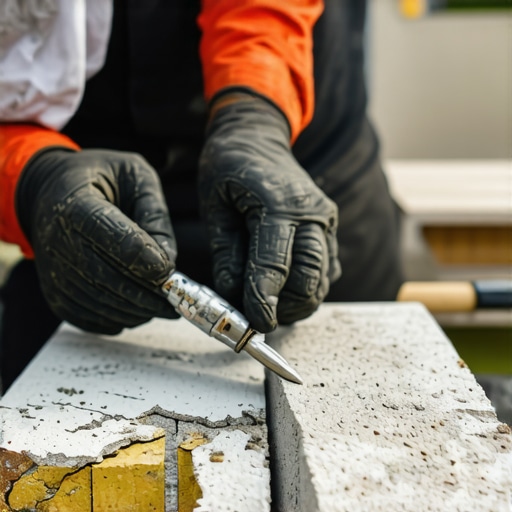
The Forensic Truth Behind Hairline Fractures in Modular Panels
I remember a call I took last November out in the rust belt. The homeowner sounded calm, almost bored. He said he had a ‘tiny pencil line’ running through his modular masonry panels. To the untrained eye, it was nothing—a cosmetic blemish. But when I got there and ran my fingers over the texture, I felt the slight lip, the ‘shelfing’ of the panel. I took my digital bore-scope and threaded it through a weep hole. What I saw wasn’t just a crack; it was a structural autopsy in progress. The internal steel reinforcement was shedding layers of oxidized iron like an old snake skin, expanding with enough force to blow the face off a three-inch thick precast block. It’s never ‘just a crack.’
The Physics of the Modular Failure
Modular masonry panels are a different breed than the traditional hand-laid brick walls my grandfather built. These are engineered systems, often involving brick infill panel repair or pre-cast concrete units that act as a unit. In the North, we deal with the brutal reality of the freeze-thaw cycle. When water finds its way into a hairline fracture in a modular retaining wall, it doesn’t just sit there. It waits for the temperature to drop. As that water transitions to ice, it expands by approximately 9 percent. This exerts thousands of pounds of internal pressure, a phenomenon we call ‘cryofracturing.’ If you just smear some hardware store caulk over it, you aren’t fixing it; you’re just hiding the evidence while the foundation underpinning starts to fail underneath.
“Water penetration is the single greatest threat to masonry durability. Moisture trapped within a wall system through cracks or improper drainage is the catalyst for almost all structural masonry failures.” – BIA Technical Note 7
The Chemistry of the ‘Mud’: Why Mortar Matching Services Matter
One of the biggest mistakes ‘weekend warriors’ and cut-rate contractors make is reaching for a bag of Type S Portland cement to fix a crack in a modular panel. They think strength is the goal. It isn’t. In the world of brick wall restoration, the mortar must always be the ‘sacrificial’ element. It needs to be slightly softer and more vapor-permeable than the masonry units themselves. If your patch is harder than the panel, the next time the building shifts or the sun bakes that wall, the panel will crack around the patch. This is why professional mortar matching services are non-negotiable. We analyze the aggregate—the sand, the lime, the cement ratio—to ensure the ‘tooth’ of the new mud bites into the old substrate without creating a cold joint. We’re looking for ‘suction.’ If the panel is too dry, it’ll suck the moisture out of your patch before it can hydrate, leaving you with a brittle, dusty mess that’ll fall out in a week.
The Surgical Process of Re-Pointing Services
To patch a crack correctly in a modular system, you don’t ‘butter’ the surface. You have to perform a resection. This starts with sustainable block cutting techniques where we rake out the crack to a depth of at least twice its width. I use a small pneumatic chisel or a diamond-blade ‘tuckpointing’ grinder. You want the back of the joint to be square, not a ‘V’ shape. A ‘V’ joint has no mechanical bond and will pop out like a tooth. Once the joint is cleaned, we talk about the hydration process. You have to pre-wet the masonry. You want ‘saturated surface dry’ (SSD) conditions. If you don’t, the concrete pump masonry mixes or the repair mortar won’t have the water it needs for the long-term carbonation of the lime. This is where the ‘Old World’ skill comes in—using a hawk and a slicker to tightly pack the mortar into the void in ‘lifts’ or layers no thicker than a quarter-inch at a time.
Structural Integrity and Masonry Rescue After Disaster
Sometimes a crack is a symptom of a much larger illness. If I see a stair-step crack moving through a modular panel, I’m looking at the soil. Foundation underpinning or modular retaining walls that haven’t been backfilled with proper aggregate will heave. This is the ‘Forensic Scene’ I deal with daily. If the panel has shifted, you aren’t looking at a patch job; you’re looking at a masonry rescue after disaster. This requires chimney structural repair techniques applied to vertical walls—helical piers or carbon fiber strapping. We have to stabilize the ‘skeleton’ before we can fix the ‘skin.’ We often see this in brick infill panel repair where the original installers didn’t allow for thermal expansion. A long modular wall in the Texas sun can expand significantly. Without a proper control joint, the wall will create its own ‘joint’ in the form of a jagged, ugly crack.
“The selection of repair mortar must prioritize the modulus of elasticity. A mortar that is too rigid will induce stress concentrations that lead to spalling of the masonry units.” – ASTM C270 Standards
The Micro-Zoom: Hydration and Carbonation
Let’s talk about what’s happening at the molecular level. When we mix our mud, we’re initiating a chemical dance. The Portland cement provides the early strength through the formation of calcium silicate hydrate (CSH) crystals. But the lime? That’s the secret sauce. Lime undergoes carbonation over decades, slowly turning back into calcium carbonate (limestone) by absorbing CO2 from the air. This process allows the mortar to ‘self-heal’ micro-cracks. If you use a cheap, lime-free mix, you lose that autogenous healing property. For re-pointing services on modular panels, we often specify a Type N or even a Type O mortar if the panels are older or more fragile. It’s about breathability. If moisture gets trapped behind a dense, non-breathable patch, it will rot the wall from the inside out, leading to honeycombing in the concrete core.
The Final Strike: Professional Aesthetics
The final part of the process is the ‘strike.’ You wait until the mortar is thumbprint hard. Then you take your slicker and compress the joint. This isn’t just for looks. Compressing the joint ‘closes’ the pores of the mortar, making it more resistant to water penetration. We try to match the original joint profile—whether it’s a ‘V’ joint, a ‘concave’ joint, or a ‘weathered’ joint. For brick wall restoration, getting the color right is an art form. We use iron oxide pigments, but you have to account for the fact that the mortar will lighten as it cures. A wet mix always looks darker than the finished, cured product. If you’re doing a soldier course or a complex modular pattern, the precision of this final strike is what separates a master from a ‘hack’ with a bucket of premix. Don’t settle for a ‘lick-and-stick’ fix. If you see a crack, treat it like a warning light on your dashboard. It’s telling you the physics of your building are out of balance.