
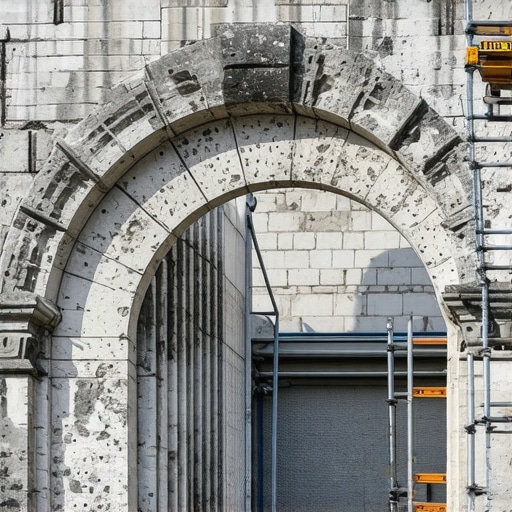
The Ghost in the Archway
The homeowner thought it was just a hairline crack, a minor blemish on the face of an 1880s Romanesque revival arch. But when I put my digital scope inside the bedding joint, the truth was far uglier. I saw that the structural iron shims, placed there by a mason long dead, had oxidized. They had expanded to four times their original thickness, exerting thousands of pounds of internal pressure. The stone wasn’t just cracking; it was being detonated from the inside out. This is the reality of masonry damage assessment in the modern age. We are no longer just looking at aesthetics; we are looking at the molecular war between moisture, metal, and mineral.
The Physics of the Arch: Why it Never Sleeps
In the trade, we say the arch never sleeps. It is a constant battle of compression. Every stone—every voussoir—is pushing against its neighbor, transferring the load down to the abutments. When an arch begins to fail, it is usually because the equilibrium has been disturbed. Historically, we relied purely on the geometry and the weight of the stone, held together by high-calcium lime mortar. But today, the introduction of modular masonry construction and modern environmental stressors like acid rain have changed the calculus. To save these structures, we are increasingly turning to advanced adhesives that behave more like the stone itself than any mortar ever could.
“Mortar should be designed to be weaker than the masonry units so that it acts as a sacrificial element.” – ASTM C270 Standard Specification for Mortar for Unit Masonry
The Chemistry of Restoration: Beyond the Mud
When I talk about ‘mud,’ I am usually talking about a mix of sand, lime, and perhaps a whisper of Portland cement. But for a failing arch, traditional mud sometimes lacks the tensile strength to stop a rotation. This is where advanced structural adhesives come into play. We are seeing a shift toward thixotropic epoxy resins and polyurethanes that can be injected deep into the core of a stone archway. These aren’t your hardware-store glues. These are high-modulus materials designed to have a similar coefficient of thermal expansion as the surrounding masonry. If you use a material that is too rigid, the stone will shatter during the next heatwave. If it is too soft, the arch will continue to sag. The goal is to create a bond that allows for the ‘breathability’ of the stone while providing the structural ‘teeth’ to hold the voussoirs in place.
Tuckpointing Curved Walls and Archway Geometry
Repairing a flat wall is one thing, but tuckpointing curved walls requires a level of finesse that most modern ‘lick-and-stick’ contractors simply don’t possess. You have to consider the radius. When you’re standing on the scaffolding with your hawk and slicker, you aren’t just filling a hole; you are recreating a weather-shedding profile. If the joint is too proud, it catches water. If it’s too recessed, it creates a shelf for ice to sit on. When we butter the joints of an arch, we have to ensure the suction of the stone is just right. If the stone is too dry, it sucks the hydration out of the mortar before it can cure, leading to a ‘burned’ joint that will crumble in three winters. This is a common cause of brick spalling prevention failure; people focus on the sealer rather than the bond.
The Role of Foundation Stability in Arch Integrity
You cannot fix an arch if the ground beneath it is moving. I’ve seen chimney structural repair projects fail because the mason ignored the base. Often, archway cracks are merely symptoms of a sinking foundation. This is where foundation slab jacking or self-leveling masonry lifts become essential tools in the forensic kit. By injecting high-density polymers under the footings, we can sometimes close an archway crack by a fraction of an inch before we even touch the mortar. It’s about correcting the geometry from the bottom up. Without a stable base, any repair to the arch is just a cosmetic Band-Aid over a sucking chest wound.
“Water penetration is the single greatest threat to masonry durability.” – BIA Technical Note 7
Modern Solutions for Ancient Problems
In cases where the original structural brick ties replacement is necessary, we often find ourselves using stainless steel helical anchors combined with resin. We drill into the backup material, inject the adhesive, and spin the tie into place. This creates a mechanical and chemical bond that distributes the load without the honeycombing effect seen in poorly poured concrete repairs. This is particularly vital in brick paver driveway repair and facade work where vibration from traffic can rattle loose traditional mechanical fasteners. We also use these resins during facade cleaning and restoration to consolidate ‘sugar’ stone—limestone that has begun to lose its binder and is turning back into sand. By injecting a consolidant, we are essentially glueing the stone back together at a microscopic level.
The Execution: Striking the Joint
Once the structural stabilization is complete, the final aesthetic work begins. We avoid a cold joint—that ugly line where new mortar meets old—by carefully matching the aggregate and the pigment of the original work. Using a soldier course for the top of the arch provides a decorative and functional ‘cap,’ but it must be flashed correctly. If moisture gets behind that soldier course, the freeze-thaw cycle will pop those bricks off like buttons on a tight shirt. It’s about the 9% expansion of water. That is the physics of destruction. By using modern adhesives to seal the top-side entry points, we create a barrier that traditional lime simply can’t provide in high-exposure areas.
The Master’s Verdict
Do not be fooled by the ‘handyman special’ that promises a quick fix with a tube of caulk. A stone archway is a living thing, a heavy, dangerous, beautiful piece of engineering that requires respect. Whether it’s a chimney structural repair or a grand entryway, the marriage of old-world masonry techniques with new-world chemical adhesives is the only way to ensure these structures stand for another century. You do it once, or you do it twice. And in my world, doing it twice means someone didn’t listen to the stone.