
The Old Master and the Whisper of the Trowel
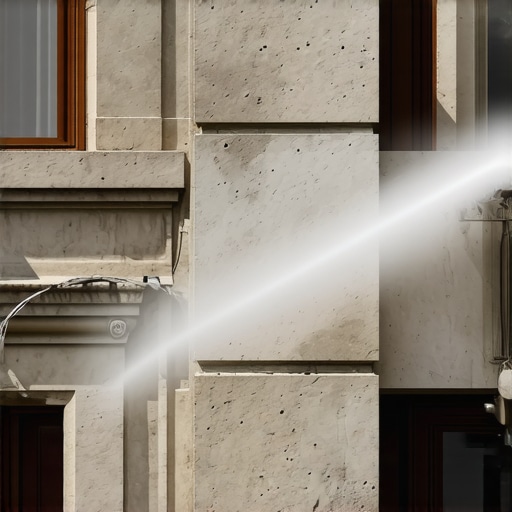
Years ago, I watched my mentor, a man who had more limestone dust in his lungs than oxygen, stop a junior apprentice from firing up a 4000-PSI pressure washer against a 19th-century facade. He didn’t yell; he just took his trowel and tapped the stone. It didn’t have that sharp, metallic ‘ping’ of a fresh-poured slab. It had a soft, muted thud—the sound of a material that had been breathing urban exhaust for a hundred years. ‘You hit that with that water cannon,’ he said, ‘and you aren’t just cleaning it. You’re skinning it alive.’ That is the reality of historic brickwork repointing and stone restoration. If you don’t respect the ‘tooth’ of the material, you’re just a glorified vandal with a contractor’s license.
The Chemistry of Urban Decay
Urban grime isn’t just dirt; it’s a complex chemical crust. In cities, sulfur dioxide from vehicle exhaust reacts with the calcium carbonate in limestone and marble to create gypsum. This gypsum crust traps soot and pollutants, forming a black, hardened layer that looks like a scab. Most ‘handymen’ see a black stain and reach for the muriatic acid. That is a death sentence. Acid doesn’t just eat the grime; it aggressively attacks the binder of the stone itself. When you etch that surface, you destroy the ‘case hardening’—the natural protective layer the stone develops over decades. Once that’s gone, the stone’s internal capillaries are exposed, and the freeze-thaw cycle begins its slow, agonizing demolition.
“Water penetration is the single greatest threat to masonry durability, particularly when the surface integrity has been compromised by aggressive cleaning.” – BIA Technical Note 7
The Micro-Zoom: Porous Stone Sealers and Breathability
We need to talk about porous stone sealers. The industry is flooded with ‘waterproof’ coatings that are nothing more than liquid plastic. If you apply a non-breathable sealer to old stone, you are essentially gift-wrapping a bomb. Moisture rises from the ground through capillary action—what we call ‘rising damp.’ If it hits a plastic barrier at the surface, it can’t evaporate. It gets trapped, freezes, and pops the face of the stone off in a process called spalling. A proper stone balustrade restoration or facade cleaning must prioritize vapor permeability. We use silanes or siloxanes that bond at a molecular level, allowing water vapor to escape while preventing liquid water from soaking in. It’s about managing the ‘suction’ of the stone, not choking it.
The Art of the ‘Mud’: Historic Brickwork Repointing
When we move from the stone to the joints, the stakes get higher. I see ‘lick-and-stick’ artists trying to use modern Type S Portland cement on 100-year-old soft-fired bricks. It’s a tragedy. Modern cement is hard and rigid. Historic bricks are soft and flexible. In the thermal expansion of a summer day, the brick needs to expand. If the full repointing services use mortar that is harder than the brick, the brick will crush itself against the mortar. This is why we mix our ‘mud’ using lime putty and coarse sand. The mortar must be the ‘sacrificial lamb’—it should be the part that fails first, decades down the road, rather than the brick itself. We use a hawk and a slicker to deeply pack the joints, ensuring no honeycombing occurs behind the surface.
“The use of high-strength Portland cement in restoration of historic soft-brick structures is the leading cause of irreversible masonry failure.” – ASTM C270 Standards
Restoring Vertical Integrity: Arches and Chimneys
A brick arch restoration isn’t just about aesthetics; it’s about the physics of the ‘key.’ If the mortar in the voussoirs (the wedge-shaped bricks) has turned to powder, the arch is essentially a stack of loose teeth. We have to carefully rake out the joints without disturbing the structural set. Similarly, with chimney leak detection, the failure often starts at the crown. We look for those hairline fissures that indicate the chimney heat shield installation has failed or that the internal flue tiles are cracked. A chimney is a vertical wind tunnel of acidic gases; if your masonry isn’t tight, those gases will eat your concrete masonry unit restoration work from the inside out.
The Foundation of Tomorrow: Self-Healing Concrete
While we spend our days looking backward, we have to look forward at self-healing concrete foundations. This technology uses calcifying bacteria embedded in the mix. When a crack forms and water enters, the bacteria wake up, consume the nutrients in the concrete, and excrete calcite, effectively sealing the crack. It’s a far cry from a simple concrete patch, which usually just falls out after two winters because of a cold joint—a failure of the new material to bond with the old. But even with high-tech foundations, the basics of drainage and hydrostatic pressure remain the same. You can have the most advanced concrete in the world, but if you don’t move the water away from the wall, the earth will eventually reclaim your work.
Tactical Execution: How to Clean Without Destruction
The safest way to clean historic stone is the ‘nebulous spray’ method. We set up a manifold that mists the stone with a fine fog of water for 24 to 48 hours. This softens the urban crust slowly, allowing it to be scrubbed away with a natural fiber brush. No acid, no pressure, no etching. Just patience and physics. Whether you are performing a stone balustrade restoration or just cleaning a soldier course of bricks, you have to treat the building like a living organism. If you treat it like a sidewalk, it will crumble like one.