3 Advanced Masonry Adhesives That Outperform Mortar in 2026
The Ghost of the Mud Box: A Professional Foreword
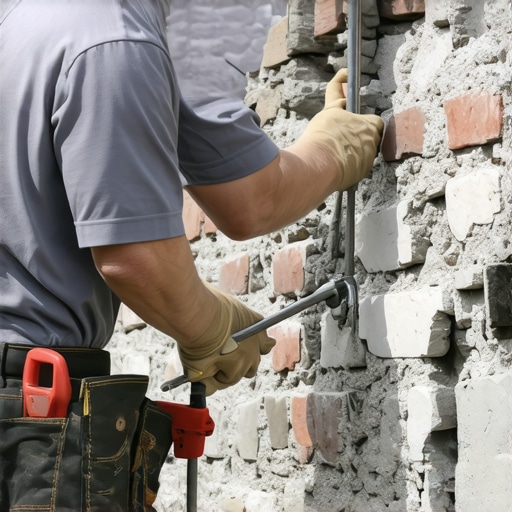
My old man, a man who could tell the moisture content of a sand pile by simply squeezing a handful, used to tell me that the joint is the lung of the building. He’d take his thumb and press it into a fresh joint of sustainable tuckpointing mortars; if the ‘suction’ wasn’t pulling the water out of the mud at the exact rate the brick demanded, he’d tear the whole lead down. We were taught that the bond was a mechanical marriage—a locking of cementitious crystals into the pores of the clay. But as we step into 2026, the chemistry of the job site has undergone a seismic shift. I’ve spent thirty years with a hawk and trowel, but I’m not blind. While ‘lick-and-stick’ veneers have given the industry a black eye, a new breed of structural adhesives is doing things that standard Type S mud simply can’t handle, especially in emergency masonry repair scenarios where you don’t have twenty-eight days to wait for a full cure.
“Water penetration is the single greatest threat to masonry durability, necessitating bonds that accommodate thermal movement without losing seal integrity.” – BIA Technical Note 7
The Physics of Adhesion: Why Mortar Fails Where Chemistry Wins
To understand why we are moving toward polymers, you have to micro-zoom into the hydration process. Standard mortar is a rigid, crystalline structure. When you’re performing a brick lintel replacement, you’re dealing with the interface of cold, hard steel and porous clay. The expansion coefficients are worlds apart. In the freezing winters of the North, that steel expands and contracts, eventually shearing the bond of traditional mortar. This is where the ‘tooth’ of the material fails. Modern adhesives utilize Van der Waals forces and covalent bonding at a molecular level. We’re talking about cross-linking polymer chains that don’t just sit in the pores; they fuse to the substrate. When I’m called out for a foundation waterproofing inspection and I see horizontal shearing, it’s usually because the rigid mortar couldn’t handle the lateral hydrostatic pressure. A high-modulus adhesive, however, acts like a structural gasket.
1. Hybrid Silyl Modified Polymers (SMP): The Flex Kings
The first heavyweight in the 2026 arsenal is the Hybrid SMP. Unlike old-school polyurethanes that outgas and leave ‘honeycombing’ voids in the bead, SMPs cure via atmospheric moisture without bubbling. This is the go-to for chimney flashing repair. A chimney is a thermal engine; it grows and shrinks every time the furnace kicks on. If you ‘butter’ your flashing with rigid mortar, it will crack by next November. SMP adhesives offer a 50% movement capability. In the trade, we call this ‘living with the house.’ When you’re executing masonry birdsmouth cuts for a complex roofline, these adhesives provide an instantaneous grab that holds the weight while the secondary chemical bond matures. It’s about preventing the ‘creep’ that ruins high-end concrete flatwork services.
2. Two-Part Structural Methacrylates: The Cold Weld
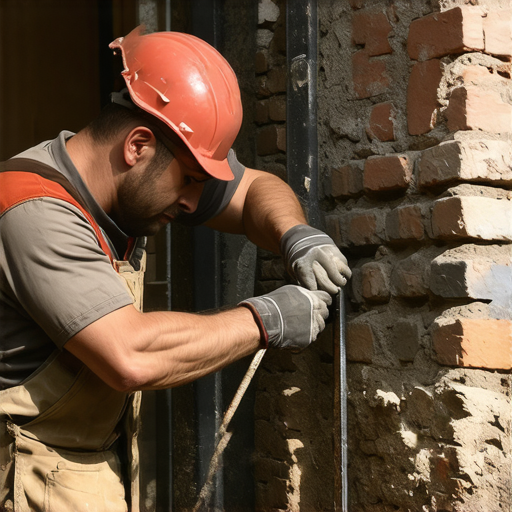
When I’m looking at a retaining wall installation that needs to hold back ten tons of saturated soil, I’m not looking for flexibility; I’m looking for sheer strength. Methacrylates are the ‘cold welds’ of the masonry world. Unlike mortar, which relies on the ‘suction’ of the brick to create a bond, methacrylates create a chemical bridge. I’ve seen retaining wall block replacement jobs where the original blocks were snapped in half, but the methacrylate bond stayed intact. The physics here involves a rapid exothermic reaction. You aren’t waiting for water to evaporate; you are witnessing a molecular reorganization. This is critical for emergency masonry repair on structural piers where the building’s integrity is at stake. You don’t ‘butter’ the head joint here; you inject it with a precision tip to ensure zero air entrainment.
“The modulus of elasticity in a jointing material must be lower than that of the masonry unit to prevent spalling during thermal cycles.” – ASTM C270 Standard Specification
3. Bio-Polymer Infused Hybrids: The Restoration Revolution
The third breakthrough is perhaps the most controversial for us old-timers: sustainable, bio-infused resins. For years, we hated ‘plastic’ in the wall because it trapped moisture, leading to the dreaded spalling in freeze-thaw climates. But the 2026 formulations are vapor-permeable. They ‘breathe’ just like a sustainable tuckpointing mortar. When we do a chimney flue liner installation, we are dealing with extreme sulfuric acid condensate and heat. These bio-polymers are engineered to resist acid attack better than any Portland-based mud. They are the ‘slickers’ best friend because they don’t ‘burn’ your hands or the brick face, and they allow for a clean, tooled finish that mirrors the ‘Old World’ look while providing 21st-century seismic resistance.
The Forensic Verdict: When to Put Down the Trowel
Does this mean we throw away our mixers? No. If you’re doing historic restoration on a 1920s bungalow, you better stay away from adhesives and stick to lime-rich mud. The ‘sacrificial principle’ dictates that the mortar must be softer than the brick. If you use a high-strength structural adhesive on soft, hand-molded clay, the adhesive will win and the brick will explode during the first deep freeze. However, for concrete flatwork services, modern retaining wall installation, and structural brick lintel replacement, the ‘bucket and hoe’ method is becoming a liability. We are moving toward a world where the ‘ring’ of a brick isn’t just about the kiln-fire; it’s about the chemical weld holding it to its neighbor. Do it once, or do it twice—the choice is usually found in the chemistry of the bond.