
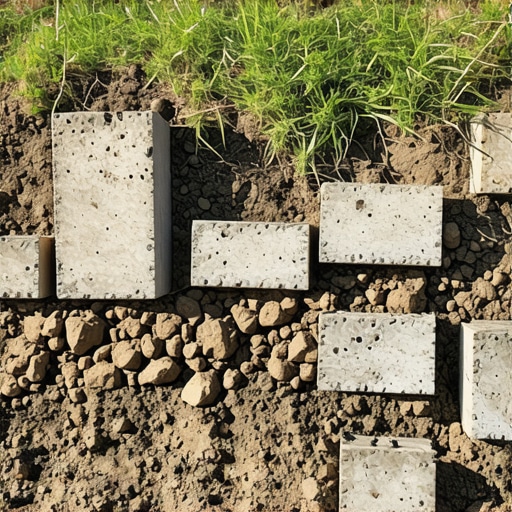
The Anatomy of a Failing Wall
I recently stood at the base of a modular retaining wall in a suburban backyard, watching a $40,000 investment literally trying to walk away from the hillside. The homeowner thought it was just a few loose blocks that needed a bit of mortar. But when I pulled the cap off and shoved my fiber-optic scope into the drainage gap, I saw the truth: the geogrid reinforcement was snapped like a dry twig under the weight of saturated clay. The wall wasn’t just ‘leaning’; it was suffering from a catastrophic failure of physics. This is what we call a ‘belly’ in the trade, and it is the silent killer of hardscapes across the country.
When a wall starts to bulge, it’s rarely a problem with the blocks themselves. Modern modular retaining walls and mortarless masonry systems are engineered marvels, but they are only as good as the ground they sit on and the drainage behind them. Most ‘lick-and-stick’ contractors forget that a retaining wall is actually a dam. If you don’t give the water a place to go, it will make its own exit through the face of your stone. This is where a structural masonry inspection becomes the difference between a minor repair and a total excavation.
“Hydrostatic pressure is the most common cause of retaining wall failure. Without proper drainage, water-saturated soil can weigh twice as much as dry soil, exerting forces that exceed design limits.” – National Concrete Masonry Association (NCMA) Design Manual
The Physics of the Bulge: Hydrostatic Pressure and Soil Mechanics
To understand why your wall is bowing, you have to look at the ‘angle of repose.’ Every soil type has a natural slope where it stays put. When we cut into that slope to build a patio or a driveway, we create a ‘wedge’ of soil that wants to slide back down. The retaining wall’s only job is to resist that sliding wedge. In a proper modular retaining wall installation, we use 57-stone (crushed gravel) for the drainage chimney. This gravel has high ‘void ratios,’ allowing water to drop straight down to the perforated drain pipe at the base.
However, when a contractor ‘cuts corners’ and backfills with the same clay they dug out, you’re in trouble. Clay is expansive. In the North, we deal with the brutal reality of the freeze-thaw cycle. When water gets trapped in that clay behind the wall, it expands by roughly 9% as it turns to ice. That 9% doesn’t sound like much until you realize it’s pushing with thousands of pounds of force against the back of the blocks. It’s like a slow-motion hydraulic ram. Over three or four winters, the wall develops a permanent ‘hunch’ as the blocks are pushed out of their ‘batter’ (the inward lean designed to resist pressure).
The Critical Role of Compaction and Base Preparation
A wall is only as stable as its ‘footing.’ I’ve seen guys ‘butter’ the bottom of a block and set it on raw dirt. That’s a death sentence for the project. A real pro spends 70% of the time on the base. We’re talking about six inches of DGA (Dense Graded Aggregate) compacted in two-inch ‘lifts’ with a plate compactor until it’s hard as a highway. If the base settles even half an inch, the geometry of the entire wall is ruined. The blocks lose their ‘tooth’—that frictional connection that keeps them from sliding past each other.
We also have to talk about ‘surcharge loads.’ If you park a truck at the top of a wall, you’re adding vertical pressure that translates into lateral (sideways) pressure. Without an AI masonry assessment or a calculated geogrid layout, that wall will eventually ‘blow out’ at the bottom third, which is where the pressure is highest. This is often where we see ‘honeycombing’ in the concrete or the actual cracking of the block faces.
Historic Challenges: Re-pointing and Restoration
If your bulging wall is a historic brick structure, the rules change entirely. You can’t just slap modern Portland cement into a 100-year-old wall. Historic tuckpointing requires a ‘sacrificial’ mortar. The ‘mud’ (mortar) must be softer than the brick. If you use a high-strength Type S mortar on old, soft-fired bricks, the brick will lose its face in a process called spalling because the moisture can’t escape through the hard mortar joints. For these structures, we use flush pointing services with lime-based mortars that allow the wall to ‘breathe.’ If you see a historic wall bulging, it’s often because someone used stone veneer over brick, trapping moisture and causing the original structural masonry to rot behind the pretty facade.
“The use of impervious mortars on historic masonry leads to the accelerated deterioration of the units themselves due to trapped moisture and salt crystallization.” – ASTM C270 Standard Specification for Mortar for Unit Masonry
The Fix: From Band-Aids to Cures
When I’m called in for a forensic structural masonry inspection, I’m looking for the ‘root cause.’ If the bulge is minor—less than an inch—we might be able to implement drainage retrofitting, such as drilling ‘weep holes’ through the face to relieve hydrostatic pressure. However, once the wall has moved past its ‘point of no return,’ you’re looking at a rebuild. An outdoor fireplace rebuild or a small decorative wall is one thing, but a six-foot-tall retaining wall is a life-safety issue.
The ‘Cure’ involves excavating the ‘active zone’ behind the wall, replacing the heavy clay with clean drainage stone, and re-installing the units with a proper batter. This is where we use ‘slicker’ tools and jointers to ensure the re-pointing services on any associated brickwork are watertight and aesthetically correct. We don’t do ‘handyman specials’ here. We do it once, or we don’t do it at all. The ‘tooth’ of the stone must be respected, and the physics of the earth must be obeyed. Anything less is just a pile of rubble waiting to happen.