
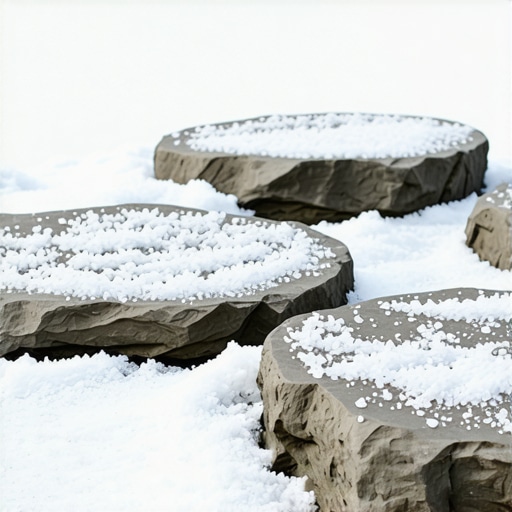
The Winter Heave: When Your Hardscape Becomes a Mountain Range
I spent yesterday morning staring at a $45,000 outdoor kitchen and patio that looked like a topographical map of the Rocky Mountains. The homeowner was distraught, pointing at flagstones that had popped up three inches higher than the rest of the course. I stood looking at a massive investment that lay in a state of structural failure because the installer forgot the most fundamental law of the North: frost doesn’t care about your budget. It’s a common tragedy I’ve seen from my days as a prentice following my old man around muddy job sites to my current role as a forensic inspector. Most people think a patio is just stones sitting on dirt. They’re wrong. A patio is a complex geological machine that either works with the earth or gets crushed by it.
The Molecular Violence of the Freeze-Thaw Cycle
To understand why your stones are popping, we have to micro-zoom into the pore structure of the substrate. Water is one of the few substances on this planet that expands when it changes state from liquid to solid. Specifically, it increases in volume by approximately 9%. When water is trapped in the ‘fines’ of a poorly compacted sub-base or within the mortar of tuckpointing brick walls, that 9% expansion exerts thousands of pounds of pressure per square inch. This is known as frost wedging. If there is no room for that expansion to go laterally, it goes vertically. It’s mechanical leverage at a molecular level.
“Water penetration is the single greatest threat to masonry durability, leading to internal pressures that can exceed the tensile strength of the units themselves.” – BIA Technical Note 7
In regions with heavy freeze-thaw cycles, the ground acts like a slow-motion piston. If you didn’t use self-leveling masonry lifts or a properly engineered base, the soil ‘heaves’ up as it freezes and then ‘subsides’ as it thaws. But here is the kicker: it never subsides back to exactly where it started. Grains of sand and silt wash into the new voids created by the ice, locking the stone in its new, crooked position. This is why a ‘wavy’ patio never fixes itself in the spring.
The Sin of the ‘Sand-Only’ Base
Many ‘handyman specials’ involve throwing two inches of leveling sand over raw topsoil and calling it a day. That is a recipe for disaster. Topsoil is organic; it holds water like a sponge. In my forty years of buttering stones and throwing mud, I’ve learned that the secret to a permanent patio is the sub-base density. You need at least 6 to 8 inches of 3/4-inch minus crushed aggregate, compacted to a 95% Modified Proctor density. Anything less is just a temporary arrangement. We are seeing a rise in sustainable masonry materials that use recycled glass or permeable aggregates, which is great for the planet, but the physics of compaction remains the same. If the base isn’t solid, the brick column repair you did last year will be the next thing to crack as the patio pulls away from the structure.
The Capillary Effect and Foundation Health
It’s not just the patio you have to worry about. A patio that isn’t pitched away from the house (at least 1/4 inch per foot) becomes a funnel for foundation waterproofing issues. I’ve performed forensic inspections where the patio heaved so much it actually blocked the weep holes in the brick veneer. When those weep holes are blocked, the wall can’t breathe. Water gets trapped behind the brick, and in the winter, it freezes, leading to spalling—where the face of the brick literally explodes off the wall. This often leads to necessary chimney sweep and repair or chimney damper repair because the entire masonry envelope of the house begins to take on moisture.
Modern Solutions: From Digital Twins to Hydrostatic Relief
In high-end restoration, we now use digital twin masonry projects to model how water flows across a property before we ever strike a joint. For existing problems, a retaining wall drainage upgrade is often the only way to save a sunken patio. If you have a wall holding back a slope above your patio, that wall is likely acting as a dam. Hydrostatic pressure builds up behind it, saturating the ground under your stones. You need perforated pipes and clean 57 stone to give that water an escape route. Without it, your outdoor masonry fountain restoration won’t matter because the ground beneath it will be a soup of shifting silt.
“The foundation of all masonry must reach a solid stratum, or be supported by artificial means to prevent the shifting of the upper works.” – Vitruvius, De Architectura
The Forensic Fix: Do It Once or Do It Twice
If you’re looking at a popped stone right now, don’t just ‘slicker’ some new mortar into the crack. You need to look at the ‘tooth’ of the material. Is the mortar crumbling like dry bread? That’s a sign of a ‘burned’ mix or a ‘cold joint’ where the mud dried too fast. For a real fix, you have to excavate. You have to get rid of the clay and the organic muck and replace it with a well-graded aggregate that allows for ‘pore space’—the ability for water to move through without being trapped. Whether you are dealing with a simple walkway or a complex brick column repair, the goal is always the same: management of moisture. Use high-quality lime-based mortars for older homes to ensure breathability, and never, ever trust a contractor who doesn’t own a plate compactor. In this trade, you either respect the frost, or you spend your life fixing the damage it leaves behind. It’s better to spend the money on the gravel you’ll never see than on the stones everyone will notice are crooked.