
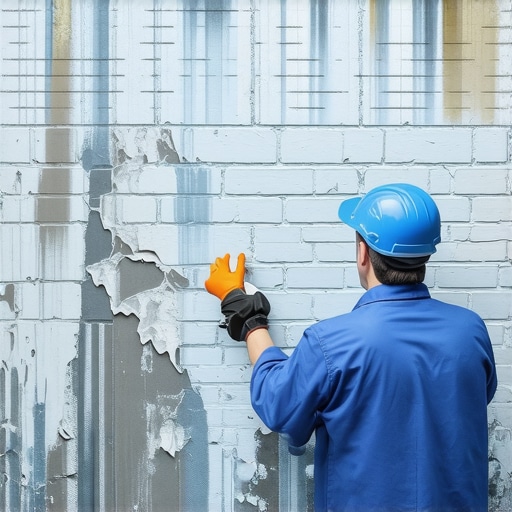
You see a metallic brick finish and you think ‘luxury.’ I see a ticking time bomb of surface tension and vapor pressure. When that glaze starts to peel like a cheap sunburn, you aren’t looking at a ‘paint’ problem; you’re looking at a failure of the molecular bond between the silicate structure of the brick and the metallic oxide skin. The homeowner thought it was just a hairline crack. But when I put my scope inside, I saw the structural steel was rusted to dust. The metallic finish was trapping moisture, acting as a non-permeable shroud that turned the wall into a slow-cooker for the structural frame. This is the reality of modern masonry forensics: aesthetic choices often war with the laws of physics. If your metallic bricks are losing their luster and shedding their skins, you’re dealing with a complex interplay of thermal expansion, moisture migration, and perhaps a botched brick veneer installation from a decade ago.
The Chemistry of the Flake: Why Glazes Fail
To understand why that expensive finish is hitting the driveway, you have to micro-zoom into the Interfacial Transition Zone (ITZ). When a metallic finish is applied to a brick, it creates a surface with a vastly different Coefficient of Thermal Expansion (CTE) than the clay body beneath it. In the heat of the afternoon sun—especially in southern climates—that metallic layer expands at a different rate than the dense clay. This creates shear stress at the bond line. If the tuckpointing is too hard or the brick lacks ‘tooth’ for the finish to grab, the finish simply shears off. We’re talking about the ‘suction’ of the brick here; if the brick was too dry or too slick when the finish was applied, the bond was dead on arrival.
“The movement of water vapor through a masonry wall is not an option; it is a physical certainty that must be managed.” – BIA Technical Note 28
Then there is the issue of vapor permeance. Brick is a sponge. It breathes. It takes in water and releases it as vapor. A metallic finish often has a ‘perm rating’ near zero. When moisture enters the wall—perhaps through a faulty chimney flue liner installation or poor foundation waterproofing—it tries to escape outward. It hits the back of that metallic glaze and has nowhere to go. The resulting hydrostatic pressure literally pushes the finish off the face of the brick. You’ll see it first at the soldier course or around window headers where the movement is most pronounced.
The Forensic Diagnosis: Spotting the Culprit
Before you even think about tuck pointing services, you have to determine if the failure is systemic or localized. Grab a slicker or a small hammer and tap the bricks. You aren’t looking for the ‘ring’ my grandfather used to listen for in a structural common brick; you’re listening for a hollow ‘thud.’ That thud tells you the delamination has already occurred, even if the finish is still hanging on by a thread. Often, I find that the issue stems from concrete pump masonry mixes used in the backup wall that were too wet, introducing excessive moisture into the system from day one. If the commercial tuckpointing was done with a high-Portland mortar on a soft-fired brick, you’ve essentially locked the moisture in a cage.
The Re-Bonding Protocol: From Mud to Metal
You can’t just ‘butter’ some new finish on and call it a day. The repair requires a surgical approach. First, we have to address the substrate. If the brick face is spalling, you might be looking at 3D printed masonry repairs for custom shapes or, more traditionally, a full replacement of the unit. For re-bonding a flaking metallic finish, the surface must be mechanically etched. We’re talking about restoring the ‘tooth.’ This isn’t a ‘handyman special’ with a wire brush. You need to clear the pores of the clay without shattering the brick’s internal structure.
“Water penetration is the single greatest threat to masonry durability.” – BIA Technical Note 7
Once the surface is prepped, we use fiber-reinforced mortars to bridge the gap between the rigid brick and the movement-prone finish. These mortars have the tensile strength to handle the ‘pull’ of the metallic layer as it heats and cools. If you’re dealing with patio stone realignment at the base of the wall, ensure your drainage is pulling water away, not letting it wick up into the masonry. Capillary rise is the silent killer of finishes.
Tuckpointing and the Art of the Joint
The joints are the lungs of your wall. If your metallic bricks are flaking, your tuckpointing needs to be softer than the brick itself. We use lime-heavy ‘mud’ that allows for sacrificial movement. When the wall expands, the joint should take the hit, not the expensive metallic face. I’ve seen commercial tuckpointing jobs where they used Type M mortar (the hard stuff) on delicate veneers, and the result was catastrophic. The brick faces popped off like bottle caps because the mortar wouldn’t budge. We always recommend a deep grind of the joints, followed by a meticulous ‘strike’ to ensure no cold joint is formed where water can seep in.
Preventative Strategy: Doing It Once
If you’re at the stage where you’re seeing flakes, it’s time to stop the bleeding. Check your foundation waterproofing. If your basement is damp, your metallic bricks are likely being pushed from the inside out. Ensure your chimney flue liner installation is intact, as heat cycles and condensation in the flue can migrate through the masonry and blow the finish off the exterior. Masonry is a system, not a collection of parts. You treat the symptom (the flake) but you cure the disease (the water). Don’t let someone sell you a ‘sealer’ for a flaking metallic finish—that’s like putting a band-aid on a pressurized pipe. It will only make the pressure build until the next chunk of your facade ends up on the grass.