
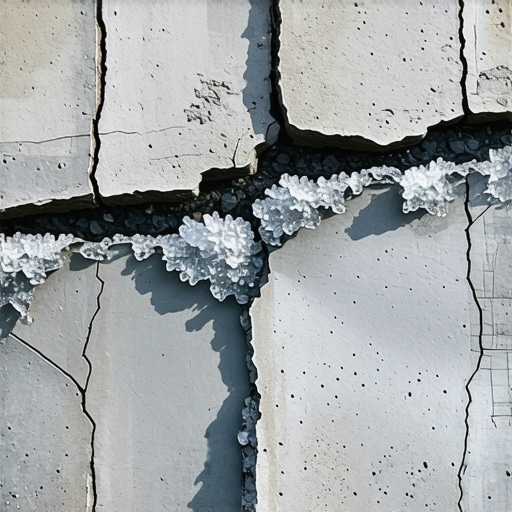
The Forensic Scene: More Than a Hairline Crack
The homeowner stood there, pointing at a thin, jagged line running through the front steps. She thought it was just a hairline crack, a cosmetic annoyance that a twenty-dollar bag of pre-mixed patch from the big-box store would fix. But when I put my digital scope inside that fissure, the reality was grim. The internal structural steel was rusted to dust, expanded to three times its original size, and pushing the masonry apart from the inside out. This is the reality of masonry forensics: what you see on the surface is rarely the whole story. You see a flake; I see a systemic failure of the mechanical bond.
The Physics of the Flake: Why Your Patch Fails
If you live in a climate where the thermometer bounces across the freezing mark like a heartbeat, you are at war with physics. When water enters a porous masonry surface and freezes, it expands by approximately 9%. This isn’t a gentle nudge; it is a hydraulic force capable of shattering solid granite. If you’ve applied a patch that doesn’t have the proper ‘tooth’ or ‘suction,’ that 9% expansion will find the weakest point—the bond line—and pop your repair off like a bottle cap. Most DIY patches fail because of a ‘cold joint.’ This happens when new material is applied to old, dry concrete without proper preparation, preventing the hydration process from knitting the two materials together at a molecular level.
“Water penetration is the single greatest threat to masonry durability. Moisture entering the masonry system can lead to efflorescence, freeze-thaw damage, and corrosion of embedded metals.” – BIA Technical Note 7
The Chemistry of ‘Mud’ and the Sacrificial Principle
In my world, we don’t just call it mortar; it’s ‘mud.’ And the mud you use for a 1920s bungalow is vastly different from what you’d use on a modern commercial warehouse. The most common mistake in restoration is using high-strength Portland cement on old, soft bricks. Those old bricks are breathable; they move. Portland is rigid and vapor-impermeable. When the temperature shifts, the brick tries to breathe, but the hard cement patch holds it hostage. The result? The brick face loses the battle and spalls off, leaving the patch standing while the structure dies. This is why mortar matching services are not a luxury; they are a forensic necessity. We follow the ‘sacrificial principle’—the mortar must always be slightly softer and more permeable than the masonry unit itself, so that the mortar fails before the brick does.
The Curse of ‘Lick-and-Stick’ Stone Veneer
I have a particular disdain for modern stone veneer over brick. It’s often sold as a quick facelift, but it’s frequently a death sentence for the substrate. Without a proper drainage plane, moisture gets trapped behind that ‘lick-and-stick’ stone. In the winter, that moisture freezes, leading to massive delamination. If you’re seeing white, powdery crust on your walls, that’s brick efflorescence removal territory. That powder is literally the salt of the earth being pulled through the capillaries of the brick by evaporating water. If you just wash it off, you’re treating the symptom, not the disease. You need to address the water infiltration through brickwork sealants application or, in severe cases, a full chimney rebuild services assessment if the crown is the culprit.
Advanced Diagnostics: From Trowels to Digital Twins
While my grandfather used to judge a wall by the ‘ring’ of a struck brick, we now utilize digital twin masonry projects to map out structural stresses before we even pick up a hawk or a slicker. For large-scale assets, commercial tuckpointing is no longer just about ‘buttering’ joints; it’s about understanding the thermal load of the entire building. In high-stakes environments, we’re even seeing robotic masonry repair and fire-rated masonry installation that utilize precision-engineered materials that old-school masons could only dream of. Yet, the physics remains the same. Whether it’s a foundation wall bowing repair or a simple soldier course detail, if you don’t respect the hydrostatic pressure and the freeze-thaw cycle, the building will eventually win.
“Mortar for repair of historic masonry should be softer than the masonry units, contain no more Portland cement than is necessary for durability, and match the original in color and texture.” – ASTM C270 Standards
The Execution: How to Make it Stick
To avoid ‘honeycombing’—those nasty air pockets that weaken your work—you must ensure the substrate is ‘Surface Saturated Dry’ (SSD). This means the old masonry is damp enough that it won’t suck the hydration out of your new mud, but not so wet that the patch won’t stick. You need to ‘butter’ the edges with intention, ensuring a mechanical key. If you’re dealing with structural movement, a patch is just a band-aid. You might be looking at soil heaving, requiring deep-tissue intervention like helical piers rather than a surface slicker. Do it once with the right chemistry, or prepare to do it every spring until the wall falls down. Masonry isn’t just stacking rocks; it’s managing the eternal struggle between gravity, water, and time. If your patch is flaking, it’s because you lost the fight with one of those three.