
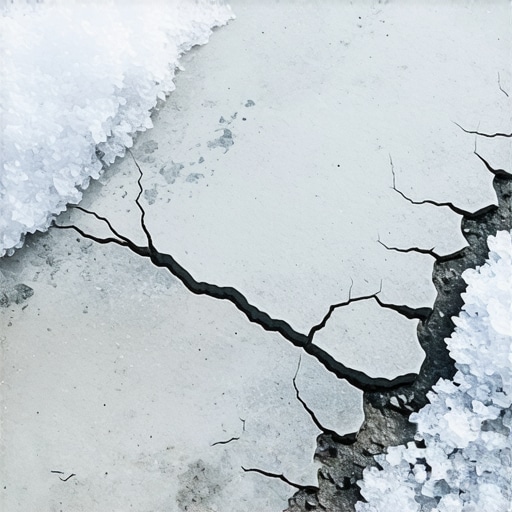
The Hairline Deception: A Forensic Scene
The homeowner stood on their porch, pointing at what they called a ‘tiny cosmetic blemish.’ It was a hairline crack, no thicker than a fingernail, running vertically through a concrete steps landing. They’d slapped a hardware-store patch over it in October. By January, that patch hadn’t just flaked; it had exploded off the surface in jagged shards. When I brought my borescope out and fed the fiber-optic lens into the void behind the facade, the truth was laid bare. The structural steel reinforcement—the rebar—wasn’t just rusted; it had oxidized to the point of expanding three times its original diameter, turning into a brittle, orange powder that was heaving the concrete from the inside out. This wasn’t a ‘patch’ job. This was a slow-motion structural execution. This is the reality of masonry in freeze-thaw climates: what you see on the surface is rarely the whole story, and a cheap fix is often a death sentence for the substrate.
The Physics of the 9%: Why Your ‘Mud’ Won’t Stick
To understand why that patch failed, you have to stop thinking of concrete as a solid block and start seeing it as a dense, rigid sponge. Concrete is full of capillary pores. When you apply a standard, over-the-counter patching compound without considering the hygroscopic nature of the existing material, you’re setting a trap. Water is a unique beast; unlike almost any other liquid, it expands by approximately 9% when it transitions from liquid to solid. If that water is trapped in the ‘cold joint’—the interface where your new patch meets the old concrete—that 9% expansion generates thousands of pounds of internal pressure per square inch.
“Water penetration is the single greatest threat to masonry durability, acting as a vehicle for weathering and structural degradation.” – BIA Technical Note 7
When you ‘butter’ a patch onto a frozen or near-frozen substrate, you’re dealing with the ‘Leidenfrost effect’s’ winter cousin. The moisture in your new mud hits the cold surface, the hydration process stalls, and instead of a chemical bond, you get a mechanical ‘skating.’ The patch sits on top like a scab rather than becoming part of the wound. Without proper porous stone sealers or a bonding agent that can handle the thermal shock, the first night the thermometer dips below 32°F, the hydrostatic pressure pops that patch right off. This is why brick veneer installation or brick patio restoration often fails within the first season if the installer doesn’t respect the dew point and the ‘tooth’ of the material.
The Anatomy of Spalling and Internal Rust
In my thirty years on the trowel, I’ve seen stone veneer repair jobs that looked like a ‘handyman special’ nightmare because the installer used a mortar that was too hard. In the forensic world, we look for ‘spalling’—that’s when the face of the masonry literally shears off. If you use a high-strength Portland cement patch on an older, softer substrate, the patch won’t move when the wall expands or contracts. The wall wants to breathe; the patch wants to hold its ground. The wall wins every time, and it takes the face of your masonry with it.
“Concrete must be designed to resist the specific environmental exposures of its geographic location, including moisture saturation and cyclic freezing.” – ASTM C94 Standard Specification
The Foundation Underpinning Reality
Sometimes, a flaking patch is a symptom of a much deeper pathology: settlement. If your concrete is cracking and flaking because the earth beneath it is moving, no amount of ‘slicker’ work or fancy mud will save it. This is where foundation underpinning comes into play. We’re talking about driving helical piers deep into the load-bearing strata to stabilize the structure. If the ‘bones’ are moving, the ‘skin’—the masonry—will always tear. I’ve walked onto jobs where people tried self-leveling masonry lifts to hide a 2-inch drop in a garage floor, only to find that the entire slab was floating on a pocket of air because of poor compaction. You can’t patch your way out of a geotechnical failure.
Modern Tech vs. Old World Craft: 3D Printing and Modular Masonry
The industry is changing. We’re seeing 3D printed masonry repairs and modular masonry construction becoming more common. These technologies allow for incredibly precise tolerances, but they still have to answer to the laws of thermodynamics. Even a 3D-printed filament needs to bond to the existing structure. If you’re doing a stone balustrade restoration on a historic estate, you’re not just looking for a visual match; you’re looking for a mineralogical match. You need to understand the ‘suction’ of the stone. If the stone is too dry, it sucks the water out of your mortar before it can hydrate, leaving you with a ‘burned’ joint that will crumble into sand by April.
The Fix: Do It Once, or Do It Twice
If you want a patch to hold through a Canadian or Chicago winter, you need to treat it like surgery. First, you must achieve a ‘saturated surface dry’ (SSD) condition. The old concrete should be damp but not glistening. This prevents the old material from robbing the new mud of its lifeblood. Second, if you’re dealing with brick veneer detachment repair, you need to look at the anchors. Are they rusted? If so, you’re just putting makeup on a corpse. You need to mechanically tie the veneer back to the studs before you even think about repointing. Finally, use a ‘slicker’ to pack the joints tight. Air pockets are the enemy; they are the condos where water lives before it turns into ice and blows your hard work apart. In this business, there are no shortcuts—only long roads back to fix the mistakes you made by trying to save a buck in October. Whether it’s brick patio restoration or a complex stone veneer repair, respect the chemistry of the freeze, or the freeze will disrespect you.”