
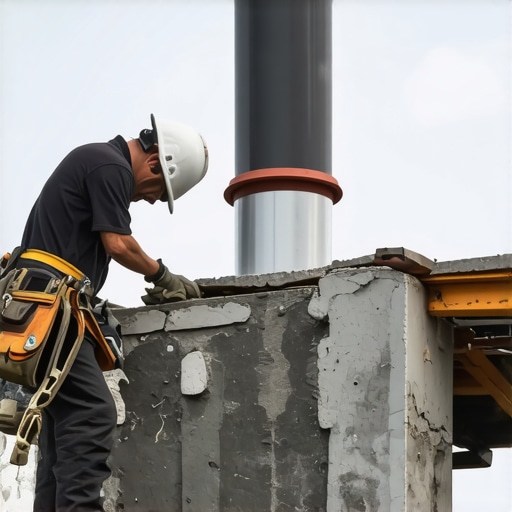
The Forensic Scene: A Vertical Sponge in a Sea of Soot
The homeowner thought it was just a hairline crack. From the ground, the 1920s Tudor chimney looked regal, if a bit weathered. But when I put my scope inside the transition between the flue and the masonry core, I saw the structural steel was rusted to dust and the inner wythe of brick had the consistency of wet cake. This wasn’t just a repair; it was a forensic excavation of a slow-motion disaster. For thirty years, water had been percolating through a hairline fissure in a rigid cement chimney wash, turning the structural brickwork into a vertical sponge. This is the reality of masonry water damage repair: by the time you see the white efflorescence on the exterior, the battle is often already lost. Most modern ‘masons’ would have slapped a new coat of Portland-heavy mud on top and called it a day. But I’ve spent my life fixing those ‘day-long’ repairs ten years later. To save a chimney in a freeze-thaw environment, you don’t use more cement; you use a material that has survived the roofs of European cathedrals for half a millennium: lead.
“Water penetration is the single greatest threat to masonry durability, specifically at the terminations where vertical walls meet the sky.” – BIA Technical Note 7
The Metallurgy of Protection: Why Lead Wins
In the world of brick wall restoration, we often talk about the ‘tooth’ of the material, but with lead, we talk about malleability and the oxide skin. When we perform a commercial smokestack repair, we aren’t just looking for strength; we are looking for a material that can survive the brutal thermal cycling of a chimney. A chimney is, by definition, a heat exchanger. The internal temperature can spike to several hundred degrees while the exterior is pelted by sub-zero sleet. This creates a massive thermal gradient. A rigid concrete wash, no matter how much fiber-reinforced mortars you pack into it, will eventually crack because its coefficient of expansion doesn’t match the clay flue tile it surrounds. Lead, however, is ‘dead soft.’ When we dress a lead cap over the chimney crown, we are creating a flexible, waterproof membrane that moves with the structure. We use 4-pound or 6-pound lead sheet, meticulously bossed with a wooden mallet to follow the contours of the soldier course at the chimney’s top. This isn’t just about covering the hole; it’s about managing the chemistry of the chimney environment. The sulfurous compounds in wood and gas smoke create an acidic condensate that eats through standard flashing. Lead forms a protective patina—a gray oxide layer—that is virtually impervious to this atmospheric battery acid.
The Physics of the Drip: Managing the 9% Expansion
In the northern climates, we fight the 9% expansion of freezing water every single winter. When water finds its way into a cold joint—that microscopic gap where a new mortar wash meets an old flue—it sits there and waits for the temperature to drop. When it freezes, it exerts upwards of 30,000 PSI of pressure. This is what causes spalling, where the face of the brick literally pops off, leaving the soft orange interior exposed. By installing a lead cap during a historic tuckpointing project, we create a definitive ‘drip edge.’ The lead extends past the masonry profile by at least an inch and is bent downward. This breaks the surface tension of the water, forcing it to fall clear of the masonry rather than running down the face of the brick. We see the same failure in concrete flatwork services where improper sloping leads to ponding, but on a chimney, the stakes are higher. A failure at the top leads to failure all the way down to the foundation. This is why we often have to perform structural brick ties replacement in the middle of a job; the internal moisture has rusted the original corrugated ties, leaving the brick veneer detached from the house frame.
“Masonry units shall be protected by a weather-resistant cap or coping that sheds water away from the masonry assembly.” – ASTM C1405 Principles
The Process: From Mud to Lead
When I’m buttering a brick for a high-exposure chimney rebuild, I’m not using the same mix I’d use for a garden wall. We need a ‘mud’ that breathes. For historic tuckpointing, we lean toward Type N or even Type O lime-based mortars. Why? Because the mortar must be the sacrificial element. If the mortar is harder than the brick—a common sin of the ‘lick-and-stick’ handyman—the brick will be the one to break during thermal expansion. Once the structural core is rebuilt, we prepare the crown for the lead cap. We don’t just lay the lead flat. We create a ‘bed’ using a soft mortar mix to give the lead a slight pitch. Then, we install a chimney heat shield installation inside the flue to manage the internal heat before the lead is dressed over the top. The lead is held in place by the flue liner itself or by specialized stainless steel anchors. We avoid the ‘honeycombing’ effect by ensuring the mortar beneath the lead is fully compacted with a slicker tool. This eliminates air pockets where condensation could collect. Even in modern applications, like 3D printed masonry repairs, the termination point remains the most vulnerable. While some argue for mortarless masonry systems in certain structural contexts, a chimney demands the monolithic protection that only a traditional, lead-capped masonry assembly can provide.
The Value of the Old World Method
You might see a contractor offering a ‘cheaper’ way—some silicone caulk and a bag of premixed concrete. That’s a ‘band-aid’ that will fail within five years. True brick wall restoration is about looking a century into the future. When we finish a lead cap, we aren’t just protecting a chimney; we are preserving the architectural integrity of the home. The lead cap is the ‘hat’ of the building. Without a good hat, the rest of the body is vulnerable. Whether we are dealing with a standard residential stack or a complex commercial smokestack repair, the physics remain the same: divert the water, allow for movement, and use materials that won’t degrade in the face of fire and ice. It’s the difference between doing a job and practicing a craft. We don’t use lead because it’s easy; we use it because, in the forensic history of masonry, it is the only thing that actually works.