
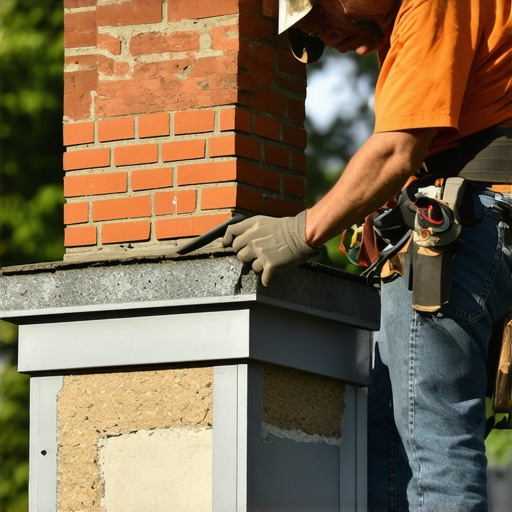
The Forensic Reality of a Crumbling Stack
The homeowner thought it was just a hairline crack. But when I put my scope inside, I saw the structural steel was rusted to dust. It was a classic case of what I call ‘masonry cancer.’ From the ground, the brickwork looked stoic, almost defiant against the gray October sky. But once my boots were on the shingles and my hands were on the masonry, the truth was undeniable. I could feel the movement. A chimney isn’t just a pile of bricks; it is a thermal engine that breathes, expands, and contracts. When the flashing—the critical gasket between your roof and your masonry—fails, the entire system begins a slow, silent collapse. We don’t start at the flashing because it’s easy; we start there because it is the zero-point of structural integrity. If you ignore the flashing, you are just putting lipstick on a pig that’s about to fall over.
The Physics of the Flashing Transition
In my forty years of chimney rebuild services, I have seen thousands of ‘handyman specials’ where a bucket of plastic cement was slapped over a leaking joint. That isn’t masonry; that’s a crime. The flashing is the most vulnerable point of the entire building envelope. It is where two different materials with two wildly different coefficients of thermal expansion meet. The roof wants to move one way; the chimney wants to stay put. This creates a mechanical shear that most amateurs fail to understand. When we perform full repointing services, we look at the ‘tooth’ of the brick at the roofline. If that brick has lost its suction due to chronic saturation, the mortar won’t bond. It will just sit there, a ‘cold joint’ waiting to let the next nor’easter into your attic.
“Water penetration is the single greatest threat to masonry durability.” – BIA Technical Note 7
When water gets behind the lead or copper, it begins the freeze-thaw damage restoration cycle. In our climate, water expands 9% when it turns to ice. That sounds small until you realize that 9% expansion generates enough force to snap a solid granite lintel. It’s like a million tiny hydraulic jacks pushing the brick away from the flue. This is why tuckpointing brick walls above the roofline is a fool’s errand if the flashing is shot. You have to ‘butter’ those bricks with a mud that can actually handle the movement. We use a specific mix—often a Type N lime-heavy mortar—that allows for the ‘breathability’ required to vent that internal moisture before it turns to ice and pops the faces off your soldier course.
The Chemistry of Mortar and the Sacrificial Principle
One of the biggest mistakes modern crews make is using high-strength Portland cement on old chimneys. It’s a death sentence for the brick. Old bricks are soft; they are porous and have a high absorption rate. If you hit them with a hard, Type S mortar, the brick becomes the weakest link. In the world of mortar repointing services, we follow the sacrificial principle: the mortar must always be softer than the brick. It is designed to be the part that wears out. It is the shock absorber. When we are deep into masonry rescue after disaster, we often find bricks that have completely disintegrated while the modern cement mortar joints stand there like a skeleton. That’s a failure of logic. We ‘strike’ our joints with a slicker tool to create a compacted, weather-shedding profile that directs water away from the core. This isn’t just aesthetics; it’s hydraulic engineering on a microscopic scale.
Beyond the Chimney: The Ground Truth
The same principles of moisture management apply to the ground. People ask why their patio stone realignment fails after one season. It’s the same enemy: hydrostatic pressure. If your base isn’t right, the masonry joint sand repair you did last summer won’t mean a thing. We see it in self-leveling masonry lifts too. If the subgrade isn’t compacted to 95% Proctor, the earth will move, and the stone will follow. It’s about the ‘wicking’ action. Capillary suction can draw water up from the soil through the masonry, carrying salts that lead to efflorescence. It’s the same ‘wicking’ that happens when chimney flashing is improperly tucked into the reglet. Whether you’re dealing with robotic masonry repair or the old-fashioned hawk and trowel, if you don’t respect the way water moves, you’re just wasting time.
“The architect should ensure that the masonry units and mortar are compatible in terms of strength and moisture movement.” – ASTM C270 Standards
The Ritual of the Rebuild
When we pull the ‘mud’ onto the hawk and start ‘buttering’ those units, we are looking for that perfect consistency—the ‘suction’ that tells us the brick is drinking in the cementitious bond. A chimney rebuild from the flashing up means we are anchoring the new work into the existing structural bones of the house. We use stainless steel wall ties, spaced every 16 inches, to ensure that the wind load won’t shear the stack. We look at the ‘honeycombing’ of the old mortar—those tiny air pockets that indicate where the system was failing. Only by removing the rot at the flashing level can we ensure that the new tuckpointing brick walls will actually hold. It’s about the ‘click’ of the brick as it sets into the bed joint. If it doesn’t ‘ring’ right, it isn’t set right. We don’t do ‘lick-and-stick’ here. We build for the next hundred years, not the next hundred days. Anything less isn’t masonry; it’s just a temporary stack of heavy rocks.