
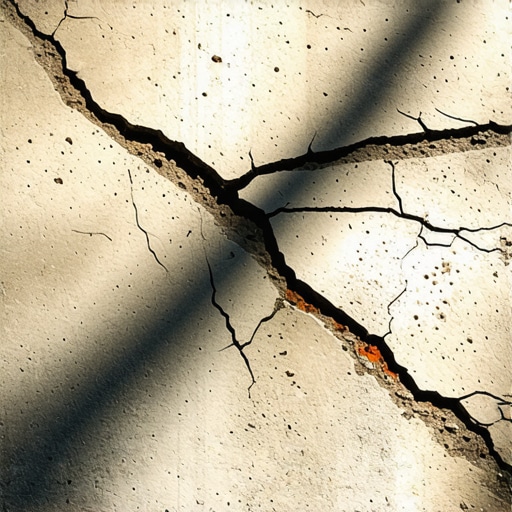
The Forensic Scene: A Sun-Bleached Failure
The facility manager called me out to look at a sprawling courtyard that was less than six months old. From twenty feet away, it looked like a map of the moon. He thought it was a bad batch of concrete. I knelt down, pulled my pick from my belt, and slid it under the edge of a patch. The whole thing popped off with the effort of opening a soda can. Underneath, the substrate was dry as a bone, smooth as glass, and coated in a fine, white powder. This wasn’t a material failure; it was a fundamental betrayal of physics. Thin-set concrete patches fail in the sun because they are physically incapable of managing the thermal stress and moisture loss inherent to a high-exposure environment. When you’re dealing with professional masonry restoration, you can’t just butter over a problem and expect it to stick. You’re fighting the law of thermodynamics, and the sun always has the high ground.
“Water penetration and the subsequent evaporation cycles are the primary catalysts for delamination in cementitious repairs.” – ASTM C928 Standard Specification
The Physics of the ‘Flash Set’ and Wicking
When you slap a thin layer of wet mud onto an old, hot concrete slab, two violent actions happen simultaneously. First, the sun bakes the surface, pulling water out of the top layer through evaporation. Second, the old, porous concrete acts like a sponge, wicking the moisture out of the bottom of the patch. This is what we call ‘flash setting.’ In the world of concrete masonry unit restoration, moisture is the currency of strength. Without that water, the cement hydration process stops dead. Instead of forming a dense, interlocking crystalline matrix that grabs onto the ‘tooth’ of the old surface, you get a brittle, unbonded layer of dust. This is why 3D printed masonry repairs are gaining traction; they allow for precise material deposition that can account for these moisture gradients in real-time. If the mud dries before it cures, it’s just expensive dirt.
The Thermal Expansion Trap
Concrete is not a static object; it’s a breathing, moving mass. In the heat of the day, a sidewalk or patio expands. In the cool of the night, it contracts. Thin patches have a different thermal mass than the thick slab beneath them. They heat up faster and expand at a different rate. Because the patch is thin, it lacks the tensile strength to resist the shear forces at the bond line. This is where digital twin masonry projects become invaluable. By creating a digital replica of a structure, we can simulate the thermal loading on a modular retaining wall or a foundation fix before we ever mix a bag of mud. Without this foresight, the patch becomes a ‘sacrificial layer’ that wasn’t intended to be sacrificial. It shears off, creating a cold joint that invites water to sit and fester.
Foundation Realities and Structural Integrity
I’ve seen guys try to use thin-set mortars to hide a foundation wall bowing repair. It’s a fool’s errand. A horizontal crack in a foundation indicates hydrostatic pressure—the weight of the earth and water pushing against the wall. Rubbing a little mud in the crack is like putting a band-aid on a gunshot wound. To truly address freeze-thaw damage restoration, you have to understand that water expands by 9% when it turns to ice. If your patch has even a microscopic gap because it ‘burned’ in the sun, water will find it. When that water freezes, it exerts thousands of pounds of pressure, popping the patch off and taking a chunk of the original brick or block with it. We call this ‘spalling,’ and it’s the death knell for any brick patio restoration job.
“The durability of a masonry system is dependent upon the compatibility of the repair mortar with the original substrate.” – BIA Technical Note 1
The Science of the Base: Beyond the Surface
Most ‘handyman specials’ fail because the worker focused on the finish rather than the compaction physics of the base. If you’re doing masonry joint sand repair or laying pavers, the surface is only as good as the eight inches of gravel beneath it. Thin concrete patches crack because the substrate moves. If the original slab wasn’t stable, no amount of ‘super-glue’ mortar will hold it. This is why we are seeing a shift toward self-healing concrete foundations, which use embedded bacteria or capsules of epoxy to seal micro-cracks as they form. But for the average homeowner, the solution is simpler: you must achieve a mechanical bond. You need to ‘scarify’ the old surface, use a high-quality bonding agent, and keep the patch damp—sometimes for days—to ensure the hydration process completes. You don’t just butter the brick; you marry the materials.
Conclusion: The Master Mason’s Warning
If you see a contractor showing up with a hawk and trowel on a 95-degree day, ready to ‘skim coat’ your cracked driveway without wetting the stone or setting up shade, send them home. They aren’t doing professional masonry restoration; they’re performing a magic trick that will disappear with the first frost. Real masonry is gritty, heavy, and respects the chemistry of the mix. Whether it’s 3D printed masonry repairs or a simple brick patio restoration, the rules of the sun and the stone never change. Do it right the first time, or you’ll be paying me to chip out your mistakes next summer. You can’t cheat the physics of the pour, and you certainly can’t hide from the sun.