
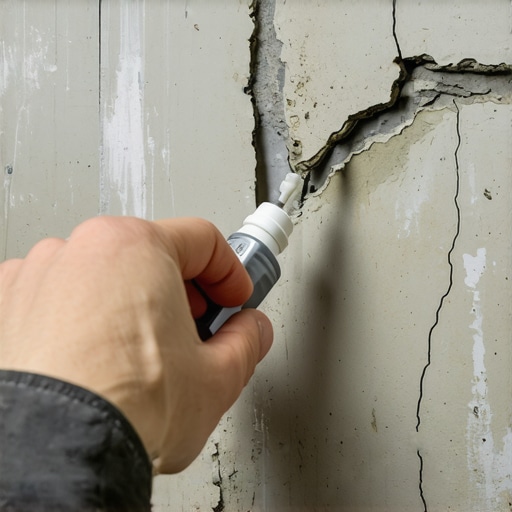
Why Standard Caulk is the Worst Choice for Repairing Concrete Cracks
Walk into any big-box hardware store, and you will find an entire aisle dedicated to tubes of caulk. For under $10, you can pick up a tube of “all-purpose” silicone or a “masonry-grade” latex sealant that promises a quick, waterproof fix for those unsightly lines running through your driveway or patio. It is a tempting proposition: a caulking gun, five minutes of labor, and your concrete crack repair is seemingly complete.
However, as professional masonry contractors, we see the aftermath of these “quick fixes” every single day. The reality is that standard caulk is perhaps the worst possible material you can use for long-term concrete maintenance. While it might look acceptable for a few weeks, research into residential masonry failure shows that a significant majority of DIY concrete repairs using off-the-shelf caulk fail within the first six months. This isn’t just an aesthetic issue; a failed repair often accelerates the degradation of the concrete substrate, leading to much more expensive structural repairs down the road.
Concrete is not a static, dead material. It is a porous, “living” substrate that breathes, moves, and reacts to the environment. To treat it like the ceramic of a bathtub or the wood of a window frame is a fundamental misunderstanding of masonry science. In this guide, we will explore why standard caulking products are destined to fail and what professional-grade alternatives you should use instead.
The “Quick Fix” Illusion: Why Homeowners Reach for Caulk
The primary reason homeowners reach for standard caulk is accessibility and price. When you see a crack, your instinct is to “fill the hole.” Silicone and latex caulks are designed to be user-friendly; they are easy to squeeze, easy to smooth with a wet finger, and they dry quickly. They are excellent for sealing gaps between two dissimilar, non-porous materials – like a glass window pane and a vinyl frame.
But concrete is a different beast entirely. It is highly alkaline, naturally dusty, and constantly undergoing thermal cycles. When you apply a standard bead of caulk over a crack, you are creating a superficial “bridge” that lacks the chemical bond necessary to withstand the rigors of the outdoors. This is a classic example of treating the symptom rather than the cause. Furthermore, many homeowners don’t realize that why DIY concrete patches often peel away is usually due to the lack of mechanical prep and the use of materials that cannot handle the weight and friction of foot or vehicle traffic.
The Science of Failure: Why Standard Caulk Can’t Handle Concrete Crack Repair
To understand why concrete crack repair requires more than just a tube of caulk, we have to look at the physics of how masonry behaves. There are three primary scientific reasons why standard caulking products fail in a masonry environment.
1. Adhesion Issues and Surface Porosity
Concrete is a porous material, filled with microscopic voids. For a repair material to last, it must “wet out” the surface – meaning it must penetrate those pores to create a mechanical bond. Standard silicone and latex caulks have high surface tension and high viscosity. Instead of soaking into the concrete, they sit on top of the dust and laitance (the weak, milky layer on the surface of concrete). Without a deep bond, the first time the concrete shifts or water pressure builds up from beneath, the caulk simply peels away like a sticker.
2. Thermal Expansion and Elongation Limits
Concrete expands when it’s hot and contracts when it’s cold. A crack in your driveway might be 1/8th of an inch wide in July and 1/4th of an inch wide in January. This movement is relentless. Standard caulks have limited “elongation” percentages. If a caulk can only stretch 25% of its width before tearing, it will inevitably fail during the first freeze-thaw cycle. Professional sealants are designed with high-movement capabilities, often stretching 50% to 100% without losing their bond or integrity.
3. UV Degradation and Weathering
Most standard caulks, especially interior-grade or cheap “all-purpose” versions, are not formulated to withstand constant bombardment from ultraviolet (UV) rays. Over time, the sun breaks down the polymer chains in the caulk, making it brittle. Once it loses its flexibility, it cracks. Furthermore, silicone-based products are notorious for attracting dirt and becoming permanently stained, and because silicone does not accept paint, you are stuck with a dirty, “plastic-looking” bead that highlights the repair rather than hiding it.
Effective Concrete Crack Repair: Silicone vs. Polyurethane vs. Epoxy
When choosing a material for concrete crack repair, it is essential to understand the hierarchy of sealants. Not all “professional” tubes are created equal.
- Silicone: While highly waterproof, silicone has poor abrasion resistance. If used on a driveway or walkway, it will quickly wear down under foot traffic or tires. It also leaves a silicone oil residue that makes future repairs – even professional ones – nearly impossible because nothing will stick to the contaminated area.
- Polyurethane: This is a step up from silicone and is often marketed as a masonry sealant. It has better adhesion and can be painted. However, polyurethane has a significant drawback: it is a vapor barrier. While that sounds good, it can actually be detrimental to exterior concrete, as we will discuss in the next section.
- Epoxy and Polyurea: These are the gold standards for structural and high-traffic concrete crack repair. They offer deep penetration and, in the case of polyurea, incredible flexibility and rapid cure times. Unlike caulk, these materials are often poured or injected into the crack, ensuring the entire void is filled rather than just the surface.
Before applying any of these, however, the preparation is key. You cannot simply squeeze material into a dirty crack. Professionals often use mechanical means to open the crack and provide a clean surface. For more on this, see our guide on Sanding vs. Grinding: Preparing Concrete for a Permanent Bond.
The Hidden Danger of Trapped Moisture
One of the most overlooked aspects of concrete crack repair is “breathability.” Concrete is a porous material that allows moisture vapor to pass through it from the ground. This is known as vapor drive. When you use a non-breathable, “waterproof” caulk (like many polyurethanes) to seal a crack, you are essentially creating a dam.
Moisture rising from the soil gets trapped beneath the sealant. In cold climates, this trapped moisture freezes and expands, exerting massive pressure on the edges of the repair. This leads to “spalling” – where the surface of the concrete chips away around the repair – or “efflorescence,” which is the white, powdery salt residue left behind as moisture evaporates through the surrounding concrete. If you’ve ever noticed a white haze after a masonry repair, it is often a sign that the repair material is trapping moisture rather than letting the substrate breathe.
Professional Alternatives for a Permanent Bond
If standard caulk is off the table, what should you use? The answer depends on the location and the type of crack. For driveway crack repair, we typically move away from “beads” of caulk and toward flowable fillers.
Polyurea and Epoxy Crack Fillers
For horizontal surfaces, a low-viscosity epoxy crack filler or a polyurea sealant is ideal. These materials are thin enough to gravity-feed deep into the crack, bonding the two sides of the concrete together structurally. Once cured, they can be ground flush with the surface, making the repair nearly invisible and highly resistant to vehicle traffic.
Fiber-Reinforced Mortars
For vertical surfaces, such as concrete steps or foundation walls, we often use fiber-reinforced mortars. These materials contain microscopic fibers that act like rebar, providing internal strength that standard caulk lacks. They can be textured to match the surrounding masonry, providing a much better aesthetic result than a shiny bead of silicone.
Using these industrial-grade materials is the only way to ensure a permanent fix. For larger issues, such as fixing driveway holes with industrial-grade concrete patches, a simple crack filler won’t suffice; you need a high-aggregate repair compound that can support the weight of a vehicle.
When a Crack is More Than Just a Crack: Structural Warning Signs
Before you begin any concrete crack repair, you must determine if the crack is “active” or “dormant.” A dormant crack is usually the result of initial shrinkage when the concrete was poured. An active crack, however, is a sign of ongoing movement.
If a crack is wider than 1/4 inch, if one side of the crack is higher than the other (heaving), or if the crack is widening over time, caulk – or even professional sealant – is just a bandage on a broken bone. These are signs of soil settlement, hydrostatic pressure, or root intrusion. In these cases, you may be identifying structural shifts before your foundation fails. Attempting to seal these without addressing the underlying soil or drainage issues is why most crack injections fail within six months.
The Long-Term Cost of Cheap Repairs
Homeowners often view concrete crack repair as a $20 DIY project. However, the “real” cost of using standard caulk is much higher. Consider the following lifecycle of a failed repair:
- Initial Cost: $20 for caulk and a gun.
- Failure: Within 6 – 12 months, the caulk peels, water enters the crack, freezes, and widens the gap.
- Removal Labor: Standard caulk (especially silicone) is incredibly difficult to remove. It must be mechanically scraped or ground out, which takes hours.
- Secondary Damage: Trapped moisture may have caused spalling, requiring the removal of more concrete.
- Professional Redo: You eventually pay a contractor to do the job you could have done right the first time, but now they have to charge more to fix the damage caused by the failed caulk.
By investing in flexible concrete sealants and professional-grade materials from the start, you protect the value of your property and avoid the cycle of temporary fixes.
Conclusion: Investing in Your Masonry’s Future
In my professional life as a dietitian, I often talk about how “quality ingredients lead to long-term health.” The same is true for your home. You wouldn’t fuel your body with low-quality substitutes and expect peak performance; you shouldn’t treat your home’s foundation or driveway with low-quality materials and expect them to last. Standard caulk is designed for kitchens and baths, not for the structural demands of concrete.
If you want a repair that actually lasts, skip the caulk aisle. Look for high-elongation polyurethanes, structural epoxies, or polyurea fillers. Better yet, have a professional evaluate the movement of your masonry to ensure you aren’t just covering up a larger structural problem.
Are you concerned about the cracks in your driveway or foundation? Don’t guess – get an expert opinion. We recommend a comprehensive “50-Point Masonry Check” to evaluate the structural health of your property. To learn more about what we look for, check out our article: Beyond the Surface: What We Look for During a 50-Point Masonry Check. Protect your investment by doing it right the first time.