
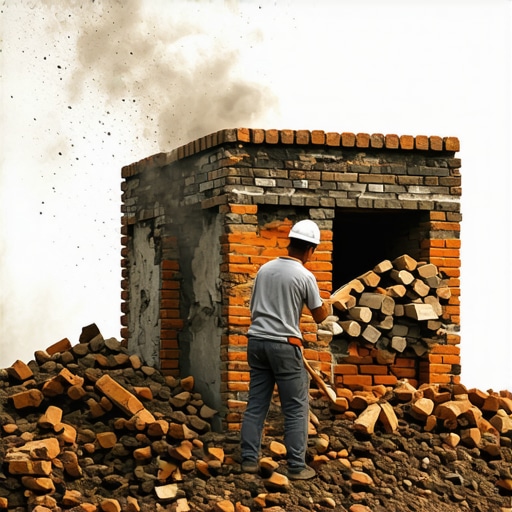
The Lure of the Antique and the Reality of Decay
Every year, I see a homeowner or a starry-eyed DIYer loading up a pickup truck with stacks of ‘reclaimed’ bricks from a 1920s chimney. They see character, history, and a cheap price tag. I see a structural masonry inspection waiting to happen—and not the good kind. They think they are getting ‘Old World’ charm, but they are actually importing 80 years of thermal trauma, sulfur saturation, and microscopic fatigue into their new project. Whether you are looking at a retaining wall capstone replacement or a patio project, those chimney bricks are a ticking time bomb. Let me tell you about my Uncle Silas. He was a man who could smell a ‘blown’ brick from twenty paces. One afternoon, he walked up to a pallet of salvaged chimney units a neighbor had bought for an outdoor masonry fountain restoration. He didn’t say a word. He just picked up a 14-pound sledge and tapped the side of a brick. Instead of a high-pitched ‘ring’—the sound of a healthy, vitrified clay body—it let out a dull, wet thud. Silas tossed the brick back on the pile and said, ‘That brick has already lived its life. Don’t ask it to start over.’ He knew that the internal matrix of that clay had been cooked and cooled so many times it was essentially a sponge held together by hope.
“The use of salvaged brick is not recommended… their properties are unknown, and they may be contaminated with salts or other harmful substances.” – Brick Industry Association (BIA) Technical Note 15
The Physics of Thermal Shock and Vitrification
To understand why chimney bricks fail, we have to micro-zoom into the kiln. When a brick is fired, it undergoes vitrification—the process where the silica and alumina in the clay melt into a glass-like bond. A chimney brick, however, lives a life of constant, localized thermal cycling. The bricks in the ‘heart’ of the chimney are subjected to temperatures that fluctuate hundreds of degrees in a matter of hours. This doesn’t just expand the brick; it creates a gradient of thermal expansion across the unit’s thickness. Over decades, this causes micro-fracturing of the vitrified bonds. When you try to butter these bricks with a fresh mud, you aren’t just applying mortar to a surface; you are applying it to a crumbling lattice. This is particularly dangerous when considering stone veneer over brick applications. The weight of the veneer pulls on the face of the salvaged brick, and because the brick’s internal ‘tooth’ is gone, the whole facade can delaminate, leaving you with a pile of rubble and a very expensive repair bill.
Sulfate Attack and the Chemistry of Combustion
The biggest enemy isn’t just the heat; it’s the chemistry of what went up that flue. Burning wood and coal releases sulfur dioxide and other acidic gases. These gases mix with moisture (from wood or humidity) and penetrate the porous clay. Over time, these sulfates react with the tricalcium aluminate in the clay, leading to a phenomenon known as ‘sulfate attack.’ This causes the brick to expand internally, much like a slow-motion explosion. If you use these bricks for retaining wall reinforcement, the moisture from the soil behind the wall will reactivate those dormant salts. You’ll see a white, fluffy powder—efflorescence—blooming on the surface, but the real damage is deeper. The salts crystallize in the pores, exerting thousands of pounds of pressure per square inch. This is why concrete block foundation repair is often necessary when people try to ‘face’ their foundations with salvage; the expanding brick literally pushes the blocks out of alignment.
The Porosity Problem and Modern Mortar
Old bricks were often fired in ‘beehive’ kilns, leading to a wide variance in hardness. The ‘salmon’ bricks—those fired at the cooler parts of the kiln—are notoriously soft. Chimneys are full of them. These bricks have high ‘suction’ or Initial Rate of Absorption (IRA). When you use a modern concrete pump masonry mixes or high-strength Portland cement mortar on these old units, the brick sucks the hydration out of the mortar before it can properly set. This leads to a cold joint where there is zero chemical bond. In historic pointing styles, we use soft lime putty for a reason—it is the ‘sacrificial’ element. If you use a hard Type S mortar on a soft salvaged brick, the brick will be the one to fail when the wall moves.
“Mortar should be weaker than the masonry units so that stress is relieved in the joints rather than through the units themselves.” – ASTM C270 Standards
This is especially critical when tuckpointing curved walls, where the stress distribution is uneven. A hard mortar on a salvaged chimney brick will pop the faces right off, a process known as spalling.
The Risks of Invisible Damage
Modern AI masonry assessment tools are getting better at spotting surface anomalies, but they can’t always see the ‘rot’ inside a salvaged unit. During a structural masonry inspection, we look for ‘ringing’ and density, but salvaged chimney bricks often hide their secrets until they are under load. If you are building a wall, you might use a soldier course for decorative effect, but those vertical bricks are even more exposed to the elements. Without a proper slicker-finished joint and high-quality new units, water will find its way into the micro-cracks of your salvage. If you’re in a freeze-thaw climate, that water expands by 9% when it turns to ice. In a healthy brick, there’s enough pore structure to handle some of that pressure. In a chimney brick already weakened by sulfate attack and thermal fatigue, the ice will simply shatter the unit from the inside out. Don’t be fooled by the aesthetic. If you want the old look, buy new ‘tumbled’ bricks designed for the exterior. Don’t bet your house—or your outdoor masonry fountain restoration—on a pile of exhausted clay. Do it once, do it right, and keep the old chimney bricks in the garden as decorative accents where their inevitable failure won’t bring the roof down.