The Forensic Scene: What Lies Beneath the Surface
I remember standing on a steep hillside behind a luxury estate last November, looking at a retaining wall that had buckled like an old accordion. The homeowner thought it was just a hairline crack, a cosmetic annoyance that a bit of mortar could fix. But when I put my fiber-optic scope inside the core of that wall, I saw the structural steel was rusted to dust and the backfill had turned into a pressurized swamp of saturated silt. That wall wasn’t just cracking; it was a ticking time bomb waiting for one more heavy rain to send fifty tons of earth into the master bedroom. In my forty years as a third-generation mason, I have seen this tragedy play out from the old brownstones of the Northeast to the expanding clays of the South. The culprit is almost always the same: a rigid, mortared system that tried to fight the laws of physics and lost. This is why we are seeing a massive shift toward modular masonry construction and mortarless systems.
The Physics of Failure: Why ‘Mud’ Isn’t Always the Answer
When most people think of masonry, they think of ‘mud’—the mortar that binds bricks and stones together. In historic tuckpointing or specialized chimney rebuild services, that mortar is the lifeblood of the structure. But when you are holding back the weight of the earth, a rigid mortar joint becomes a liability. The enemy is hydrostatic pressure. Water weighs roughly 62.4 pounds per cubic foot. When soil becomes saturated, that weight pushes laterally against the back of the wall. In a traditional wet-set wall, if the drainage isn’t perfect, that pressure builds until the wall bows or the mortar joints blow out.
“Water is the primary cause of masonry deterioration, and its management is the key to longevity.” – ASTM C1372 Standard for Segmental Retaining Wall Units
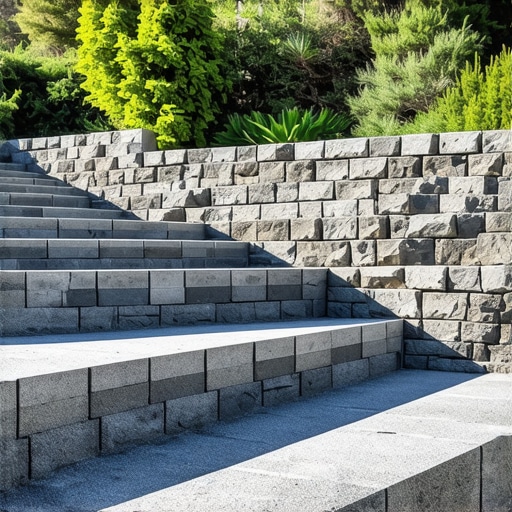
Unlike a soldier course on a decorative facade, a retaining wall must be a living, breathing machine. Mortarless masonry systems, often referred to as segmental retaining walls (SRW), rely on gravity and geogrid reinforcement rather than the brittle bond of cement. They allow for ‘weeping’—small amounts of water to pass through the joints naturally—which relieves the pressure that would otherwise snap a mortared wall like a dry twig.
Micro-Zooming into the Geotechnical Logic
To understand why these systems work, we have to look at the ‘tooth’ of the block. Modern modular units are engineered with a built-in setback and shear pins or lips that create a mechanical interlock. This isn’t like ‘lick-and-stick’ stone veneer that falls off after three winters. This is about the friction angle of the aggregate. When we use concrete pump masonry mixes for the footings, we are creating a solid, level plane, but the wall itself remains flexible. In the North, where the freeze-thaw cycle is a brutal reality, water expands 9% upon freezing. If that water is trapped in a mortar joint, it causes spalling—the face of the stone literally pops off. A mortarless system doesn’t care about that 9% expansion; the blocks have enough ‘give’ to move slightly and then settle back into place. It’s the difference between a tree that bends in a hurricane and one that snaps.
The Critical Importance of the Base and Drainage
If you see a wavy wall, don’t blame the blocks; blame the man who dug the trench. Most ‘handyman specials’ fail because they treat the base like an afterthought. I’ve seen guys throw down two inches of pea gravel and call it a day. That is a recipe for a cold joint disaster. A real master mason knows it’s all about the compaction. We’re talking about 6 to 12 inches of dense-graded aggregate, compacted to 95% Proctor density. This isn’t just about stability; it’s about breaking the capillary action of the soil. We also have to be precise with masonry birdsmouth cuts when we are wrapping around corners or integrating stairs. These cuts ensure that the structural integrity of the block isn’t compromised just to make a pretty angle. Even in outdoor masonry fountain restoration, we see how water finds the path of least resistance. In a retaining wall, we have to dictate that path using perforated drain tile and clean 57 stone backfill. Without that drainage, your wall is just a dam, and dams eventually break.
The Scam of the ‘Leftover Material’
Be wary of the contractor who tells you they have ‘leftover material’ from a nearby job and can give you a deal on a retaining wall or chimney sweep and repair. High-quality modular masonry construction requires specific block types and geogrids engineered for the height and soil type of your specific site. Using the wrong block is as dangerous as using the wrong mortar in historic tuckpointing. For example, if you use a block designed for a three-foot garden wall on a six-foot structural slope, you are asking for a collapse. I’ve been called to far too many forensic scenes where the homeowner tried to save five grand on the front end only to spend fifty grand on the back end for excavation and reconstruction.
“Effective drainage is not an accessory; it is a fundamental requirement of any retaining structure.” – BIA Technical Note 31B
Whether you are looking at chimney flashing repair, chimney cap replacement, or a massive structural wall, the principles of material science remain the same: you must account for the movement of moisture and the thermal expansion of the materials. You do it once, or you do it twice. And doing it twice usually involves a bulldozer and a lawyer.
The Craftsmanship of the Modern Era
Some ‘Old World’ purists look down their noses at mortarless systems, but they are missing the point. Just because we aren’t using a hawk and a slicker to butter every joint doesn’t mean the craft is dead. It has just evolved. The precision required to lay a three-hundred-foot modular wall that is perfectly level and plumb across varying terrain is immense. It’s about understanding soil mechanics, hydrostatic load, and the chemistry of the concrete itself. We still see honeycombing in poorly vibrated concrete footings, and we still see the devastating effects of ‘flash setting’ in hot climates like Arizona or Texas where the base material dries too quickly. In those hot zones, we have to wet our materials and work in the cool of the morning to ensure the base doesn’t burn out. This isn’t just stacking blocks; it’s forensic engineering with a trowel in your hand. From chimney rebuild services to the most complex retaining systems, the goal is always the same: building something that will outlast the man who laid it. Don’t settle for ‘good enough.’ Demand the physics that support the aesthetics.