
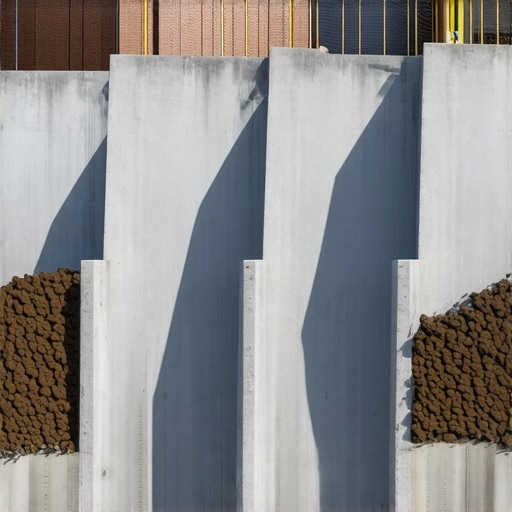
The $50,000 Pile of Rubble: A Forensic Post-Mortem
I stood looking at a $50,000 retaining wall that lay in a pile of rubble because the contractor forgot one thing: drainage. It wasn’t the blocks that failed; those Segmental Retaining Wall (SRW) units were rated for four thousand PSI and looked as sturdy as a fortress. But there they were, scattered across the client’s lawn like a child’s discarded Legos. The culprit wasn’t a lack of ‘mud’ or poor ‘buttering’ of the joints—modular walls are dry-stacked, after all. The killer was a missing layer of non-woven geotextile filter fabric, a mistake that turned a structural asset into a ticking geological time bomb.
When you build a wall, you aren’t just fighting gravity; you are fighting the physics of water and the relentless pressure of the earth. In my thirty years of masonry damage assessment, I have seen more ‘wavy’ walls and sinking patios than I care to count. This isn’t just about aesthetics. When a wall bulges, it is a signal that the internal geogrid and drainage systems have been compromised. Usually, it’s because someone wanted to save a few hundred bucks on a roll of fabric and a few extra tons of clean aggregate.
The Physics of Hydrostatic Pressure and Soil Migration
To understand why that wall is leaning over like a tired old man, you have to understand hydrostatic pressure. Water weighs approximately 62.4 pounds per cubic foot. When heavy rains hit, the soil behind your wall becomes saturated. Without a clear exit path, that water weight is added to the lateral earth pressure already pushing against the back of the blocks. If you’ve skipped the filter fabric, you’ve essentially invited the ‘fines’—those tiny particles of silt and clay—to migrate into your drainage stone.
Think of the drainage stone (usually 3/4 inch clean crushed rock) as the wall’s lungs. It needs to breathe to let water pass through to the weep holes or the perforated toe drain. When silt migrates into that stone, it’s like filling a pair of lungs with wet cement. The stone becomes ‘blinded,’ the water traps behind the wall, and the pressure builds until the friction holding those modular blocks together simply gives up. Unlike a brick wall restoration project where we might worry about the ‘tooth’ of the mortar, here we worry about the ‘angle of repose’ and the friction between the concrete units.
“Water penetration is the single greatest threat to masonry durability.” – BIA Technical Note 7
The Freeze-Thaw War: A Northern Perspective
Up here in the North, we deal with the most violent force in masonry: the 9% expansion. When water turns to ice, it expands by nearly ten percent of its volume. If your drainage stone is clogged with soil because you didn’t wrap it in a geotextile envelope, that trapped moisture has nowhere to go. It freezes, pushes the block out a fraction of an inch, thaws, and lets more silt in. This cycle repeats until the wall has a ‘belly’ that no patio stone realignment can fix. You are looking at a full tear-down.
This is the same principle we see in commercial parapet wall repair. If the coping is cracked and water gets behind the masonry units, the winter will pop those bricks off the face of the building. In modular retaining walls, the lack of fabric accelerates this process exponentially. The soil behind the wall effectively ‘liquefies’ during heavy spring thaws, exerting a force that can move thousands of pounds of concrete with ease.
The Anatomy of a Proper Drainage Envelope
A professional wall build involves more than just stacking blocks. You start with a compacted base—not just dirt, but crushed stone. As you go up, you need a minimum of 12 inches of clean drainage stone behind the units. This stone MUST be separated from the native soil by a high-quality filter fabric. This fabric acts as a sieve; it lets the water molecules pass through while stopping the silt.
When I’m called out for a tuckpointing cost estimation on a chimney or a chimney flashing repair, I often look at the surrounding hardscape. If I see a retaining wall with weeds growing out of the face, I know the fabric is missing. Those weeds are growing because soil has migrated through the stone and reached the joints. It’s a sign of rot from the inside out. Just as tuckpointing weatherproofing protects a vertical brick surface, the filter fabric and drainage stone protect the horizontal structural integrity of your landscape.
Micro-Zooming: The Chemistry of Carbonation and Clogging
In older masonry, we talk about the carbonation of lime—how it takes decades for mortar to truly reach its peak strength. In modern modular walls, the ‘chemistry’ is in the soil. Different soils have different ‘fines’ content. A heavy clay soil is the natural enemy of the modular block. The tiny platelets in clay can clog a drainage system faster than you can say ‘lawsuit.’
We also have to consider green roofing masonry integration. When you have plantings above a wall, the irrigation adds a constant source of water. If that water isn’t managed with a proper geotextile barrier, you’re essentially feeding the ‘fines’ into your drainage pipe every time the sprinklers kick on. This leads to chimney sweep and repair levels of maintenance—constant cleaning of the drainage outlets just to keep the wall standing.
“The separation of dissimilar materials is a fundamental requirement for the long-term performance of any geotechnical system.” – ASTM D4751 Standard
The Scam: Why Contractors Skip the Fabric
The ‘handyman special’ or the ‘asphalt gypsy’ will tell you that the blocks are heavy enough to hold back anything. They’ll ‘butter’ the top course to make it look pretty, maybe even throw in a chimney damper repair for cheap while they’re there, but they’ll bury the evidence of their shortcut. Fabric is a pain to install correctly—you have to tuck it, pin it, and make sure there are no gaps. It adds a few hours to the job and a few hundred to the material bill. But skipping it is a scam. It’s the difference between a wall that lasts 50 years and a wall that fails in five.
When to Panic: Assessing the Damage
If you see a ‘stair-step’ crack in your modular wall, it might just be settlement. But if you see the center of the wall bowing outward—the classic ‘bulge’—you are looking at a catastrophic drainage failure. At this point, no amount of brick wall restoration techniques will help. You can’t just ‘tuckpoint’ a bulging modular wall. You have to relieve the pressure. This often involves excavating the backfill, which is where the real cost lies.
Before you hire a contractor, ask them about their drainage plan. If they don’t mention filter fabric or ‘burrito-wrapping’ the stone, show them the door. It’s better to pay for a proper masonry damage assessment now than to pay for a total rebuild later. A wall should be a permanent fixture, a testament to the ‘Old World’ idea that we build things to last. Don’t let a missing piece of fabric turn your investment into a pile of expensive rubble.
{“@context”:”https://schema.org”,”@type”:”HowTo”,”name”:”How to Assess a Bulging Retaining Wall”,”step”:[{“@type”:”HowToStep”,”text”:”Inspect the wall for horizontal bulging or ‘bellies’ in the middle of the vertical span.”},{“@type”:”HowToStep”,”text”:”Check for soil or weeds growing between the dry-stacked joints, indicating filter fabric failure.”},{“@type”:”HowToStep”,”text”:”Locate the weep holes and check for water flow during rain; if dry, the internal drainage is likely clogged.”},{“@type”:”HowToStep”,”text”:”Measure the lean with a plumb bob to determine if the wall has exceeded its safe angle of repose.”}],”totalTime”:”PT30M”}