
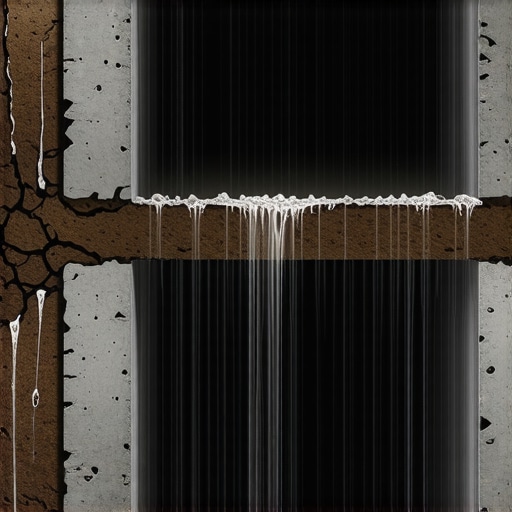
The homeowner thought it was just a hairline crack. A thin, jagged line tracing the mortar joints of her 1950s bungalow basement. But when I put my scope inside that void, I saw the structural steel was rusted to dust, and the interior webbing of the concrete masonry units had turned into a damp, crumbling slurry. That is the calling card of the silent killer: hydrostatic pressure. As a third-generation mason, I have seen more foundations murdered by water than by any earthquake or storm. It is a slow, rhythmic crushing force that does not care about your property value or your fresh coat of paint. If you do not understand the physics of the soil pressing against your home, you are just waiting for the day the wall decides to walk across the floor.
The Weight of the World: The Physics of Hydrostatic Pressure
To understand why concrete block foundation repair is so common, you have to look at the dirt. In heavy clay soils, water does not just drain away. It sits. It clings to the particles. When that soil becomes saturated, it transforms from a solid mass into a liquid-heavy batter. Pure water weighs about 62.4 pounds per cubic foot. When you stack eight feet of that against a cellar wall, you are not just looking at dampness; you are looking at thousands of pounds of lateral force. This is hydrostatic pressure. It is the same force that makes a submarine creak. Your basement is essentially a submarine hull buried in the earth, and most of them were not built to withstand the depth. When the pressure exceeds the shear strength of the mortar joints, the wall bows. I have stood in basements where the center of the wall was pushed four inches inward. You can feel the tension in the air, a structural groan that tells you the emergency masonry repair bill is about to get very expensive.
“Water penetration is the single greatest threat to masonry durability.” – BIA Technical Note 7
When we talk about the “tooth” of the stone or the way a brick sucks the moisture out of the mud, we are talking about capillary action. But hydrostatic pressure is the aggressive older brother of capillary action. It does not wait for an invitation. It finds the microscopic fissures in your commercial masonry maintenance routine and exploits them. In a concrete block wall, the water fills the hollow cores. It sits there, stagnant, slowly dissolving the calcium hydroxide in the cement. This is a process called leaching. Over decades, the very glue holding the block together is washed away, leaving behind a brittle shell. If you are lucky, you get efflorescence—that white, salty powder. If you are unlucky, you get a blowout.
The Forensic Identification: Stair-Steps and Horizontal Blowouts
As a forensic inspector, I look for the story the cracks are telling. A vertical crack often means the footing has snapped due to settlement. But a horizontal crack? Especially one located three or four courses down from the surface? That is the classic sign of hydrostatic pressure. The wall is hinging. The weight of the wet earth is pushing the top of the wall in, while the floor slab holds the bottom in place. The middle has nowhere to go but forward. This is where professional masonry restoration becomes a game of inches. If the bow is less than two inches, we might save it with carbon fiber straps or fiber-reinforced mortars. Anything more, and you are looking at excavation and a total rebuild. I have seen “handyman specials” where someone tried to smear a little hydraulic cement over a hinging crack. It is like putting a Band-Aid on a compound fracture. Within one season, the pressure will pop that patch right off, often taking a chunk of the block face with it.
[IMAGE_PLACEHOLDER]
Let’s talk about the “mud.” In the old days, we used high-lime mortars. They were soft, flexible, and they could “self-heal” to an extent. Modern sustainable tuckpointing mortars are trying to get back to that chemistry, but most guys today are slapping down high-strength Portland cement that is harder than the block itself. In a hydrostatic environment, that is a recipe for disaster. When the wall shifts under pressure, the hard mortar does not give; it forces the block to crack. You want the mortar to be the sacrificial lamb. I always tell my apprentices: the mud should be the servant, not the master of the masonry.
The Chimney and the Retaining Wall: Gravity’s Other Victims
Hydrostatic pressure does not just live in the basement. It is the primary cause for failing retaining wall repair calls. People build these beautiful stone walls but forget the drainage. Without a proper gravel backfill and weep holes, that wall is just a dam. And dams eventually break. I have seen 50-ton walls tilted at a 15-degree angle because the “contractor” did not understand that water needs a path of least resistance. The same logic applies to chimney repair services. A chimney is a vertical pier exposed to the elements on all four sides. If the crown is cracked, water gets behind the bricks. In the winter, that water freezes and expands by 9%. It literally hammers the bricks apart from the inside. This is why tuckpointing curved walls on old chimneys or silos is such a specialized skill. You have to account for the radial tension and the way water migrates through the radius.
“The mortar shall be type S or N, depending on the lateral loads and environmental exposure.” – ASTM C270 Standards
When I am called for an outdoor fireplace rebuild, I am usually looking at a pile of soot and broken firebrick because someone used standard mortar instead of refractory mortar, or they didn’t account for the thermal expansion. But water is still the culprit. The moisture gets into the porous firebrick, turns to steam when the fire starts, and blows the face off the brick. It is all about the physics of expansion—whether it is from ice or steam or the raw weight of a rain-soaked backyard.
The Solution: Beyond the Band-Aid
So how do we fix it? You don’t fix hydrostatic pressure from the inside. That’s the biggest lie in the industry. Smearing waterproof paint on the interior of a leaking wall is like trying to stop a flood by holding your hand over a knothole. The water is still in the wall. The pressure is still there. To truly fix it, you have to go to the source. You excavate. You install a proper drainage plane. You use a dimpled membrane to create an air gap so the water falls straight down to a perimeter drain (a French drain) and gets pumped away. Only then can you talk about professional masonry restoration. We use fiber-reinforced mortars today because the micro-fibers act like tiny rebar, bridging the gaps and providing tensile strength that standard mud lacks. It is about creating a monolithic structure that can breathe but won’t buckle. When we are tuckpointing curved walls or restoring a historic facade, we are looking at the chemical compatibility of the materials. If I use a modern Type S mortar on a 100-year-old soft brick, I am signing that brick’s death warrant. The water will get trapped, freeze, and the brick will spall into dust.
The Hard Truth of Masonry
In this business, you are either doing it once or you are doing it twice. I have no patience for the “lick-and-stick” crews who think a bucket of mastic and some thin veneer stone makes them a mason. Real masonry is about managing the elements. It is about understanding that the earth is alive and it is always moving. Whether it is commercial masonry maintenance on a high-rise or a simple outdoor fireplace rebuild, the principles remain: respect the water, manage the pressure, and never trust a brick that doesn’t ring like a bell when you hit it with your trowel. If you see a crack, don’t wait. By the time it looks like a problem to you, it has been a catastrophe to the structural integrity of the wall for years. Get a hawk, get some mud, and get someone who knows the difference between a cosmetic fix and a forensic cure.