
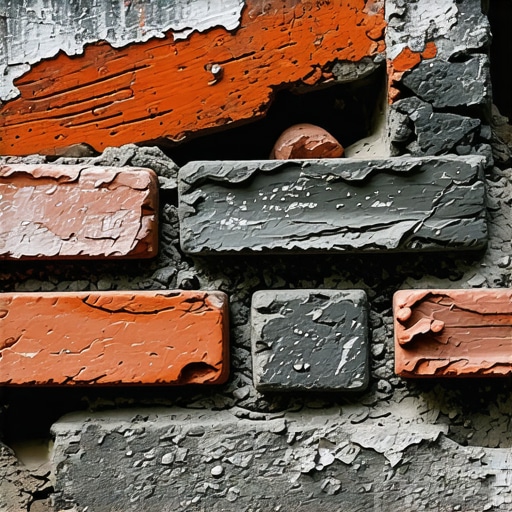
The Autopsy of a Crumbling Heritage
I was standing in a damp alleyway last October, looking at a Victorian-era load-bearing wall that had stood for 120 years until a ‘handyman’ decided to ‘fix’ it with three bags of high-strength Portland cement. When I pulled my inspection scope out of the cavity, I didn’t see solid masonry. I saw red dust. The homeowner thought they had a minor moisture issue; what they actually had was a structural corpse. The hard, grey mortar joints stood out like a proud grid, perfectly intact, while the faces of the bricks had sheared off and the interiors had turned to the consistency of brown sugar. This is the forensic reality of using modern mud on old bones. It is not just an aesthetic mistake; it is a slow-motion demolition of the property’s structural integrity.
The Physics of the Sacrificial Joint
To understand why hard cement kills old bricks, you have to understand the ‘Sacrificial Principle.’ In the world of historic stone facade restoration and brick maintenance, the mortar joint is intended to be the weak link. It is the gasket of the building. Before the mid-1940s, bricks were fired at lower temperatures in beehive kilns. This resulted in a ‘soft’ brick—highly porous and capable of significant thermal movement. The mortar used back then was primarily lime and sand. It was flexible, breathable, and, most importantly, softer than the brick itself.
“Mortar should always be weaker than the masonry units it binds. A mortar that is too strong will cause the masonry units to crack and spall during thermal expansion or structural settlement.” – ASTM C270 Standard Specification for Mortar for Unit Masonry
When you introduce a modern Type S or Type M mortar—loaded with Portland cement—you are inserting an unyielding, crystalline rock into a flexible system. Modern cement has a high Modulus of Elasticity. When the sun hits that wall and the bricks try to expand, the hard mortar won’t budge. The brick, being the softer material, is crushed against the mortar. This leads to vertical cracking and the dreaded ‘spalling,’ where the face of the brick literally pops off because it has nowhere else to go. I’ve seen brick quoin repair jobs where the corners of the building were literally exploding because the ‘structural repointing’ was done with a mix that was harder than the stone it was supposed to protect.
The Vapor Trap: Why Breathability is Life
Old masonry is a living, breathing sponge. It takes in moisture and it breathes it out. This is ‘hydrostatic equilibrium.’ Lime mortar is an open-pore material that facilitates this ‘wicking’ effect. If water gets into the wall, it travels through the brick and exits through the lime mortar joints. However, modern Portland cement is nearly waterproof. When you butter a joint with hard cement, you are effectively sealing the exit door. The water gets trapped behind the mortar. In a Northern frost-belt, this is a death sentence. As that trapped water hits 32 degrees Fahrenheit, it undergoes its 9% volume expansion. Since it can’t push through the hard cement ‘mud,’ it exerts internal pressure on the brick. The result? The brick face shatters, exposing the soft, under-fired interior to the elements, accelerating the decay until you need a full-scale stone facade restoration or a complete teardown.
The Chimney and the Crown: Where Gravity Meets Chemistry
I often see the worst of this during chimney crown repair. The crown is the first line of defense, but when a ‘lick-and-stick’ contractor uses a standard concrete mix without proper expansion joints or drips, the water enters the stack. If the stack has been repointed with hard cement, the moisture is driven inward, rotting the liners and causing the brick veneer installation on the exterior to bulge. We call this ‘masonry heart rot.’ The same physics apply to retaining wall batter correction. If a retaining wall is leaning, it’s often because hydrostatic pressure is building up behind a face that has been sealed with non-breathable mortar. Without proper drainage and a flexible mortar, the wall will eventually succumb to the weight of the saturated earth. In these cases, we often have to look at retaining wall geogrid installation to provide the structural tension that the failing masonry can no longer provide.
The Myth of the Tuckpointing Machine
In recent years, I’ve seen an influx of tuckpointing machine services promising speed and ‘seamless’ finishes. While a grinder with a vacuum shroud is great for raking out joints, the application of the new mortar is a craft, not a race. You can’t just spray modern cement into an old wall and call it a day. Proper structural repointing requires the ‘hawk’ and the ‘slicker.’ It requires hand-compacting the lime-based mud into the joint in ‘lifts’ or layers to ensure there are no voids or honeycombing. If you see a contractor ‘buttering’ the bricks with a thick, wet slurry of grey cement, fire them on the spot. They are essentially applying a metallic masonry finishes mindset to a breathable clay system, and you’ll be paying for it in five years when the spalling starts.
“Water penetration is the single greatest threat to masonry durability. The use of incompatible mortar is the second.” – BIA Technical Note 7: Water Resistance of Brick Masonry
The Aesthetics of Failure: Staining and Quoins
It’s not just structural; it’s visual. Modern cement leaches salts—a process called efflorescence. If you’ve ever seen a beautiful old building covered in white, powdery streaks, you’re looking at the chemistry of Portland cement reacting with moisture. People try to hide this with masonry staining, but that’s just putting makeup on a wound. You have to fix the source. When we perform brick quoin repair, we are often undoing decades of these ‘quick fixes.’ We have to carefully grind out the hard cement without nicking the ‘tooth’ of the original brick, then color-match a traditional lime-putty mix that will allow the building to move and breathe again.
Doing It Once vs. Doing It Twice
The cynical truth of the masonry trade is that it’s easier to do it wrong. It’s easier to buy a $6 bag of Type S than it is to slake lime for three months. But as a forensic inspector, I see the price of that shortcut. Whether it’s retaining wall batter correction or a simple porch repair, the physics of the materials will always win. You can’t fight the expansion of water or the movement of the earth with a bag of cheap cement. You have to respect the materials. Do it once with the right mud, or do it twice and lose half your bricks in the process. Old masonry doesn’t need to be ‘reinforced’ with hard cement; it needs to be understood and maintained with the same logic that built it a century ago.