
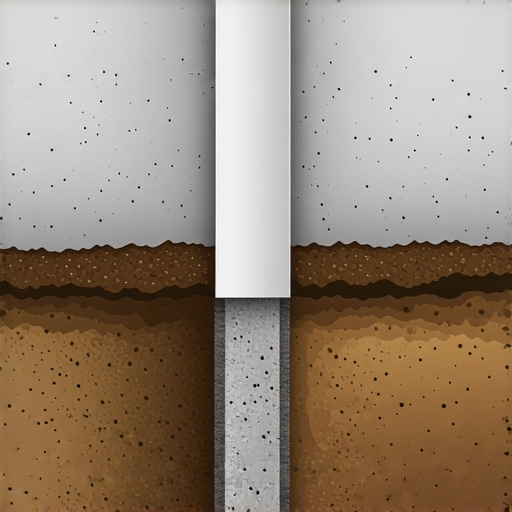
The forensic scene was one I had walked into hundreds of times in the Rust Belt, but this particular basement in a 1958 ranch-style home had a specific stench of damp lime and impending structural failure. The homeowner, a man who clearly spent too much time listening to ‘handyman’ podcasts, thought it was just a hairline crack caused by the house stretching its legs. But when I put my high-definition bore scope inside the horizontal fissure running along the third course of block, I didn’t see solid concrete. I saw structural steel that had been oxidized to a fine orange dust, and the webs of the hollow-core blocks were crushed like eggshells. The wall wasn’t just cracking; it was buckling under a load it was never designed to carry. The middle of that eighty-foot run was pushed inward by nearly four inches, while the corners remained stubbornly plumb. This is the reality of foundation physics: the center is always the first to surrender.
The Structural Physics of the ‘Beam’ Analogy
To understand why a foundation wall bows in the middle, you have to stop thinking of it as a wall and start thinking of it as a vertical beam. In masonry engineering, a wall is supported at its base by the footer and at its top by the floor joists of the house. The corners of the foundation act as rigid piers, providing lateral stability because they are reinforced by the perpendicular walls. This creates a situation where the center of the wall is the furthest point from any rigid support. When you apply lateral earth pressure—the weight of the soil and the water within it—the wall behaves exactly like a wooden plank being stepped on in the middle. The maximum bending moment occurs at the midpoint of the span. This is where the tensile stress exceeds the capacity of the mortar joints. Unlike modern brick veneer installation, where the brick is mostly aesthetic, a foundation wall is a load-bearing beast that has to fight the earth every second of the day. When the ‘mud’—what we call mortar—starts to fail, the wall loses its ability to transfer those loads.
“Water penetration is the single greatest threat to masonry durability, as it initiates the hydrostatic pressure that leads to structural displacement.” – BIA Technical Note 7
The Relentless Force of Hydrostatic Pressure
In regions with heavy clay soils, the pressure against a foundation isn’t static. It’s a pulsating, growing force. Clay is a sponge. When it rains, the soil particles swell, a process known as adsorption at the molecular level. This expansion creates hydrostatic pressure. Think of it like a car parked against your basement wall, constantly revving its engine to push the blocks inward. If you haven’t invested in stone wall repair or proper drainage, that water has nowhere to go. It sits against the block, soaking into the pores. In northern climates, the freeze-thaw cycle turns this water into ice, which expands by 9%. This ‘frost heave’ doesn’t just push down; it pushes sideways. Over fifty years, those thousands of freeze-thaw cycles act like a slow-motion sledgehammer. This is why chimney flashing repair and gutter maintenance are actually foundation strategies—if the water doesn’t stay away from the house, the foundation is doomed. I’ve seen walls where the crumbling mortar joint repair was ignored for so long that the water was literally jetting through the wall during a spring thaw.
The Chemistry of Mortar Failure
When I’m performing historic tuckpointing on a pre-1940s home, I’m often dealing with lime-based mortars. These are ‘soft’ and can move a bit with the house. But most bowing walls I see are mid-century Portland cement jobs. Portland is hard and brittle. When the wall starts to flex even a fraction of an inch, the Portland doesn’t give; it snaps. This creates the classic ‘stair-step’ crack near the corners or the long horizontal crack in the middle. Once that crack opens, the ‘tooth’ of the mortar is gone. The mechanical bond is broken. At this point, no amount of advanced masonry adhesives or stone veneer repair will save the structure. You are no longer looking at a cosmetic fix; you are looking at a forensic intervention. You have to understand the suction of the block—how it pulled the moisture out of the mud when it was first laid. If the original mason didn’t ‘butter’ the head joints properly, or if they used a ‘hot’ mix that dried too fast, the wall was born with a death sentence. Masonry cleaning won’t help here; you need steel or carbon fiber.
“The selection of mortar type should be based on the structural requirements and the physical properties of the masonry units being used.” – ASTM C270 Standard Specification
Modern Solutions: The Band-Aid vs. The Cure
When the wall is bowing, homeowners often ask about chimney interior parging or porous stone sealers as if a coat of paint will stop the earth. It won’t. If the bow is less than two inches, we can often use carbon fiber straps. These are high-tensile strength ribbons that we ‘butter’ onto the wall with epoxy. They have a tensile strength ten times that of steel, and they stop the wall from flexing further. But if the wall has moved beyond that, you’re looking at helical piers or I-beams. We have to excavate the exterior, push the wall back into place—which is a terrifying thing to watch if you don’t know what you’re doing—and then waterproof the exterior. This is where we see the value of stone wall repair techniques applied to modern concrete. We have to ensure the base is stable and the drainage is clear. Without a 4-to-8-inch gravel base and a working French drain, you’re just throwing money into a hole in the ground.
The Final Word on the Job Site
Don’t be fooled by a ‘slicker’ tool and a fresh coat of parging. A bowing wall is a symptom of a deeper war between your home and the geology of your lot. If you ignore the signs—the sticking doors upstairs, the horizontal cracks at the frost line, or the dampness that smells like an old tomb—the soil will eventually win. You do the job once, or you do it twice. And doing it twice usually involves a bulldozer and a much larger checkbook. Keep your gutters clean, seal your masonry with porous stone sealers, and for heaven’s sake, if you see a crack that you can fit a nickel into, call someone who knows the difference between a ‘cold joint’ and a structural failure.