
The Forensic Reality of the ‘Smear Job’
I recently walked onto a job site where a homeowner was distraught over a chimney that had been ‘repaired’ only three years prior. To the untrained eye, it looked like the mortar was just falling out. But when I pulled my magnifying scope and a cold chisel from my kit, the truth was far more sinister. The previous contractor hadn’t performed full repointing services; they had performed a ‘smear job’—applying a thin veneer of high-strength Portland cement over the top of crumbling, historic lime mortar. This lack of depth created a moisture trap that was literally detonating the brick from the inside out. The hairline cracks weren’t just aesthetic; they were the gasps of a structure that could no longer breathe. This is the hallmark of a failed repair, and it is why deep grinding isn’t just a recommendation—it is a physical necessity for the survival of the wall.
“Mortar should always be weaker than the masonry units it binds, acting as a sacrificial element that allows for moisture movement and thermal expansion.” – BIA Technical Note 7B
The Physics of the Bond Line and the ‘Tooth’
When we talk about tuckpointing brick walls, we are dealing with the science of mechanical adhesion. In my three decades on the scaffold, I have seen too many ‘handyman specials’ where the new mud is buttered over the old joint like frosting on a cake. This fails because of a lack of ‘tooth.’ To get a bond that lasts fifty years instead of five, you have to excavate the rot. Deep grinding—typically to a depth of 3/4 inch or until you hit sound mortar—is the only way to create a clean, square-sided channel. This channel allows the new sustainable tuckpointing mortars to sit deep within the masonry, creating a massive surface area for the mortar to grip. Without this depth, the new mortar has no structural integrity and will eventually delaminate during the first heavy freeze-thaw cycle. In cold climates, water penetrates the micro-gap between the old and new material, expands by 9% as it turns to ice, and pops the new mortar right out of the joint.
The Chemical War: Portland vs. Lime
For buildings constructed before the mid-20th century, the material science is critical. These structures were built with soft, porous bricks designed to work with lime-based mortars. If you use a modern, hard Type S mortar without grinding out the old stuff, you create a ‘hard point.’ As the building shifts and breathes with the seasons, the soft brick is crushed against the rigid, unyielding cement. I have seen soldier courses snapped in half because someone used a mortar that was too ‘strong.’ Real restoration requires understanding the carbonation process. Lime mortar cures by absorbing CO2 from the atmosphere over months, staying flexible and ‘self-healing.’ Modern cement ‘flashes’ or sets through a rapid chemical hydration that makes it brittle. Deep grinding ensures that when we re-fill those joints, the new material has enough mass to cure slowly and bond chemically to the remaining historic substrate.
Chimneys and the High-Heat Challenge
Chimneys are the most abused masonry on any home. They are attacked by acidic flue gases from the inside and lashing rain from the outside. A proper chimney crown repair is useless if the joints below it are failing. When we perform a chimney heat shield installation, we often find that the internal masonry is more compromised than the exterior. This is where masonry birdsmouth cuts and precision grinding become vital. If the joints aren’t ground out deep enough to accept a high-heat resistant mortar, the thermal expansion from the fireplace will cause the exterior brickwork to buckle. We often apply brickwork sealants application only after the carbonation of the new mortar is complete; sealing a fresh joint too early traps moisture and leads to sub-florescence—the crystallization of salts behind the brick face that causes spalling.
“The durability of a masonry wall is fundamentally dependent on the integrity of the mortar joints and their ability to shed water.” – ASTM C270 Standards
The Hardscape and Retention Connection
The same forensic principles apply to the ground. A retaining wall drainage upgrade is the only way to save a leaning wall, but the masonry itself must be sound. If the joints in a stone or brick retaining wall are failing, hydrostatic pressure will push water through the wall. If those joints were ‘pointed’ without deep grinding, that water pressure will simply blow the face of the mortar off. We see this often in ‘honeycombing’—where the interior of the wall has turned to dust while the exterior looks fine. It takes a slicker and a hawk, and a lot of patience, to pack that mud back in 1/4 inch at a time, but it’s the only way to ensure the wall doesn’t become a pile of rubble. Whether it’s masonry staining to hide the scars of a repair or a full-scale restoration, skipping the grind is just a way of scheduling your next repair for next year.
Tools of the Trade: Beyond the Grinder
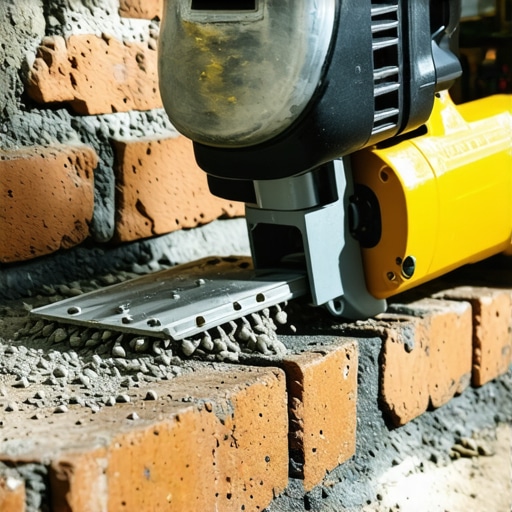
Deep grinding isn’t just about making dust; it’s about preparation. We use vacuum-shrouded diamond blades to ensure we don’t damage the ‘skin’ of the brick. After grinding, the joints must be washed to remove every speck of dust. If you butter a dusty joint, you’re just applying mortar to a layer of ball bearings. The ‘suction’ of the brick must be managed—too dry, and it steals the water from the mortar (burning it); too wet, and the mortar won’t stick. It’s a delicate dance that separates the masters from the ‘blow-and-go’ crews. Every tuck pointing services contract should specify the depth of the grind. If they don’t mention it, they aren’t doing the job right. Do it once, or do it twice. In the world of masonry, there is no middle ground.