
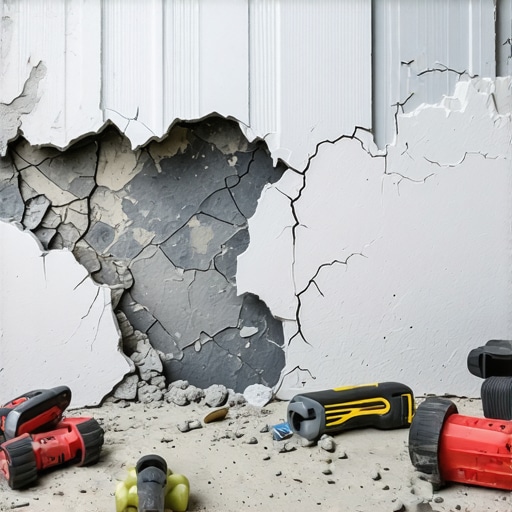
The Autopsy of a Failing Parge Coat
The homeowner thought it was just a hairline crack. But when I put my scope inside the hollow cell of that Concrete Masonry Unit (CMU), I saw the structural steel was rusted to dust. This is the reality of forensic masonry. You see a little bit of flaking ‘mud’ on the exterior—what the greenhorns call ‘cosmetic peeling’—and you realize the entire vertical structure is essentially a slow-motion shipwreck. CMU parging, that thin layer of cementitious material applied to the face of a block wall, is often the first thing to fail and the last thing people understand. I’ve spent forty years watching guys ‘butter’ a wall with a mix that’s too hot, over-tooling it until they’ve killed the suction, and then wondering why the whole face pops off after the first hard frost. To understand why your parging is falling off in sheets, you have to stop looking at it as a decoration and start looking at it as a semi-permeable membrane caught in a war between soil chemistry and atmospheric pressure.
The Physics of the Failure: Why the ‘Tooth’ Matters
Parging fails because of a breakdown in the mechanical and chemical bond. When you apply a parge coat to a CMU foundation or a retaining wall, you are relying on the ‘tooth’ of the block—the microscopic pores that allow the wet cement slurry to penetrate and lock into the substrate. If the block is too smooth, or if it’s been tainted by old porous stone sealers or dirt, the mud has nothing to grab. But the real killer is vapor drive. In the North, where the freeze-thaw cycle is a seasonal hammer, water migrates from the high-pressure side (the saturated soil behind the wall) to the low-pressure side (the air). If you’ve slapped a dense, non-breathable Portland-heavy parge on the outside, that water gets trapped behind the coating. When that water hits 32 degrees Fahrenheit, it expands by 9 percent. That expansion force is greater than the tensile strength of the mortar bond. The result? The parge coat delaminates, often taking a thin layer of the CMU face with it. This is why retaining wall block replacement becomes a structural necessity rather than a choice; once the face of the block is compromised, the structural integrity of the wall begins to crumble.
“Water penetration is the single greatest threat to masonry durability. Proper drainage and moisture management are not optional; they are the foundation of all masonry design.” – BIA Technical Note 7
The Anatomy of Hydrostatic Pressure and Poor Drainage
I’ve walked onto job sites where the modular retaining walls looked like they were breathing—bowing out in the center because the contractor ignored the weep holes. Parging a wall that has high hydrostatic pressure behind it is like trying to paint a balloon while someone is blowing it up. The pressure will find the weakest point. Usually, that’s a foundation crack repair that was handled with a cheap ‘handyman special’ epoxy injection instead of addressing the root cause. If the soil isn’t draining, the water stays against the block. CMU is essentially a sponge. It wicks that moisture upward through capillary action. This is why you see white, crusty powder—efflorescence—on the parge coat. Those are mineral salts being carried by water. As the water evaporates, the salts crystallize and grow, creating ‘subflorescence’ that physically pushes the parge away from the block. Without retaining wall weep hole cleaning and a proper gravel backfill, no amount of ‘mud’ is going to stay stuck. You aren’t just fighting gravity; you’re fighting the weight of the earth and the chemistry of the water table.
The Chemistry of the Mud: Portland vs. Lime
Modern ‘lick-and-stick’ crews love a high-Portland mix because it sets fast. But high-Portland mixes are brittle and too dense. I tell my apprentices that the mortar should always be slightly softer than the unit it’s sticking to. This is the sacrificial principle. In outdoor masonry fountain restoration, for example, if you use a mix that’s too hard, the expansion of the stone will crack the mortar, or worse, the mortar will crack the stone. For CMU parging, you need a mix that can handle the ‘suction’ of the block. If the block is dry, it will suck the hydration water out of your parge coat before the cement crystals can properly form. This leads to ‘flash setting’ or ‘burning’ the mix. The parge looks fine for a month, then you touch it and it turns to powder. You have to ‘pre-wet’ the wall to control that suction, ensuring the hydration process—the chemical reaction between water and cement—happens at a controlled rate, forming a dense matrix of calcium silicate hydrate. This is the same logic we apply to concrete flatwork services; if the subbase steals the water from the slab, the finish will be garbage.
“The strength of a masonry wall is dependent not only on the units and the mortar but on the bond between them, which is influenced by the water-retention of the mortar and the initial rate of suction of the masonry unit.” – ASTM C926 Standard Specification for Application of Portland Cement-Based Plaster
The Forensic Fix: Beyond the Band-Aid
Fixing a failing parge coat permanently requires more than just a masonry cleaning and a new layer of mud. You have to go forensic. First, we strip the old, failing material back to a sound substrate. We use a hawk and trowel to apply a ‘scratch coat’ with a high lime content to allow for vapor transmission. We don’t just ‘butter’ it on; we work it into the pores. If the wall is showing signs of movement, we look at the chimney cap replacement or the roofline to ensure water isn’t dumping into the wall from above. Vertical cracks are addressed with helibar reinforcement or deep-injection foundation crack repair techniques that actually bridge the gap rather than just hiding it. We often integrate masonry waterproofing solutions that are silane or siloxane-based, which are vapor-permeable. They let the wall ‘breathe’ out while preventing liquid water from driving in. This is critical for preventing the ‘honeycombing’ effect where the interior of the concrete begins to degrade from constant saturation.
Execution and the Master’s Touch
When you’re finally ready to lay the finish coat, you have to watch the weather. If it’s too hot, the sun will ‘burn’ your mud. If it’s too cold, the hydration stops and the water freezes, ruining the bond. We use a slicker to finish the joints and ensure a tight seal at the grade line. A soldier course of brick at the top might look nice, but if the flashing isn’t right, it’s just a gutter for water to enter the CMU cells. Every step—from the retaining wall weep hole cleaning to the final strike of the jointer—is about controlling the movement of water. In this trade, you either respect the physics, or the physics will tear your work apart. You don’t want to be the guy who has to explain why a $20,000 wall is flaking off like a cheap sunburn after three winters. Do it once, do it right, and remember that the ‘mud’ never lies. It tells the story of how much you cared about the prep work long after you’ve left the job site.