
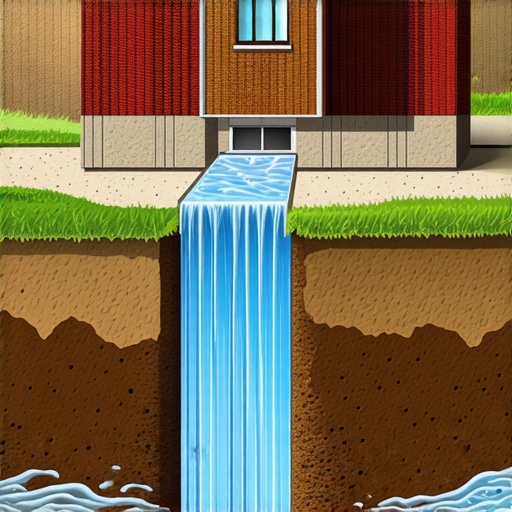
The homeowner stood in a damp basement in the dead of spring, pointing at a hairline fracture that ran the length of the north wall. They thought it was a settling issue, a minor cosmetic flaw that could be hidden with a coat of waterproof paint or perhaps some stone veneer over brick to modernize the space. But when I pulled my plumb bob and aligned my laser level, the truth was uglier. The center of that eight-foot wall was leaning two inches into the room. I didn’t need to see the outside to know the story; I could smell the anaerobic decay of saturated soil. When I put my borescope into a core-drilled hole, I didn’t just see damp blocks—I saw horizontal reinforcement steel that had been reduced to orange dust, sacrificed to the relentless chemistry of groundwater. This wasn’t just a crack; it was a structural surrender.
The Physics of the Invisible Push
Bowing foundation walls are rarely the result of a bad batch of mud or a lazy mason. They are the physical manifestation of hydrostatic pressure, a force so powerful it can lift entire skyscrapers if not managed. To understand why your wall is turning into a sail, you have to micro-zoom into the soil mechanics. Imagine the earth surrounding your home as a collection of microscopic voids. In dry conditions, these voids are filled with air. But during heavy rain or snowmelt, these voids fill with water. In heavy clay soils, the water molecules undergo a process called adsorption, where they bond to the surfaces of clay minerals like montmorillonite. This causes the soil to swell, increasing the lateral earth pressure from a manageable 30 pounds per square foot to a staggering 60 or 90 pounds. This water doesn’t just sit there; it exerts pressure in all directions, and your foundation wall is the only thing standing in its way.
“Water penetration is the single greatest threat to masonry durability. Hydrostatic pressure can exceed the structural capacity of an unreinforced masonry wall, leading to lateral displacement and eventual failure.” – BIA Technical Note 7
In regions where the freeze-thaw cycle is a seasonal reality, this pressure is amplified by the expansion of ice. When that saturated soil freezes, the water trapped in the pore spaces expands by approximately 9%. This isn’t a gentle push; it’s a hydraulic ram. If your exterior drainage is clogged or non-existent, the wall is caught in a vice between the expanding frozen earth and the static interior air. This is why we often see horizontal cracking approximately three to four feet below grade—right at the frost line.
The Crack Whisperer: Reading the Failure
As a forensic mason, I look at cracks like a doctor looks at an X-ray. A vertical crack often tells a story of differential settlement—one corner of the house is sinking faster than the rest. A stair-step crack usually follows the mortar joints and suggests that the footing is dropping. But a horizontal crack? That’s the calling card of lateral pressure. It means the wall is literally snapping in half. The top of the wall is held in place by the floor joists of the house, and the bottom is pinned by the concrete floor slab. The middle, however, has nowhere to go but inward. When we perform brick wall restoration on these structures, we aren’t just buttering the joints with new mud; we are addressing the catastrophic failure of the masonry unit’s flexural tension strength.
The “Lick-and-Stick” Trap and Modern Failures
I have a particular disdain for the modern trend of applying stone veneer over brick as a way to hide these structural screams. It’s the ultimate handyman special. You take a wall that is already struggling to breathe under hydrostatic load and you smother it with a non-breathable polymer-modified mortar and fake stone. This traps moisture inside the original brickwork, accelerating the spalling process. True masonry requires a drainage plane. Without it, you’re just building a vertical swimming pool. For commercial masonry facade maintenance, we see this often in poorly executed structural repointing where a hard Portland-based cement is shoved into joints of soft, historic brick. The moisture cannot escape through the mortar, so it forces its way through the brick face, blowing it off in a process we call spalling. For a chimney, this leads to the need for immediate chimney flashing repair or a full chimney flue liner installation to prevent carbon monoxide and moisture from migrating into the living space.
The Remedy: From Band-Aids to Cures
How do we fix a wall that has lost its fight with the earth? Some folks will try foundation slab jacking if the floor is heaving, but for a bowing wall, you need to counteract the lateral load. In the trade, we talk about the “cure” versus the “Band-Aid.” An epoxy injection is a Band-Aid. It might stop a leak for a season, but it does nothing to stop the earth from pushing. The cure involves relieving the pressure. This means excavating the exterior, replacing the heavy clay with a free-draining aggregate, and installing a proper French drain. For the wall itself, we often use carbon fiber straps or helical piers. Carbon fiber is a marvel of sustainable masonry materials; it has a tensile strength ten times that of steel and can be bonded to the interior face of the wall to provide the tension resistance the masonry lacks. Once the wall is stabilized, we can perform structural repointing, using a slicker to strike the joints and ensure a weather-tight finish. We might even look at the surrounding hardscape. A wavy, sunken driveway often contributes to foundation issues. Proper brick paver driveway repair involves a deep, compacted base—at least 8 inches of crushed stone—to ensure water moves away from the foundation rather than pooling against it.
“Mortar should always be weaker than the masonry units it binds, acting as a sacrificial element to accommodate movement and moisture vapor transmission.” – ASTM C270 Standard Specification
The Reality of Commercial Maintenance
In the world of commercial tuckpointing and large-scale facade work, the stakes are even higher. A bowing wall on a three-story brick warehouse isn’t just a wet basement; it’s a public safety hazard. We look for honeycombing in the concrete or cold joints where the pour was interrupted, creating a weak point for water to exploit. A soldier course of brick at the top of a wall might look decorative, but if the flashing above it fails, it becomes a funnel for water. This is why commercial masonry facade maintenance must be proactive. You don’t wait for the bow to become visible to the naked eye. You use thermal imaging and moisture meters to find the hydrostatic hotspots before the steel begins to rust and the brick begins to dance. Do it once, or do it twice—that’s the mason’s motto. If you don’t respect the physics of water, the earth will eventually reclaim your work.