
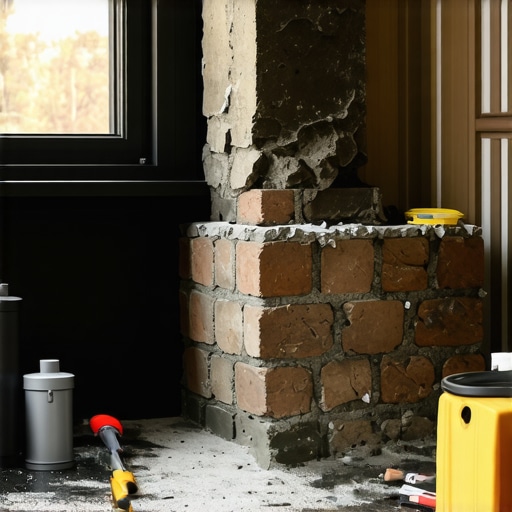
The Forensic Scene: When the Smoke Reveals the Invisible
The homeowner thought it was just a hairline crack near the crown. A bit of weathering, she called it. But when I fired up the smoke candles in the hearth and sealed the top of the flue, the truth didn’t just whisper; it screamed. Within three minutes, thick gray plumes weren’t just exiting the chimney cap—they were ghosting through the floorboards in the attic and seeping through the mortar joints of the exposed brick in the master bedroom. That is the forensic reality of a failing chimney. When I put my digital scope inside that dark, soot-caked void, I didn’t see solid masonry; I saw structural steel that had rusted to a fine orange dust and lime mortar that had the consistency of wet flour. This is where chimney structural repair stops being an aesthetic choice and starts being a life-safety requirement.
The Chemistry of Decay: Why Old Chimneys Fail
To understand why an old chimney begins to leak smoke, you have to micro-zoom into the material science of early 20th-century masonry. Most historic chimneys were built with soft-fired clay bricks and high-calcium lime mortars. These materials were designed to be breathable, allowing moisture to migrate in and out. However, a chimney is a unique chemical reactor. Every time you burn wood, you release water vapor, carbon dioxide, and sulfur dioxide. When these gases cool below their dew point—usually on the interior face of the masonry—they condense into a mild sulfuric acid. Over eighty years, that acid eats the ‘tooth’ out of the mortar. The calcium hydroxide in the lime mortar reacts with the sulfur to form gypsum. Here is the kicker: gypsum has a higher molecular volume than the lime it replaces. It expands, creates internal pressure, and eventually causes the mortar to crumble into the flue, leaving the bricks ‘floating’ without a seal. This is where brick wall restoration becomes a surgical process rather than a simple patch job.
“Water penetration and the subsequent chemical attack from combustion by-products are the primary catalysts for masonry degradation in residential chimneys.” – BIA Technical Note 19B
The Parging Solution: Applying the Hidden Armor
Interior parging is the process of applying a thin, smooth coat of high-performance mortar mixes to the inside of the flue or the smoke chamber. Think of it as ‘buttering’ a giant, vertical loaf of bread from the inside out. We don’t just use standard masonry cement for this. In a historic restoration context, we utilize sustainable masonry materials like fiber-reinforced mortars that can handle the extreme thermal shock of a 1000-degree fire followed by a 20-degree winter night. This ‘mud’ has to have incredible suction to bond to old, soot-stained bricks. We start by scutching the interior surface to remove loose debris, then we apply the parge coat using a long-handled ‘hawk’ and a specialized ‘slicker’ tool. This creates a monolithic, gas-tight barrier that prevents those acidic condensates from ever touching the structural brick again.
The Problem with Modern Fixes: Why Stone Veneer over Brick Fails
I often see ‘handyman specials’ where a contractor has tried to hide a crumbling chimney by slapping stone veneer over brick. This is a forensic nightmare. Stone veneer is often applied with high-strength Type S Portland cement, which is far harder and less permeable than the original historic brick. This creates a vapor barrier. Moisture gets trapped between the old brick and the new stone. In a northern freeze-thaw cycle, that water expands by 9%, and because the Portland cement won’t budge, it forces the face of the historic brick to shear off. We call this spalling. You end up with a chimney that looks ‘new’ on the outside while the core is literally turning to mush. True chimney rebuild services focus on the structural integrity of the core, not just the ‘lick-and-stick’ cosmetics of the facade.
The Physics of the Crown: Chimney Cap Replacement
The top of the chimney—the crown—is its first line of defense. Most builders just slap a half-inch of leftover mortar on top and call it a day. That is a ‘cold joint’ waiting to happen. A proper chimney cap replacement requires a cast-in-place concrete wash with an overhanging drip edge. We use fiber-reinforced mortars here to prevent the shrinkage cracks that allow water to migrate down into the soldier course of the bricks. Without a proper drip edge, water runs down the face of the masonry, saturating the joints and leading to efflorescence—that white, salty staining that signals your mortar is leaching its minerals. If you see white stains, your chimney is effectively dissolving.
“The chimney crown shall be transitioned to a slope that sheds water away from the flue liner and the chimney masonry, utilizing materials that accommodate thermal expansion.” – ASTM C1283
The Sustainable Path: Sustainable Tuckpointing Mortars
When we move to the exterior, we talk about sustainable tuckpointing mortars. This isn’t just about the environment; it’s about the longevity of the structure. We use natural hydraulic lime (NHL) which re-absorbs CO2 as it cures, a process known as carbonation that can take years to fully complete. Unlike modern cement which is brittle, lime mortar is ‘self-healing.’ If a tiny micro-crack forms due to thermal expansion, water entering the crack dissolves a small amount of free lime, which then re-deposits and seals the crack as it dries. It’s a living material. For retaining wall reinforcement near the chimney base, we might integrate stainless steel helical ties, but the mortar itself must remain soft. The mortar is the sacrificial lamb; it is supposed to wear out so the bricks don’t have to.
The Master Mason’s Verdict: Do It Once, or Do It Twice
In the world of forensic masonry, there are no shortcuts. A smoke test doesn’t lie. If you see smoke where it shouldn’t be, your chimney’s structural ‘lung’ is compromised. Whether you are looking for chimney rebuild services or just need a chimney cap replacement, the focus must always be on the physics of moisture movement and the chemistry of the bond. Don’t let a general contractor ‘butter’ over your problems with a bag of cheap premix from a big-box store. Demand a high-performance mortar mix and a mason who knows the difference between a slicker and a jointer. Your house—and your lungs—will thank you.