
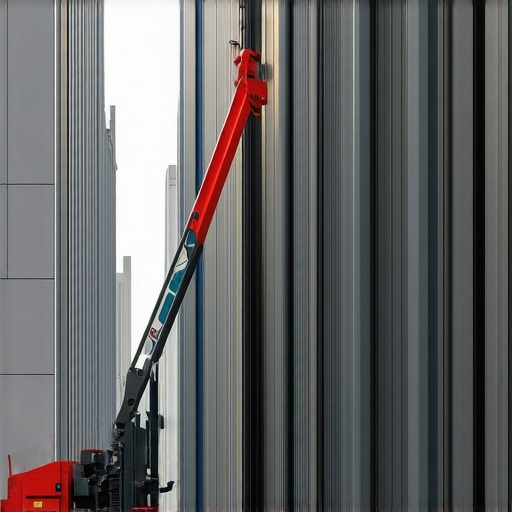
The alleyway was barely eight feet wide, a claustrophobic corridor of soot-stained brick and rusting fire escapes. In the North End of the city, where the foundations are older than the concept of electricity, I was called to a scene where a modern developer was about to commit a structural sin. He had a line pump hooked up to a ready-mix truck three blocks away, trying to force a high-PSI mix through three hundred feet of hose to pour a footer. I put my borescope into the adjacent property’s wall, a structure built in the late 1800s. What I saw through the lens was a forensic nightmare: the vibration from the improperly stabilized pump line was literally shaking the lime mortar into dust. The structural steel in the neighbor’s basement was rusted down to a skeletal remains, and the hydrostatic pressure from the wet pour was already starting to bulge a wall that hadn’t moved in a century. The homeowner thought it was just a hairline crack. But when I put my scope inside, I saw the structural steel was rusted to dust, and the ‘modern’ pumping technique was about to bring the whole house down like a deck of cards.
The Physics of the ‘Slick’ and the Slump
In the world of concrete flatwork services, the pump is often treated as a mindless beast. You feed it ‘mud,’ and it spits it out. But in tight urban spaces, the physics of friction and the chemistry of hydration become your masters. The secret to a smooth pour isn’t just more water—it’s the ‘slick.’ Before a single drop of concrete moves through that hose, you have to prime it with a lubricant, often a synthetic polymer or a bentonite slurry. Without this, the dry hose sucks the moisture right out of the leading edge of the concrete. This creates a ‘plug.’ When that plug hits a ninety-degree bend in a narrow alley, the pressure spikes. If you’re lucky, the pump stalls. If you’re unlucky, the hose whips and takes out a brick column repair job you just finished last week.
“The pumpability of a concrete mix is not solely a function of its water content, but rather the rheological properties of the cement paste and the grading of the fine and coarse aggregates.” – ACI 304.2R-17: Guide to Placing Concrete by Pumping
We have to look at the ‘tooth’ of the aggregate. For urban pumping, you can’t just throw in any old crushed stone. You need rounded river rock or carefully graded aggregate that allows the particles to roll over one another under pressure. We’re talking about the hydration process of tricalcium silicate (C3S). When you’re pumping concrete through a long line in the heat of a city summer, the friction generates internal heat. This accelerates the hydration, leading to ‘flash setting’ inside the hose. To combat this, we use superplasticizers—not just to make it flow, but to keep the water-to-cement ratio low enough that the final product doesn’t become a porous, crumbling mess in five years. This is critical when you are performing foundation helical pier installation, where the concrete cap must be dense enough to transfer thousands of pounds of structural load without cracking.
The Architecture of the Urban Pour
In the North, where the freeze-thaw cycle is a relentless enemy, the concrete we pump into these tight spaces has to be ‘air-entrained.’ We’re talking about billions of microscopic bubbles per cubic yard. When water enters the concrete and expands by its inevitable 9% during a freeze, these bubbles act as tiny expansion chambers. Without them, the face of your beautiful concrete flatwork services will spall and pop, leaving you with a surface that looks like a lunar landscape. I see it every day: ‘handyman specials’ where they used a standard bag mix for a sidewalk. One winter later, they’re calling me for a tuckpointing cost estimation because the salt-saturated runoff has eaten into the adjacent brickwork. Proper commercial masonry maintenance starts with understanding that concrete is a living, breathing sponge. If you don’t use porous stone sealers after the cure, you’re just waiting for the first frost to destroy your investment.
Repointing and the Sacrificial Principle
Urban masonry is a battle against the past. When we talk about full repointing services, we aren’t just slapping new mud into a joint. You have to understand the ‘suction’ of the old brick. If you’re working on a building from 1920, those bricks were fired in a kiln that didn’t reach the temperatures of modern manufacturing. They are soft and porous. If you use a modern Type S mortar—which is hard as a rock and rich in Portland cement—you will destroy that building. As the building expands and contracts, the hard mortar won’t budge. Instead, it will crush the edges of the soft brick. The mortar must always be the ‘sacrificial’ element. It’s meant to wear out so the brick doesn’t have to. For historic work, we mix a lime-rich ‘mud,’ sometimes even a pure lime putty, and we ‘butter’ the joints with the precision of a surgeon. We use a ‘slicker’ to pack the joint deep, ensuring there’s no ‘honeycombing’ where water can hide.
“Water penetration is the single greatest threat to masonry durability.” – BIA Technical Note 7
When I’m doing a chimney flashing repair, I’m looking for how the water sheds off the entire envelope. If the stone veneer repair on the facade was done with cheap ‘lick-and-stick’ methods, the water gets trapped behind the stone, rots the OSB sheathing, and eventually undermines the foundation. This is where retaining wall reinforcement becomes a forensic necessity. I’ve seen walls that were built without a single weep hole, holding back tons of saturated urban soil. The hydrostatic pressure builds until the wall bows. In those cases, we don’t just patch the crack; we install foundation helical pier installation to tie the structure back into stable soil and then pump a high-strength grout to fill the voids. It’s about ‘The Cure’ vs ‘The Band-Aid.’
The Gritty Reality of Urban Restoration
Managing commercial masonry maintenance in a city requires a cynical eye. You have to assume every previous contractor cut a corner. You look for the ‘cold joint’—that ugly line where one pour stopped and another started three hours later. In a tight urban space, if the pump truck gets delayed by traffic, that cold joint becomes a permanent fracture line. To prevent this, we use retarders in the mix to keep the mud ‘open’ longer. We also look at the brick column repair on old storefronts. Often, these columns are the only thing keeping the second-floor joists from pancaking. If the ‘soldier course’ of bricks at the top is leaning out, it means the steel lintel behind it has expanded due to rust—a phenomenon we call ‘oxide jacking.’ You can’t just ‘tuckpoint’ that away. You have to stabilize the steel, treat it, and then rebuild. It’s about understanding the ‘tooth’ and the ‘bond.’ It’s about knowing that masonry isn’t just about what you see on the surface; it’s about the chemistry of the bond and the physics of the load. Do it once, or do it twice. In my family, we only do it once. We make sure the ‘mud’ is right, the ‘slick’ is ready, and the physics are on our side before we ever pull the trigger on that pump. Anything less is just a waste of good sand and cement. “