
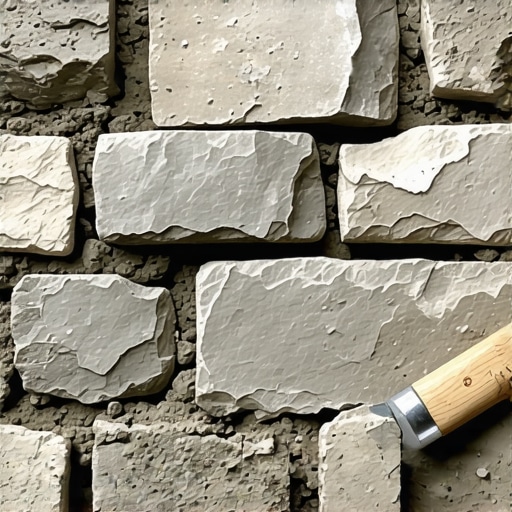
The Anatomy of a Failing Bond: A Forensic Discovery
The homeowner called me out because of a single hairline crack running through a limestone lintel, but when I pushed my fiber-optic scope into the void behind the facade, the reality was much grimmer. I didn’t see solid backup; I saw the ghosts of a hundred years of moisture. The structural steel was rusted to a fine orange dust, and the internal masonry wythes had separated completely because a previous ‘handyman’ had tried to patch the joints with high-strength modern cement. That ‘fix’ acted like a dam, trapping water inside the wall and rotting the building from the inside out. In professional masonry restoration, the greatest enemy isn’t time—it’s the fundamental misunderstanding of how new mud bonds to old stone.
The Physics of the ‘Tooth’: Mechanical vs. Chemical Bonds
Getting new mortar to stick to a century-old substrate isn’t about glue; it’s about microscopic mechanical interlocking. When we talk about the ‘tooth’ of the stone, we are referring to the open pore structure that allows a cementitious slurry to penetrate and crystallize. If you’re dealing with historic brick salvage or ancient fieldstone, you aren’t just slapping mud on a surface. You are engineering a capillary bridge. The chemistry of adhesion relies on the suction of the masonry. If the stone is too dry, it ‘burns’ the mortar, sucking the hydration out before the crystals can grow. If it’s too wet, you get a cold joint where the mortar simply floats on a film of water, never finding its grip. This is the delicate dance of the hawk and trowel.
“Water penetration is the single greatest threat to masonry durability, and the bond between mortar and unit is the primary line of defense.” – BIA Technical Note 7
The Sacrificial Principle: Why Softer is Stronger
Most modern contractors make the fatal mistake of thinking harder is better. They use Type S or even straight Portland cement on a brick arch restoration, thinking they are adding strength. They are actually signing a death warrant for the stone. In historic work, the mortar must always be softer than the surrounding units. This is known as the sacrificial principle. The mortar is designed to breathe, to move, and eventually to fail so that the stone doesn’t have to. When you use a hard, brittle mortar on soft historic stone, the stone becomes the weakest point. During thermal expansion, the stone can’t push against the mortar, so it spalls—popping its face off in a tragic display of material mismatch. This is why mortar matching services are not a luxury; they are a forensic necessity to determine the exact ratio of lime, sand, and cement required to mimic the original physical properties.
Tuckpointing Machine Services and the Art of the Joint
When we move into large-scale projects like commercial smokestack repair, the scale of adhesion becomes a vertical nightmare. You cannot rely on hand-buttering alone when you’re 200 feet in the air facing high-velocity winds and extreme thermal cycling. This is where tuckpointing machine services come into play, utilizing pneumatic pressure to drive the mud deep into the prepared joints. But the machine is only as good as the prep. You have to grind out the old, failing material to a depth of at least twice the width of the joint. You can’t just ‘skin coat’ it. If you don’t provide enough depth, the new mortar has no ‘body’ to hold onto, and it will peel off like a scab within two winters. We call this ‘honeycombing’ when the interior of the joint is hollow, leaving a perfect pocket for water to freeze and expand.
The Critical Role of Moisture Management
Adhesion fails when hydrostatic pressure builds up behind the wall. I’ve seen brick quoin repair jobs where the corner of the building literally sheared off because the internal moisture had nowhere to go. This is often the result of neglecting the small things, like retaining wall weep hole cleaning. If the water can’t get out, it will push the wall over, regardless of how good your bond is. For brick veneer installation, we ensure a clear drainage plane. For historic stone, we rely on the vapor permeability of lime-based mortars. Unlike modern plastic-heavy ‘lick-and-stick’ stone, real masonry needs to sweat. If you choke that breathability with waterproof sealants or hard mortars, you are creating a pressure cooker.
“The mortar shall be as weak as possible, consistent with the required strength and durability of the masonry.” – ASTM C270 Standard Specification
Advanced Restoration: Chimneys and Arches
When performing chimney structural repair, the science of adhesion is complicated by the presence of acidic soot and extreme temperature fluctuations. The ‘mud’ has to survive the freeze-thaw cycles on the outside and the heat-thaw cycles on the inside. This requires a specific lime-rich mix that can self-heal. Small cracks in lime mortar can actually reseal themselves through a process of carbonation, where the lime reacts with CO2 to form new calcium carbonate crystals. You won’t get that from a bag of pre-mixed big-box store concrete. Similarly, in a brick arch restoration, the soldier course and the key stone rely on the friction and the bond to keep the entire structure from collapsing under its own weight. We ‘butter’ each brick with precision, ensuring 100% coverage on the bed joints to avoid any point-loading that could crush the unit.
The Verdict of the Trowel
At the end of the day, masonry is a battle against the elements. You can’t cheat the physics of suction and expansion. Whether you are performing a delicate brick quoin repair or an industrial-scale commercial smokestack repair, the rules remain the same: Respect the substrate, match the strength, and manage the water. Don’t be the guy who leaves a trail of ‘lick-and-stick’ failures for the next generation to clean up. Do it once, do it right, and let the stone ring when you tap it. If you’re looking for a shortcut, you’re in the wrong trade. Real masonry takes time, it takes grit, and it takes a deep understanding of the invisible forces that hold our world together.