
The Forensic Scene: When ‘Pitting’ is a Warning Shot
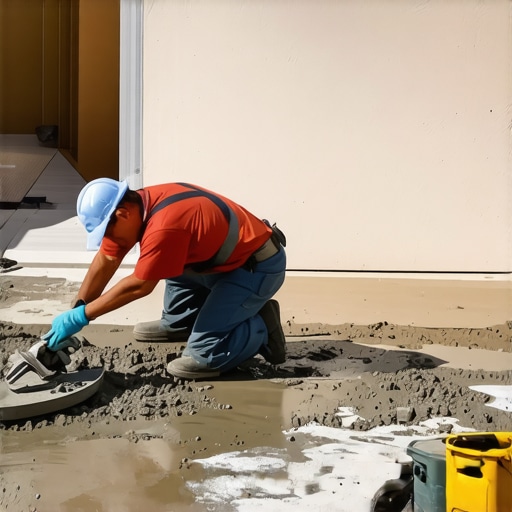
I stood on a driveway last November in the freezing drizzle, looking at what the homeowner called ‘a bit of character.’ To the untrained eye, it was just a few pits and some flaky grey skin. But when I knelt down and scraped a coin across the surface, the concrete didn’t ring; it groaned. I saw the tell-tale sign of a structural catastrophe in slow motion: the aggregate was exposed, and the ‘cream’—that smooth, finished top layer of cement paste—was delaminating in sheets the size of silver dollars. This wasn’t just a cosmetic blemish. Beneath that surface, the very chemistry of the driveway was failing. I put my scope into a deeper fissure and saw that the moisture had reached the rebar, which was already beginning to bloom with the orange rot of oxidation. It’s a scene I’ve seen a thousand times, and it always starts with someone thinking a quick ‘patch’ will fix it. The reality of the most effective way to repair a spalled concrete driveway isn’t about hiding the damage; it’s about surgically removing the cancer and restoring the bond at a molecular level.
The Physics of the Freeze-Thaw War
In the North, we live in a combat zone. Every winter, your driveway undergoes hundreds of freeze-thaw cycles. Here is the micro-zoom on the physics: concrete is a porous sponge. When water enters the capillary pores and the temperature drops, that water expands by approximately 9% in volume. In high-quality concrete, air-entraining agents create billions of microscopic ‘relief valves’ where this expansion can happen safely. But if your mix was ‘burned’ (over-troweled) or if the ‘mud’ was too wet when it was poured, those relief valves are crushed or nonexistent. The resulting internal pressure exceeds the tensile strength of the concrete, and the surface ‘spalls’ or pops off. This isn’t just a surface issue; it’s often linked to deeper foundation crack repair needs, as the same hydrostatic pressure that ruins your driveway is likely pushing against your basement walls. This is why ‘lick-and-stick’ repairs fail—they don’t account for the osmotic pressure of the next freeze.
“Surface scaling is frequently caused by the use of de-icing chemicals or the absence of adequate air-entrainment in the concrete mixture.” – ASTM C94 Standard Specification
The Anatomy of the Fail: Why Your ‘Mud’ Matters
Most handymen will tell you to just throw some bagged patch over the holes. That’s a lie. To understand why, you have to look at the ‘Interfacial Transition Zone’ (ITZ). This is the microscopic area where the new repair material meets the old concrete. If the old surface is contaminated with salt, oil, or loose laitance, the new ‘mud’ will never find its ‘tooth.’ I’ve seen guys ‘butter’ a slab with a thin layer of mortar, only to have it peel off the following spring like a bad sunburn. You need to understand the suction of the concrete. A dry, thirsty slab will suck the moisture out of your repair mix before it can hydrate, leaving you with a ‘flash set’ that has the structural integrity of a cracker. This is as true for driveways as it is for tile grouts on masonry or metallic masonry finishes; the substrate preparation is 90% of the job.
The Restoration Protocol: Step-by-Step Forensic Repair
The only way to win this war is through a rigorous process. First, we start with masonry cleaning. You cannot repair what you cannot see. We use a high-pressure wash—not the toy you buy at the big-box store, but a 4,000 PSI unit that can strip the failed laitance right off the aggregate. Next, we look for ‘honeycombing’—those pockets of air and loose stone that indicate a poor pour. Any area that sounds hollow when tapped with a slicker or a hammer must be excavated.
The Secret of the Bond
Once we have a clean, sound surface, we apply a bonding agent. But not just any glue. We’re talking about a structural epoxy or a polymer-modified slurry that creates a chemical bridge. This is the same logic we use in full repointing services for historic brickwork: you must match the modulus of elasticity. If your repair material is too hard, it will crack around the edges. If it’s too soft, it will erode. We then mix our repair mortar—a high-strength, fiber-reinforced ‘mud’—and use a hawk and trowel to pack it into the voids. We aren’t just smoothing it; we are mechanically forcing it into the ‘tooth’ of the stone. This is a far cry from the modular masonry construction techniques used in cheap housing; this is forensic reconstruction.
“Water penetration is the single greatest threat to masonry durability, and in horizontal applications like driveways, the threat is magnified tenfold by gravity.” – BIA Technical Note 7
Hardscape Truths: The Base is Everything
Why do driveways fail in the first place? Often, it’s not the concrete; it’s the ground beneath it. If you have a failing retaining wall repair job nearby, the soil movement is likely affecting your driveway too. We see this with modular retaining walls all the time—the lack of proper compaction leads to settlement, which creates the cracks that allow water to start the spalling cycle. If your driveway is sinking as it spalls, you don’t just have a surface problem; you have a geotechnical failure. You might need to consider stone coping installation along the edges to redirect water away from the slab, or even tuckpointing curved walls nearby to ensure that the entire drainage system of the property is functioning as a unit.
The ‘Asphalt Gypsy’ Warning
I have to warn you about the guys who knock on your door saying they have ‘leftover material’ from a job down the street. In the masonry world, we call these guys ‘mud-tossers.’ They’ll offer to ‘seal’ your spalled driveway for a few hundred bucks. They’ll spray a cheap, siloxane-based sealer over the top of the rot. It looks great for exactly three weeks. Then, the moisture trapped *under* that sealer freezes, and the entire surface of your driveway peels off in one giant, expensive sheet. They aren’t fixers; they’re forensic vandals. Real repair requires grinding, cleaning, and the surgical application of industrial-grade polymers.
The Final Finish: Protecting the Investment
After the repair is set, we don’t just walk away. We address the aesthetics. If the homeowner wants a specific look, we might discuss metallic masonry finishes for a modern edge, though I usually advise against them for heavy-traffic driveways in freeze-thaw zones. Instead, we focus on a high-quality penetrating sealer that doesn’t form a film but rather chemically alters the surface tension of the concrete pores. This makes the concrete ‘hydrophobic’—the water beads up and rolls off rather than soaking in to start the destruction all over again. It’s the difference between wearing a raincoat and just standing in the rain with an umbrella. One protects you; the other just delays the soak. Do it once, do it right, and you’ll never have to look at a ‘pitted’ driveway again.