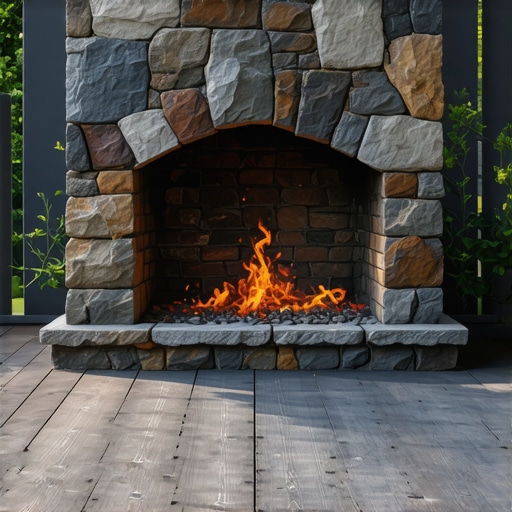
My grandfather used to tap a brick with his trowel. If it did not ‘ring’ like a heavy brass bell, he threw it out into the scrap pile. He knew that a dull thud meant an internal fissure, a silent killer that would absorb moisture, freeze, and blow the face right off the masonry. Today, I see homeowners building and rebuilding outdoor fireplaces with materials that do not just thud—they practically scream failure before the first fire is even lit. There is a raw, unforgiving physics to masonry, and nowhere is this more evident than in an outdoor fireplace exposed to the brutal elements of the North.
When you build a fireplace indoors, you only have to worry about heat. When you build one outdoors in a climate prone to severe freeze-thaw cycles, you are fighting a two-front war against thermal shock from the inside and water penetration from the outside. Water expands nine percent when it freezes. If that water is trapped inside a dense, non-breathable modern cement mortar behind a hard-burned brick, that nine percent expansion will pop the face of your brick clean off. This is why understanding material science is not an academic exercise; it is the difference between a lifetime monument and a pile of dangerous, crumbling debris.
Blueprint B: The Restoration Reality of Fireplace Rebuilds
The tragedy of a ruined outdoor fireplace usually begins with a trip to the local big-box home improvement store. Homeowners and well-meaning handymen walk out with bags of off-the-shelf Type S Portland cement and a stack of decorative concrete pavers, thinking they can build a lasting hearth. They do not realize they have just formulated a recipe for structural failure. Modern Portland cement is incredibly dense and rigid. When used with older, salvaged units or even standard clay bricks, it creates an unyielding bond. The brick must expand and contract as it heats and cools, but the hard cement mortar refuses to give. The softer material—the brick itself—is forced to buckle, crack, and spall.
“Water penetration is the single greatest threat to masonry durability.” – BIA Technical Note 7
To prevent this, you must understand the difference between tuckpointing (a cosmetic application of mortar to the face of a joint) and structural repointing (the deep excavation and filling of the joint with compatible material). For historic or reclaimed materials, using sustainable tuckpointing mortars mixed with lime is essential. These softer, lime-rich mortars act as a sacrificial lamb. They are more flexible and breathable than the brick, allowing moisture to escape through the joint rather than forcing its way out through the face of the stone or brick. If the mortar cracks over decades of use, you can easily grind it out and repoint it; if the brick cracks, your structure is compromised.
The Science of Thermal Shock and the “Flash Set”
Building an outdoor fireplace requires a deep understanding of thermodynamics. When you build a fire, the temperature inside the firebox can jump from ambient freezing temperatures to over one thousand degrees Fahrenheit in a matter of minutes. Standard clay bricks and typical mortar cannot handle this extreme thermal gradient; they will crack instantly. The firebox must be lined with true refractory firebricks laid with fireclay or high-temperature calcium aluminate mortar. This mortar must be applied incredibly thin—often less than one-eighth of an inch—to minimize joint expansion.
“Refractory concretes and mortars must withstand both chemical attack from combustion byproducts and physical stress from rapid thermal cycling.” – ASTM C199
Outside the firebox, the structural backup must be built to handle moisture. Many homeowners fail to install a proper chimney crown. The crown is the concrete slab at the very top of the chimney that sheds water away from the masonry facade. Without a proper drip edge and a resilient chimney crown repair program, water will run straight down the face of your brick, soaking the joints. During winter, that moisture freezes, initiating the destructive spalling cycle. To identify these hidden vulnerabilities before they cause a total collapse, professionals utilize advanced methods like drone chimney inspections to scan the uppermost structures for hairline fractures and failing seals.
The Mechanics of the Build: Buttering, Slipping, and Striking
To get a fireplace rebuild right, you have to get your hands dirty and understand the behavior of the “mud.” Before you even lay a brick, you have to check its suction. If you place a dry brick onto a wet mortar bed, the brick will instantly suck all the moisture out of the mortar. This causes a “flash set” or “burning” of the mortar, preventing a proper chemical bond from ever forming. You must pre-wet dry bricks to control this suction. When you are ready to lay, you “butter” the brick, scraping a smooth beveled edge of mortar along the sides of the unit before placing it on the bed. You use your trowel to tap it home, listening for that solid ring, and then use a “slicker” or jointer tool to strike the joint smooth, compressing the mortar to seal out water.
For those integrating natural stone or heavy masonry elements around the hearth, relying on standard concrete can lead to early failure. Incorporating fiber-reinforced mortars into the backing or surrounding flatwork helps distribute structural loads and prevents micro-cracks from turning into gaping chasms. Whether you are performing a complex stone facade restoration on a grand outdoor chimney or doing a simple failing retaining wall repair to support the fireplace terrace, skipping these material physics steps will guarantee a rebuild failure within five winters.
Preserving Value vs. Destroying It
An outdoor fireplace is not just a pile of stone; it is a thermal engine and a structural retaining wall rolled into one. If you treat it like a simple weekend DIY project using cheap, non-breathable materials, you are building a liability. Take the time to source historically appropriate materials, utilize historic brick salvage when repairing old structures, and ensure your mortar is softer than your masonry units. If you are uncertain about the structural integrity of your chimney flue or the stability of your foundation concrete, professional commercial masonry facade maintenance and concrete flatwork services should be consulted to run diagnostics. Do it once, do it right, and let your masonry ring like a bell for a hundred years.