
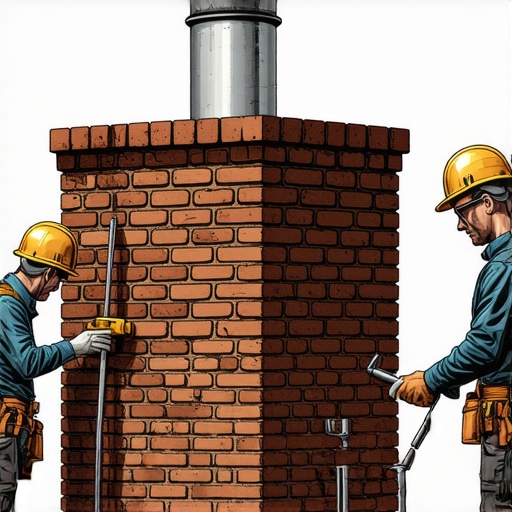
The Forensic Reality of the Vertical Kilometer
I was standing on a suspended scaffold 150 feet above a boiler room, staring at a vertical fracture that ran thirty feet down the north face of a commercial smokestack. To the building owner, it looked like a hairline crack. But when I slid my fiber-optic scope into the void, I didn’t see solid masonry. I saw a hollow cavern where the internal wythe had completely delaminated. The steel reinforcement, once meant to provide tensile strength, had undergone a process of expansive oxidation, swelling to four times its original size and literally blowing the brickwork apart from the inside out. This is the reality of commercial masonry facade maintenance: by the time you see the problem from the sidewalk, the structural integrity has often been compromised for a decade.
The Physics of the Thermal Engine
A commercial chimney is not just a pile of bricks; it is a thermal engine. It lives in a state of perpetual physiological stress. Inside, you have flue gases reaching hundreds of degrees; outside, you have the biting wind of a January freeze. This creates a massive thermal gradient across the wall section. In the world of professional masonry restoration, we focus on the ‘dew point’ within the wall. If that moisture condenses inside the brick rather than exhausting out the top, you get a chemical reaction that turns the lime in your mortar into a mushy soup. This is why structural repointing is not an aesthetic choice—it is a surgical necessity. We aren’t just ‘filling holes’; we are restoring the chimney’s ability to manage the physics of heat and moisture.
“Water penetration is the single greatest threat to masonry durability, specifically when coupled with the expansive forces of freezing water trapped within the pore structure of the unit.” – BIA Technical Note 7
The Micro-Chemistry of the Mortar Joint
When we talk about tuckpointing weatherproofing, we have to look at the molecular level. Modern ‘handymen’ love to use high-strength Portland cement (Type S or M) because it gets hard fast. But in a commercial chimney, that’s a death sentence. A chimney needs to breathe and move. If the ‘mud’ is harder than the brick, the brick will lose. We use structural repointing techniques that involve Type N or even specialized lime-putty blends. These mortars are ‘sacrificial.’ They are designed to be slightly softer and more permeable than the surrounding brickwork, allowing moisture to escape through the joint rather than the brick face. When you see ‘spalling’—where the face of the brick pops off like a scab—it’s usually because someone used a hard, non-breathable cement that trapped water behind the surface.
Integrated Systems: Green Roofs and Commercial Facades
Modern architecture often tries to marry old-world masonry with new-age tech. Green roofing masonry integration is a prime example. While beautiful, these systems introduce a constant reservoir of moisture at the base of the chimney. Without a properly executed flashing system and brickwork sealants application at the transition points, you are inviting hydrostatic pressure to rot your foundation. I’ve seen foundation crack repair jobs that cost six figures all because a roof garden was installed without considering the capillary rise of water into the chimney’s structural base. You need a 100% waterproof barrier that doesn’t just ‘touch’ the masonry but is chemically bonded to it to prevent the ‘wicking’ effect.
Addressing the Veneer: The Hidden Danger
Often, commercial chimneys are wrapped in a decorative layer. Brick veneer detachment repair is a common forensic site for me. The ‘lick-and-stick’ stone veneer over brick trend of the last twenty years has created a massive liability. If the corrugated ties that hold that veneer to the backup wall rust out—often due to poor brickwork sealants application—the entire facade can peel away like an orange skin. We look for ‘bulges’ in the wall. If I can’t see the ‘tooth’ of the mortar or if the veneer is ‘floating,’ we have to go in with stainless steel helical ties to pin that facade back to the structural core before it ends up on someone’s car in the parking lot.
“The selection of mortar for chimney restoration must account for both the compressive strength of the unit and the thermal expansion coefficient of the masonry assembly.” – ASTM C270 Standard Specification for Mortar
The Maintenance Protocol: A Professional Checklist
1. **The ‘Ring’ Test:** I still use my grandfather’s method for commercial smokestack repair. You tap a brick with a hammer. A healthy brick ‘rings’ with a high-pitched note. A dead brick, one that has suffered internal micro-cracking from the freeze-thaw cycle, gives a dull ‘thud.’ If it thuds, it’s ‘shaling’ and needs to be cut out and replaced.
2. **Butter and Slick:** When we are performing professional masonry restoration, we don’t just ‘schlop’ the mud in. We ‘butter’ the edges of the replacement brick to ensure 100% head-joint saturation. Then, we use a ‘slicker’ or jointer tool to compress the mortar. This compression is what creates the weather-tight seal. If you leave it ‘sandy,’ it’s just a sponge.
3. **Managing the Cold Joint:** In commercial masonry facade maintenance, a ‘cold joint’ is where new work meets old work. If you don’t prep the old surface by wetting it down—achieving ‘Saturated Surface Dry’ status—the old brick will suck the water out of the new mud too fast. This ‘burns’ the mortar, leaving it brittle and prone to foundation crack repair needs later on.
The Verdict: Precision or Failure
Commercial masonry is a game of millimeters and molecules. You can’t just slap a coat of ‘waterproofer’ on a chimney and call it a day. In fact, many off-the-shelf sealants do more harm than good by trapping vapor inside. True tuckpointing weatherproofing requires silane-siloxane penetrating sealers that are vapor-permeable. You want the water to bead off the surface, but you want the internal vapor to be able to ‘sweat’ out. Anything less is just a ‘band-aid’ on a gunshot wound. Do it right the first time, use the right ‘mud,’ and respect the physics of the stack, or you’ll be calling someone like me to pick up the pieces when the gravity finally wins. { “@context”: “https://schema.org”, “@type”: “HowTo”, “name”: “Commercial Masonry Chimney Maintenance”, “step”: [ { “@type”: “HowToStep”, “text”: “Conduct a visual forensic inspection for spalling or vertical cracking.” }, { “@type”: “HowToStep”, “text”: “Perform a ‘ring test’ to identify units with internal structural failure.” }, { “@type”: “HowToStep”, “text”: “Grind out failing joints to a minimum depth of 2.5 times the width of the joint.” }, { “@type”: “HowToStep”, “text”: “Apply vapor-permeable silane-siloxane sealants for weatherproofing.” } ] }