
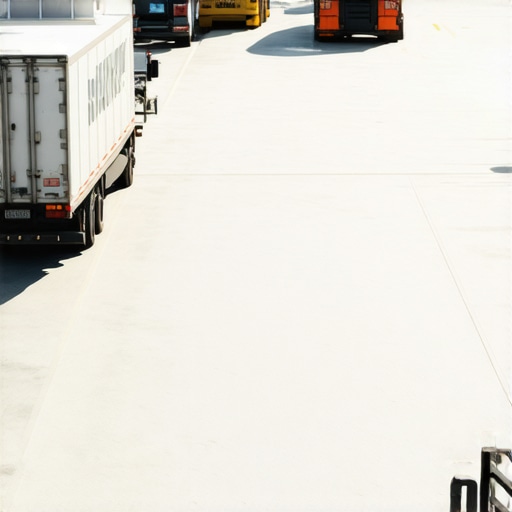
The Forensic Scene: When the Quick Fix Becomes a Liability
The call came in at 4:00 AM. A distribution hub manager was staring at a three-foot-wide crater in the middle of Bay 12. He had tried a hardware store patch kit forty-eight hours prior, but as soon as the first eighty-thousand-pound rig backed in, that patch didn’t just crack; it pulverized. When I arrived with my scope, I saw the structural steel reinforcement was already weeping rust, oxidized to a dull orange dust by the salt-laden slush dragged in from the yard. The homeowner-grade ‘mud’ he’d used had zero bond strength, and the ‘cold joint’ between the old slab and the new material was wide enough to fit a putty knife. This is the reality of industrial masonry: if you don’t understand the chemistry of the bond, you’re just throwing money into a hole.
The Physics of Loading Dock Failure
A loading dock is not a sidewalk. It is a high-stress environment where concrete is subjected to extreme compressive forces, shear stress, and thermal shock. When a forklift with solid rubber tires hits a transition point, the impact pressure can exceed 5,000 PSI in a localized area. Standard concrete reaches its peak strength over twenty-eight days, but in a commercial setting, you don’t have twenty-eight days. You have hours. This leads many to use ‘flash setting’ materials that heat up too fast, causing micro-fractures before the first truck even arrives.
“The most critical factor in a concrete repair’s longevity is the development of a high-strength bond at the Interfacial Transition Zone (ITZ).” – ASTM C928 Standard Specification
The Enemy: Freeze-Thaw and Chemical Attack
In northern climates, the loading dock is the front line of a chemical war. Trucks bring in de-icing salts that lower the freezing point of water, allowing it to penetrate deep into the capillaries of the concrete. When that water eventually freezes, it expands by nine percent. If your patch material is denser and less flexible than the surrounding slab, that expansion has nowhere to go but out, popping the face of the patch off in a process we call spalling. I’ve seen ‘handyman specials’ where the repair was harder than the original floor; the result was the original floor shattering around the patch like a cheap dinner plate. For high-traffic areas, we need air-entrained concrete or polymer-modified mortars that can handle this internal pressure without ‘honeycombing’ at the edges.
Micro-Zooming into the Chemistry of Adhesion
To get a patch to stick, you need more than just ‘suction.’ You need a mechanical and chemical ‘tooth.’ This starts with the hydration process. When you mix your ‘mud,’ the water reacts with the calcium silicates to form Calcium Silicate Hydrate (C-S-H) crystals. These crystals grow into the pores of the existing concrete. If the existing slab is too dry, it will ‘suck’ the water out of the patch too fast—a phenomenon I call ‘burning the mud.’ The hydration stops, and you’re left with a brittle, dusty mess that has no structural integrity. I always insist on a Saturated Surface Dry (SSD) condition: the old concrete must be damp but with no standing water. This ensures the C-S-H crystals have the time to ‘lock’ into the substrate.
“Water penetration and the subsequent corrosion of embedded reinforcement are the primary causes of premature failure in industrial masonry structures.” – BIA Technical Note 7
The ‘Hardscape Truth’ Blueprint for Loading Docks
If you are looking for the best concrete patch, you aren’t looking for a bag of ‘cement.’ You are looking for a three-part system: mechanical preparation, advanced masonry adhesives, and a high-early-strength mortar. First, the ‘slicker’ or smooth surface of the old concrete must be ground down to an ICRI Concrete Surface Profile (CSP) of at least 5 or 6. We’re talking about a texture like heavy-grit sandpaper. Next, the ‘buttering’ of the edges. Using a high-solids epoxy or a polymer bonding agent, we create a bridge between the old and new. This prevents the ‘cold joint’ that eventually turns into a new crack. Finally, the pour. For docks, we use a fiber-reinforced, shrink-compensated mix. The fibers act as internal rebar, holding the ‘mud’ together when the shear forces of a turning forklift try to tear it apart.
Beyond the Slab: Chimneys, Parapets, and Foundations
The lessons we learn on the loading dock floor apply to the entire envelope of the building. Commercial masonry maintenance is a holistic discipline. If you have a failing dock, you likely have issues with commercial parapet wall repair or chimney structural repair as well. The same thermal expansion that cracks a floor will push a parapet wall out of alignment if there aren’t proper relief joints. When we talk about foundation waterproofing, we’re really talking about managing hydrostatic pressure. If water is ‘pumping’ under your loading dock slab every time a truck drives over, no patch in the world will save you. You have to address the drainage—retaining wall weep hole cleaning isn’t just for aesthetics; it’s to keep the soil behind the wall from becoming a liquid heavy-weight that crushes the structure from the outside in.
The Professional Process: Doing it Once
When I’m supervising a brick arch restoration or a retaining wall capstone replacement, I look for the ‘ring.’ If I tap a finished repair with my hammer and it sounds ‘hollow,’ it’s a fail. It means there is a void or a delamination. In a loading dock, a hollow sound is a death knell. It means the patch is ‘floating’ and will shatter under load. We use a ‘hawk’ and trowel to ensure every inch of the patch is compressed, removing the ‘honeycombing’ air pockets. This isn’t just about ‘filling a hole.’ It’s about fire-rated masonry installation standards where the density of the material is a matter of life and safety. After the patch is set, we don’t just walk away. Facade cleaning and the application of a silane-siloxane sealer are the final steps to ensure that the next salt-covered truck doesn’t start the destruction process all over again. You can do it once, or you can do it twice. My grandfather used to say the most expensive repair is the one you have to do again next year.