
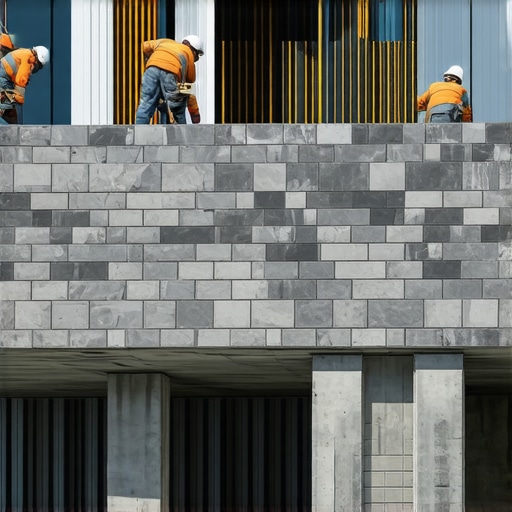
I was standing behind a big-box retail center last November, looking at a three-hundred-foot section of split-face block that had decided it didn’t want to be a wall anymore. The homeowner or the casual passerby sees a crack; I see a forensic crime scene. When I shoved my fiber-optic scope into a weeping head joint, I didn’t find clear drainage paths. I found a slurry of dead, crumbly mortar that had turned into a sponge. The structural steel behind it? It looked like a sunken shipwreck—rusted to a fine orange dust. That is the reality of the ‘mud’ game when it’s played wrong on a commercial scale. In the world of high-volume masonry, we are seeing a massive shift away from traditional wet-set techniques toward mortarless masonry systems, and as a man who has spent forty years with a trowel in his hand, I can tell you: it’s about time.
The Physics of the Failure: Why Mud Dies
Traditional masonry relies on a chemical bond. You mix your portland, your lime, and your sand—what we call the ‘mud’—and you butter the ears of the block. But in large-scale commercial jobs, the sheer volume of material means human error is inevitable. If the apprentice mixes the batch too hot, it ‘flashes,’ drying out before it can hydrate. If it’s too cold, the hydration process stalls.
“Differential movement between the masonry veneer and the structural backup is the primary cause of cracking in modern commercial envelopes.” – BIA Technical Note 18
This movement is the silent killer. A three-story commercial building isn’t a static object; it is a living, breathing organism that expands and contracts with every sunrise. When you use rigid mortar joints, you are essentially trying to glue a giant, shifting puzzle together. Eventually, something has to give. That’s where crumbling mortar joint repair becomes a full-time job for restoration crews, and why the industry is looking at mortarless alternatives.
The Mortarless Revolution: Precision Over Paste
Mortarless systems, or dry-stack masonry, eliminate the variable of the ‘mud’ entirely. These units are often CNC-machined or cast with interlocking ‘teeth’ that provide a mechanical bond rather than a chemical one. Think of it as the difference between gluing two pieces of wood together and using a dovetail joint. The mechanical connection is predictable. One of the biggest advantages is the masonry waterproofing solutions inherent in the design. Without a solid bed of mortar, these systems often incorporate internal drainage channels that allow moisture—the eternal enemy—to drop straight to the flashing line and exit the building. We aren’t fighting hydrostatic pressure; we are outsmarting it.
Micro-Zoom: The Geotechnical Reality of Retaining Walls
When we move from the building envelope to the site work, the benefits of mortarless systems become even more apparent. I’ve seen countless commercial retaining walls fail because a contractor thought he could just stack heavy blocks and go home. On a commercial site, a retaining wall geogrid installation is non-negotiable. Geogrid is a high-tenacity polyester mesh that acts like the ‘tendons’ in a body. It’s laid between the layers of mortarless blocks and extended back into the compacted soil. This creates a reinforced soil mass. Without the rigid constraint of mortar, these walls can flex slightly under the immense weight of the earth behind them. If that wall were mortared, that flex would manifest as a massive horizontal fracture. In a dry-stack system, the units shift, redistribute the load, and stay standing. It’s the difference between a glass rod and a bundle of willow branches.
The Intricacy of the Cut: Birdsmouths and 3D Printing
Even in a mortarless world, the skill of the mason isn’t obsolete; it just changes shape. Take masonry birdsmouth cuts, for example. When we are wrapping a column or hitting an odd-angle corner in a commercial lobby, we have to notch the block with a precision that would make a cabinet maker sweat. You are removing a V-shaped wedge from the back of the unit to allow it to ‘nest’—though I hate that word—to sit tight against the substrate. We are also seeing the rise of 3D printed masonry repairs. In professional masonry restoration, we often find ourselves trying to match a profile from 1920 that hasn’t been manufactured in a century. We can now scan the existing stone and print a replacement unit with the same thermal expansion coefficient as the original, allowing for a historic masonry preservation approach that actually lasts.
“Standard Specification for Loadbearing Concrete Masonry Units requires a minimum compressive strength that many modern ‘lick-and-stick’ products fail to meet under real-world stress.” – ASTM C90
The Moisture Problem: From Chimneys to Foundations
Moisture doesn’t just attack the walls; it attacks the high points and the low points. On commercial rooftops, chimney sweep and repair often reveals that the chimney cap replacement was done with cheap mortar that cracked within two seasons. A mortarless or metal-clad cap system prevents the ‘wicking’ action that pulls water down into the core of the masonry. Similarly, inside the building, people try to use tile grouts on masonry surfaces for aesthetic reasons in commercial kitchens or bathrooms. This is a recipe for disaster. Tile grout is too rigid and lacks the breathability of masonry. It traps vapor, leading to sub-florescence—where salts crystallize behind the face of the stone and pop the front off. It’s the same physics that causes spalling in a freeze-thaw cycle.
The Scam of the ‘Quick Stack’
Just because a system is mortarless doesn’t mean any guy with a truck can install it. The ‘scam’ I see most often in the commercial world is the contractor who skips the base preparation. Whether it’s a massive paver courtyard or a structural wall, the masonry is only as good as the dirt it sits on. If you don’t have eight inches of crushed, compacted aggregate, your ‘high-tech’ mortarless wall will look like a roller coaster within three years. They call it ‘honeycombing’ when the gaps start to open up, and at that point, you aren’t looking at a simple fix; you’re looking at a total tear-out. I tell my clients: do it once, or do it twice. There is no third option in this business.
The Master’s Verdict on the Future
We are moving toward a more engineered way of building. The ‘mud’ will always have its place in historic masonry preservation—where we must use soft lime mortars to protect old, fragile bricks—but for the modern commercial landscape, the mortarless system is the superior choice. It handles thermal expansion better, it drains better, and it removes the ‘human variable’ of the mortar mix. As a forensic inspector, I’d much rather see a wall designed to move than a wall designed to crack. It’s not about losing the craft; it’s about applying the craft to a higher level of physics. Stop worrying about the ‘tapestry’ of the joints and start worrying about the tooth of the mechanical bond. That’s how you build a legacy that stays standing.