
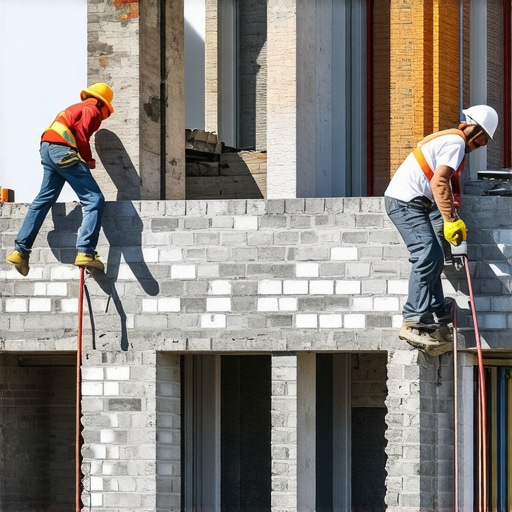
The Forensic Reality of the Facade
The homeowner stood on their manicured lawn, pointing toward what looked like a harmless hairline fracture running through a soldier course above a grand arched window. To the untrained eye, it was a cosmetic blemish. To me, it was a crime scene. When I fed my digital scope into that fissure, I didn’t just see a crack; I saw a catastrophic failure of physics. The previous contractor had used a high-strength Portland cement mix to ‘patch’ a wall built in 1925. Because that modern mortar was harder than the original clay-fired bricks, it had trapped moisture behind the face of the wall. That trapped water had found the structural steel lintel and oxidized it until the metal was little more than a memory of rusted dust. The entire masonry skin was essentially floating, disconnected from its skeletal support. This is the price of ignoring mortar matching services.
“Water penetration is the single greatest threat to masonry durability, and the use of incompatible mortar accelerates this degradation by trapping moisture within the unit rather than allowing it to escape through the joint.” – BIA Technical Note 7
When we talk about high-value properties, we aren’t just talking about real estate; we are talking about a legacy of material science. The ‘mud’—what civilians call mortar—is the most misunderstood component of a building. It is not meant to be a permanent glue. In the world of historic pointing styles, mortar is a sacrificial element. It is designed to be the weakest link in the chain, the part that breathes, moves, and eventually fails so that the irreplaceable brick or stone does not. When you lose that balance, you lose the building.
The Chemistry of Vapor Permeability and Carbonation
To understand why precision mortar matching is vital, we have to zoom into the molecular level of the hydration process. Modern concrete pump masonry mixes are designed for speed and compressive strength. They hydrate quickly, forming a dense, crystalline lattice that is nearly waterproof. For a new warehouse, that’s fine. For a luxury estate built with traditional methods, it’s a death sentence. Older masonry relies on vapor permeability. The wall needs to ‘inhale’ and ‘exhale’ moisture. Traditional lime-based mortars undergo carbonation—a slow process where the lime reacts with atmospheric CO2 to turn back into limestone over decades. This creates a porous structure that allows water to wick out. If you ‘butter’ those joints with a non-breathable Type S mortar, you create a dam. When the freeze-thaw cycle hits, that trapped water expands by 9%, and because the mortar won’t give, the face of your expensive brick pops off in a process called spalling.
The Evolution of Assessment: AI and Forensic Analysis
We’ve moved past the days of a guy squinting at a wall and guessing the mix. Today, AI masonry assessment allows us to analyze the exact degradation patterns across a 10,000-square-foot facade. We use thermal imaging and algorithmic crack mapping to determine where the hydrostatic pressure is highest. This data informs our tuckpointing cost estimation, ensuring we aren’t just treating symptoms but curing the underlying structural disease. We take samples of the original mud to a lab to determine the sand-to-lime ratio and the specific grain size of the aggregate. This isn’t just for aesthetics; the ‘tooth’ of the sand determines how well the new mortar bonds to the old. Without this, you get a cold joint, where the new material simply peels away from the old like a scab.
Advanced Materials in Restoration
While we respect the old ways, we don’t ignore progress. Fiber-reinforced mortars are now used in high-stress areas where lateral movement is a concern. These micro-fibers act like rebar on a microscopic scale, providing tensile strength without sacrificing the breathability of the lime. When we are dealing with tuckpointing curved walls, which you often see in turreted Tudor revivals or modern architectural masterpieces, the geometry of the joint is punishing. A curved wall puts unique shear stresses on the mortar. Using a self-leveling masonry lift ensures our masons have the perfect ergonomic angle to ‘strike’ the joint, whether they are executing a beaded, grapevine, or weathered joint. If the angle of the strike is off by even a few degrees, it creates a shelf where water can sit, leading to honeycombing and deep-seated rot.
“Mortar should always be softer than the masonry units it binds to ensure that thermal and moisture expansion do not cause the units themselves to crack.” – ASTM C270 Standard Specification
The Aesthetic Science of Masonry Staining
Sometimes, even the best lab-matched mortar looks ‘new’ against century-old soot and patina. This is where masonry staining becomes a critical forensic tool. We don’t use paint—paint is a film-forming disaster that chokes the brick. We use breathable, mineral-based pigments that chemically bond with the substrate. We can match the subtle variations of a weathered retaining wall block replacement so perfectly that the repair is invisible to the eye but structurally superior to the original. This is the hallmark of a master; we want our work to be forgotten. If you can see where I was, I didn’t do my job.
The Economics of the ‘Done Right’ Philosophy
I see it every week: a homeowner tries to save $5,000 on a tuckpointing cost estimation by hiring a handyman who uses ‘all-purpose’ premix. Three years later, they call me because their interior plaster is bubbling and their limestone window surrounds are cracking. Now, that $5,000 ‘saving’ has turned into a $60,000 full-scale restoration. You can do it once, or you can do it twice. In high-value masonry, there is no middle ground. Whether it’s the precision of concrete pump masonry mixes for a new subterranean wine cellar or the delicate hand-tooling of a historic chimney, the physics remain the same. Respect the suction of the brick, understand the chemistry of the lime, and never, ever trust a man who doesn’t carry a slicker and a hawk. Real masonry is a dialogue between the earth and the sky, and the mortar is the language they speak.