
The Forensic Reality: Behind the Brick Curtain
The property manager told me it was just a cosmetic issue. He pointed at a thin, jagged line running through the soldier course of a twenty-story commercial building. To the untrained eye, it was a nuisance; to me, it was a scream for help. I pulled out my telescopic bore scope and threaded it into a weep hole that had been carelessly plugged with caulk by some handyman. What I saw on the monitor wasn’t just rust; the structural steel angle—the very bone holding up thousands of pounds of masonry—was exfoliating. It looked like a rusted puff pastry, expanding and pushing against the brick with enough force to eventually send a ton of masonry onto the sidewalk below. This is the reality of masonry damage assessment. It is not about what you see on the surface; it is about the physics of what is happening in the dark cavities of the wall.
The Physics of Decay in the Freeze-Thaw Zone
In our climate, the enemy is not just time; it is the 9% expansion of water. When moisture penetrates a commercial facade, it settles into the microscopic pores of the brick and the mortar joints. In a northern freeze-thaw cycle, that liquid turns to ice, expanding with a mechanical force that can shatter stone. If you have been sold a bill of goods on a hard, waterproof sealant or a high-strength Portland cement for an old building, you are looking at a death sentence for your masonry. Modern ‘lick-and-stick’ mentalities fail because they ignore the sacrificial principle of mortar. In a proper system, the mortar must be softer and more permeable than the brick itself. This allows the wall to ‘breathe,’ pulling moisture out through the joints rather than forcing it to blow the face off the brick—a process we call spalling.
“Mortar should be designed to be weaker than the masonry units it binds, ensuring that stresses and moisture movement occur within the mortar joints rather than the units themselves.” – ASTM C270 Standard Specification for Mortar for Unit Masonry
Step 1: The Macro-Visual and Thermal Sweep
We start with a high-resolution visual sweep, but eyes can lie. That is why we use thermal imaging to detect temperature differentials. A wet wall holds heat differently than a dry one. We look for ‘shadows’ that indicate trapped moisture behind the facade, often caused by failing stone coping installation or blocked drainage systems. If the ‘hat’ of the building—the coping—is cracked or has lost its seal, every gallon of rainwater is funneling directly into the core of the wall. We look for brick efflorescence removal needs, which is often the first sign of a hidden leak. That white, powdery salt isn’t just an eyesore; it is the residue of minerals being leached out of the masonry by migrating water. If you see white stains, you have a plumbing problem inside your wall.
Step 2: Physical Sounding and the ‘Ring’ of Truth
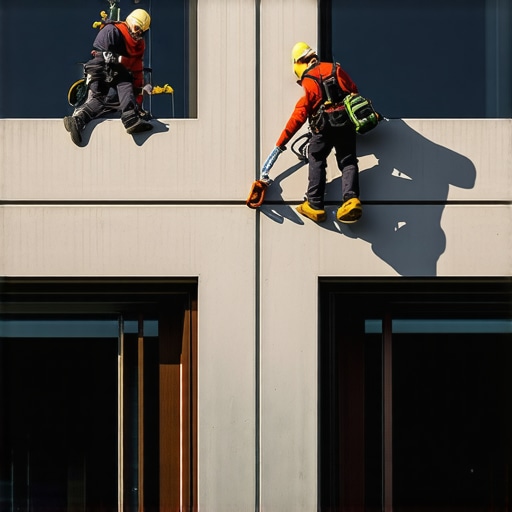
There is no substitute for getting on a swing stage and touching the building. I use a specialized masonry hammer to ‘sound’ the wall. When I tap a healthy brick, it should ring with a clear, high-pitched tone. If I hear a dull ‘thud,’ I know the masonry has delaminated from the backup wall. We check for crumbling mortar joint repair needs by probing the ‘mud’ with a tuckpointing tool. If the mortar falls out like dry sand, the binder has failed, likely due to a poor original mix or ‘flash setting’ where the moisture was sucked out of the mortar before it could properly hydrate. This is where we identify the need for professional tuckpointing services to restore the structural integrity of the joints.
Step 3: Material Analysis and Sustainable Tuckpointing Mortars
Once we have identified the failure points, we take samples. You cannot just throw any mortar into a joint and call it a day. We analyze the existing material to match its compressive strength and vapor permeability. We are seeing a massive shift toward sustainable tuckpointing mortars that utilize natural hydraulic lime. Unlike modern Portland cement, which is brittle and non-porous, lime-based mortars allow for autogenous healing—meaning small cracks can actually reseal themselves over time as the lime reacts with carbon dioxide. This ‘breathability’ is the secret to why a cathedral built in 1200 is still standing while a strip mall built in 1990 is falling apart. When we ‘butter’ the joints during the repair phase, we ensure the new mud has the right ‘tooth’ to bond with the old brick without creating a cold joint.
“Water penetration is the single greatest threat to masonry durability. Proper flashing, weep holes, and mortar joint profiles are the primary defenses against structural failure.” – BIA Technical Note 7
Step 4: Substructure and Foundation Verification
A facade is only as stable as what it sits on. Part of a forensic masonry damage assessment involves looking at the foundation. If the concrete flatwork services surrounding the building were poorly executed, water might be pooling at the base, leading to hydrostatic pressure that pushes the bottom of the wall outward. We look for stair-step cracking, which usually indicates the soil is heaving or settling. In commercial masonry repair services, we often find that the ‘scab’ of a previous repair has hidden a deeper foundation issue. We check the lintels—those horizontal beams over windows—for ‘honeycombing’ or deep rust. If the steel is failing, no amount of tuckpointing will save the building; you have to cut out the masonry, replace the steel, and rebuild the courses from the ground up.
The Long-Term Value of Forensic Integrity
The goal of a professional 4-step inspection isn’t just to generate a report; it is to prevent a catastrophic collapse. When you hire a crew that understands the ‘suction’ of a dry brick and the chemistry of the hydration process, you are investing in the next fifty years of your asset. Don’t trust the guy with a bucket of premixed hardware store mortar and a slicker. Real masonry is a marriage of geology and chemistry. If you ignore the signs—the crumbling joints, the white salt stains, the hairline cracks—you aren’t saving money; you are just waiting for gravity to take its toll. Do it right once, or do it twice at triple the cost. That is the only law of the job site that never changes.