
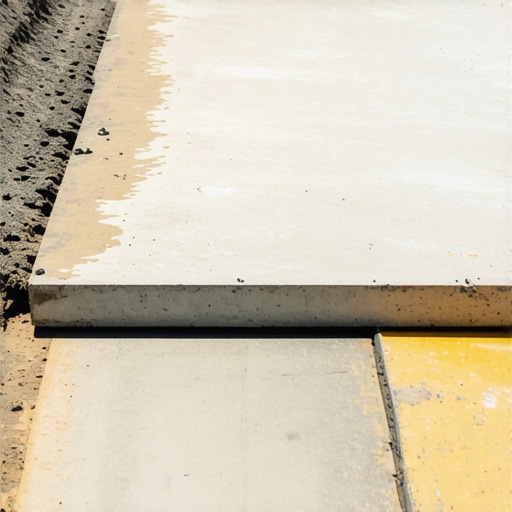
The Anatomy of a Trip Hazard: When the Ground Gives Way
I recall a forensic scene where a homeowner believed a simple hairline crack in their front walkway was merely an aesthetic nuisance. When I arrived with my structural probe and pushed it through a small bore hole, the tool sank nearly four feet into a cavernous void before hitting anything resembling stable subgrade. The structural steel in the adjacent retaining wall, exposed to the damp oxygen of that hidden pocket, had rusted into a pile of red dust. This is the reality of soil subsidence. A walkway doesn’t just ‘settle’—it is failing under the physics of weight, water, and poor compaction. In my forty years of dragging a hawk and trowel across jobsites, I have seen thousands of these ‘handyman specials’ where a bag of quick-mix is poured over a moving crack. That is not masonry; that is a band-aid on a broken limb. Concrete slabs are heavy, rigid bodies resting on a fluid, shifting world of soil. When the friction angle of that soil is compromised by water, the slab becomes a liability. We aren’t just fixing a trip hazard; we are performing forensic stabilization to prevent the entire hardscape from migrating toward the low point of the property.
“Water penetration is the single greatest threat to masonry durability, leading to hydrostatic pressure and sub-grade erosion.” – BIA Technical Note 7
The Physics of the Freeze-Thaw Cycle
In our northern climate, we are fighting a constant war with the 9% expansion rule. When water penetrates the soil beneath your walkway, it doesn’t just sit there. As temperatures drop, that water freezes and expands by approximately 9% of its volume. This creates ‘frost heave,’ a vertical force that can lift a four-inch thick slab of 4,000 PSI concrete as if it were a sheet of plywood. The problem arises during the thaw. The ice melts, the soil becomes a slurry of mud, and the heavy slab sinks further than its original position. Over a decade, this cycle creates a jagged staircase of concrete edges. You might think about cracked brick wall repair or brick quoin repair as separate issues, but they are often symptoms of the same sub-grade instability. When the walkway moves, it pulls at the foundation, leading to the need for mortar repointing services to fix the collateral damage. If the chimney is involved, you may find yourself looking at chimney leak detection or even a full chimney flue liner installation because the whole house is shifting on an unstable axis.
Why Mud-Jacking and Slab Jacking Outperform Replacement
Many contractors will tell you to rip it all out and start over. They want to sell you a new pour because it’s high-margin work that doesn’t require the surgical precision of forensic masonry. But new concrete is often a mistake. Why? Because the existing slab has already done its ‘initial settlement.’ It has compressed the soil as much as it naturally will. By using slab jacking—the process of injecting a high-density slurry or polyurethane foam beneath the slab—we utilize the existing concrete as a stable lid. We drill a series of small holes, usually no bigger than a penny, and inject the ‘mud.’ This mud is a precise mix of Portland cement, fly ash, and fine-grain sand. As we pump it in, it fills the honeycombing voids first. Once the voids are filled, the hydraulic pressure begins to lift the slab with incredible control. We use a slicker to ensure the joints remain clean during the process. This isn’t just about height; it’s about density. We are essentially creating a new, pressurized foundation beneath the old one. This is far more effective than modular masonry construction for repair scenarios because it adapts to the irregular shape of the eroded soil cavern.
“Structural concrete must be supported by a non-erodible sub-base to prevent differential settlement and eventual shear failure.” – ASTM C1272 Standard Specification
The Forensic Inspector’s Eye: Identifying the Void
Before we even touch a pump, we have to understand the ‘why.’ Is the water coming from a failing gutter system? Is it a lack of green roofing masonry integration where runoff is hitting the foundation? Or perhaps the chimney damper repair you ignored years ago has allowed water to seep down the interior of the wall, saturating the footings? We look for the ‘suction’ of the soil. If the dirt around the slab is pulling away, the slab is losing its ‘tooth.’ During the injection process, we watch the ‘cold joints’—those places where two different pours meet. If they move independently, we have to stitch them back together. In high-heat environments like Texas or Arizona, we worry about ‘flash setting’ where the injection material dries too fast and creates a bridge rather than a full fill. In the north, we focus on air-entrainment. The slurry must have enough microscopic air bubbles to allow for the expansion of any future moisture without cracking the ‘mud’ we just injected. [image_placeholder_1]
Modern Innovations: From 3D Printing to Fire-Rated Safety
We are entering a new era of masonry. We are seeing 3D printed masonry repairs where custom-fitted blocks are used to shore up historic edges, and fire-rated masonry installation techniques are being applied to walkways that double as emergency egress routes. However, the fundamentals remain the same as when my grandfather was tapping bricks to hear if they ‘rang’ with quality. You cannot cheat the chemistry of cement. Whether you are dealing with a simple walkway or complex chimney flue liner installation, the material must be compatible with the existing structure. If you use a mortar that is harder than the brick, the brick will fail. This is the ‘sacrificial principle’ of masonry. In slab jacking, our injection material must be strong enough to support the load but flexible enough to not shatter the slab above it. We don’t just ‘butter’ the edges; we fill the soul of the walkway. Once the slab is level, we finish with mortar repointing services to seal the surface against the next winter. This is how you stop the trip hazard and preserve the integrity of the home for another generation. Don’t let a handyman throw a layer of patch over your problems. Demand a forensic approach that addresses the soil, the physics, and the long-term chemistry of the site.