
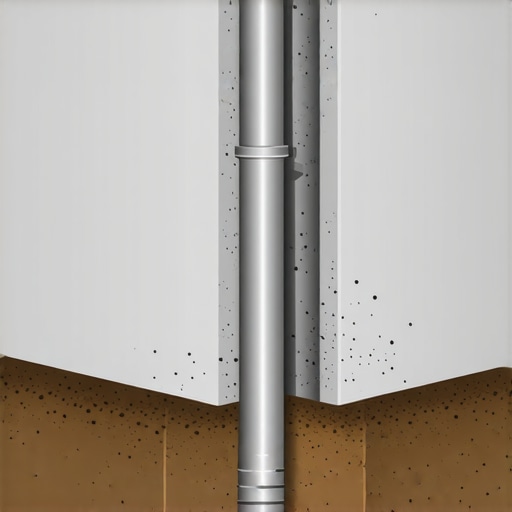
The Forensic Scene: When a Hairline Becomes a Nightmare
The homeowner thought it was just a hairline crack. It was a humid Tuesday when I stepped into a basement in a neighborhood built on heavy clay. To the untrained eye, the thin, horizontal fracture running along the third course of blocks looked like a cosmetic nuisance. But when I put my digital borescope inside a weep hole, I saw the structural steel was rusted to dust and the wall had shifted three-quarters of an inch inward. This wasn’t a ‘settling’ issue. This was a slow-motion car crash caused by the weight of the earth itself. Most people don’t realize that soil is alive; it breathes, it swells, and when it gets saturated, it turns into a hydraulic ram. This is the reality of foundation wall bowing repair—it’s a battle against physics where the house is usually losing.
“Water penetration is the single greatest threat to masonry durability. Hydrostatic pressure can exert thousands of pounds of force against a foundation wall, exceeding its design capacity.” – BIA Technical Note 7
The Physics of the Push: Why Walls Bow
To understand why you need professional masonry restoration, you have to understand the ‘Angle of Repose.’ Every soil type has a natural angle where it stays put. When you dig a hole for a foundation and backfill it, you destroy that natural stability. If the contractor didn’t compact that ‘mud’ in six-inch lifts, you’ve essentially created a giant bathtub around your house. When it rains, that bathtub fills. Water weighs roughly 62.4 pounds per cubic foot. When you saturate ten feet of backfill, the pressure against your foundation crack repair site isn’t just vertical; it’s lateral. This is hydrostatic pressure. It forces water into the microscopic pores of the concrete, leading to a phenomenon known as ‘honeycombing’ where the cement paste washes away, leaving only the aggregate behind.
In my forty years on the ‘hawk’ and trowel, I’ve seen tuckpointing brick walls that looked perfect on the outside while the backup wythe was crumbling from moisture trapped by hydrostatic forces. If you’re dealing with tuckpointing curved walls, the stress is even higher because the geometry doesn’t allow for the same lateral movement as a straight run. This is where AI masonry assessment comes into play. We are now using algorithms to track the rate of crack expansion down to the millimeter, identifying whether a wall is ‘active’ or ‘dormant’ before we ever mix a batch of mortar.
The Anatomy of a Failure: From Spalling to Structural Collapse
When water is trapped against a wall, it doesn’t just push; it attacks the chemistry of the material. In colder climates, the freeze-thaw cycle is the executioner. Water enters the spalled concrete steps repair zone, expands by 9%, and literally pops the face off the masonry. If you’ve ever seen stone facade restoration where the stones are falling off like loose teeth, it’s usually because some ‘handyman’ used a hard Portland cement on a soft historic stone. The stone needs to breathe. When you ‘butter’ a joint with a mortar that is harder than the unit itself, the moisture can’t escape through the joint, so it forces its way through the stone, causing it to shatter. This is why we insist on Type N or even Type O lime-based mortars for older structures.
“The strength of the mortar should always be less than the strength of the masonry units to ensure that any stress-induced cracking occurs in the mortar joints, which are easier to repair.” – ASTM C270 Standard Specification for Mortar for Unit Masonry
We are seeing a revolution in robotic masonry repair, where machines can now inject high-strength resins into deep fissures that a human ‘slicker’ could never reach. But even the best robot can’t fix a house built on bad geophysics. If your chimney sweep and repair technician notices cracks in the crown, it might not just be weather; it could be the entire stack shifting because the foundation footing is being undercut by subterranean water flow. It all comes back to the base. If you don’t control the water, the water will control your bank account.
The Band-Aid vs. The Cure
I despise the ‘lick-and-stick’ mentality of modern construction. A real professional masonry restoration involves more than just slapping some ‘mud’ in a crack. You have two choices: The Band-Aid or The Cure. The Band-Aid is an epoxy injection. It stops the leak for a season, but it does nothing to stop the hydrostatic pressure. It’s like putting a cork in a bursting dam. The Cure involves relieving the pressure. This means excavating the exterior, installing a proper ‘French drain’ system, and parging the wall with a high-density waterproof membrane. Only then do we look at foundation crack repair using carbon fiber straps or helical piers to pull the wall back to its original ‘soldier course’ alignment.
When to Panic: The Red Flags of Masonry Failure
You don’t need a degree in structural engineering to know when your house is screaming for help. Look for the ‘stair-step’ crack—that’s a sign of settlement. But a horizontal crack? That’s the ‘Cold Joint’ of a failing structure. If you see ‘efflorescence’—that white, salty powder on your bricks—that’s the masonry’s way of sweating out its minerals. It means water is moving through the wall, and it’s only a matter of time before the ‘tooth’ of the mortar loses its grip. Don’t wait for the wall to bow three inches. By then, you aren’t just looking at tuckpointing brick walls; you’re looking at a total rebuild. Do it once, or do it twice. The choice is yours, but the earth never stops pushing.
[howToSchema]