
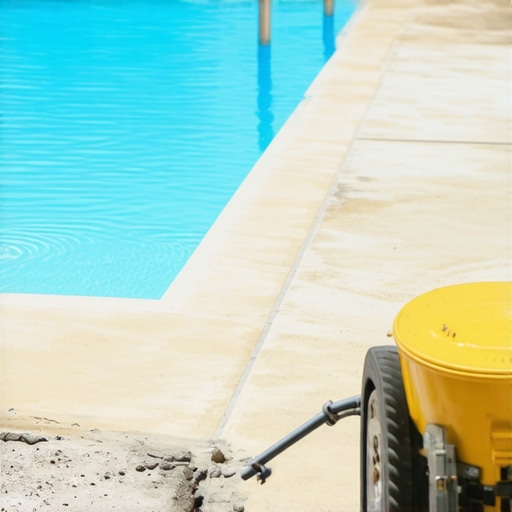
The 3 AM Phone Call from a Sinking Paradise
I stood looking at a $120,000 vanishing-edge pool in the Scottsdale heat that was literally splitting in two because the builder ignored the basic physics of soil compaction. The homeowner called me when the ‘hairline crack’ in his travertine deck became a two-inch vertical offset. He thought he needed to tear the whole thing out. I told him he didn’t need a sledgehammer; he needed a surgeon. Most guys in this trade want to come in, rip up your concrete, and sell you a new pour. They love the ‘rip and replace’ because it’s easy money and they don’t have to think. But when you understand the ‘tooth’ of the soil and the way hydrostatic pressure works under a slab, you realize there is a better way. This wasn’t a case of bad stone; it was a case of the earth moving beneath it, leaving a void that was just waiting to swallow that expensive masonry.
The Physics of the Void: Why Your Deck Sinks
When we talk about foundation slab jacking, we are fighting a war against gravity and moisture. Around a pool, the soil is never truly static. You have constant wetting and drying cycles. In the desert heat, the clay-heavy soils shrink as they lose moisture, pulling away from the bottom of the concrete. Then, a monsoon hits or a pinhole leak develops in the pool plumbing, and that water finds the path of least resistance. It washes out the fines—the tiny particles of sand and silt—leaving a cavern behind. This is what we call ‘honeycombing’ of the sub-base on a massive scale. Once that slab is spanning a void instead of resting on solid ground, it’s only a matter of time before the shear stress exceeds the tensile strength of the concrete. That’s when you get the ‘snap’—that sickening crack that ruins your afternoon.
“Water penetration is the single greatest threat to masonry durability and structural stability of concrete assemblies.” – BIA Technical Note 7
The Surgical Rescue: How Foundation Slab Jacking Works
Forget the old-school ‘mudjacking’ where they pumped a heavy slurry of dirt and cement under the slab. That stuff is heavy, and sometimes the weight of the ‘fix’ actually causes more settlement. Modern foundation slab jacking uses high-density geo-polyurethane resins. We drill holes no bigger than a penny—the size of a ‘slicker’ tool—and inject a two-part polymer. The chemical reaction is a thing of beauty. As the two components mix, they undergo an exothermic reaction, expanding up to 20 times their liquid volume. We are talking about thousands of pounds of lift per square foot. I’ve seen this stuff lift a 10-ton slab like it was a piece of balsa wood. The resin flows into the smallest fissures, densifying the soil and creating a structural foam that is impervious to water. It doesn’t wash away. It doesn’t shrink. It’s a permanent ‘butter’ layer between the earth and your deck.
Digital Twin Masonry Projects: The Forensic Advantage
Before we ever pull a trigger on an injection gun, we use digital twin masonry projects to map the disaster. By using ground-penetrating radar and 3D scanning, we create a virtual model of what’s happening under the travertine. I can see the exact dimensions of the void. This isn’t guesswork; it’s forensics. We can simulate how the slab will react to the lift, ensuring we don’t put too much pressure on the pool shell itself. This level of precision is what separates a master from a ‘handyman special.’ We aren’t just filling a hole; we are re-engineering the ground. This data also helps in historic mortar analysis if the pool is part of an older estate, ensuring that any repairs to the surrounding walls use ‘mud’ that matches the original chemistry of the site.
The Secondary Failures: Ties, Veneers, and Voids
A sinking deck is rarely a lonely problem. When the slab moves, it pulls on everything attached to it. I often see structural brick ties replacement as a necessary follow-up. Those metal ties that hold your brick veneer to the cabana wall? They aren’t designed for lateral movement. When the deck drops, it can shear those ties right off, or worse, pull the entire wall face out. If you’ve got stone veneer over brick near your pool, you have to be even more careful. Most modern masons just ‘lick and stick’ that stone without thinking about the ‘cold joint’ they are creating. If moisture gets behind that stone because of a shifting foundation, the freeze-thaw cycle (even in the south, those desert nights get cold) will pop that stone off like a bottle cap. We look at the whole system—from the chimney leak detection on the outdoor fireplace to the facade cleaning needed after the ‘mud’ is set.
“The stability of a structure depends entirely upon the integrity of the soil-to-foundation interface.” – ASTM D1194 Standard Guide
Preserving the Soul: Historic Brick Salvage and Matching
For those of you with older homes, you can’t just buy a bag of Type S mortar at a big-box store and call it a day. That stuff is too hard. It’s got too much Portland cement. If you put hard mortar in a soft, old brick wall, the brick will lose the fight and spall. Our mortar matching services ensure that the ‘mud’ we use for repointing the pool house after a lift is ‘sacrificial’—it has to be softer than the brick. If the damage is too far gone, we utilize historic brick salvage to find replacements that have the same ‘suction’ and ‘ring’ as the originals. We don’t want a patch; we want a restoration that is invisible to the eye but structurally superior to the day it was built.
The Finishing Touch: Porous Stone Sealers
Once the deck is level and the cracks are stitched, you have to protect the investment. Most people slap a cheap, shiny sealer on their stone and call it a day. That’s a death sentence for masonry. You need porous stone sealers that allow the material to breathe. Masonry is like a lung; it takes in moisture and it needs to let it out. If you trap that water under a plastic-like film, the salt (especially in saltwater pools) will crystallize under the surface—a process called subflorescence—and literally explode the face of the stone. A high-quality silane-siloxane sealer penetrates deep into the ‘tooth’ of the stone, providing hydrophobic protection while remaining vapor-permeable. It’s the difference between wearing a plastic bag and a Gore-Tex jacket.
The Hard Truth: Do It Once, or Do It Twice
In this business, you get what you pay for. You can hire the guy who promises to fix your ‘wavy’ deck with a couple of bags of ready-mix and a prayer, or you can do it the right way. Foundation slab jacking combined with facade cleaning and proper sealing isn’t just a repair; it’s an insurance policy. I’ve seen enough ‘handyman specials’ to know that a cheap fix is just a down payment on a future disaster. When you see that first stair-step crack or that ‘smile’ in your pool deck, don’t wait for the collapse. Address the physics, respect the materials, and for heaven’s sake, keep the water out from under the slab.
{“@context”:”https://schema.org”,”@type”:”HowTo”,”name”:”How to Perform Foundation Slab Jacking for Pool Decks”,”step”:[{“@type”:”HowToStep”,”text”:”Conduct a forensic site assessment using digital twin masonry projects to identify void locations under the slab.”},{“@type”:”HowToStep”,”text”:”Drill small injection ports (approx 5/8 inch) through the sinking concrete or stone sections.”},{“@type”:”HowToStep”,”text”:”Inject high-density structural polyurethane resin into the ports, monitoring lift with laser levels to within 1/10th of an inch.”},{“@type”:”HowToStep”,”text”:”Seal the injection ports with color-matched mortar using professional mortar matching services.”},{“@type”:”HowToStep”,”text”:”Apply porous stone sealers to the entire deck to prevent future water-driven soil erosion.”}]}