
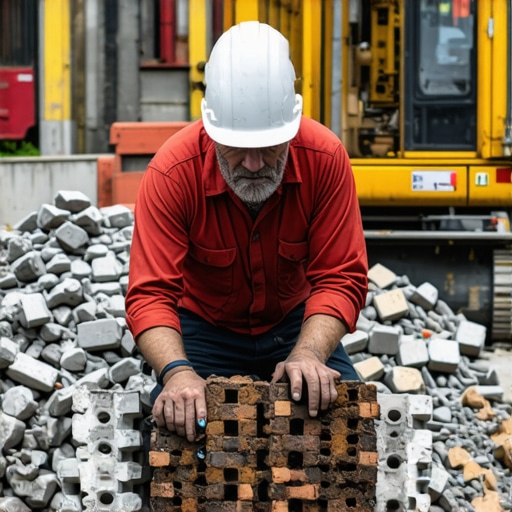
The Ghost in the Machine: A Forensic Look at Historic Masonry Failure
The wrecking ball doesn’t have a conscience, and neither does a modern diesel excavator. I stood on a site last month in an old industrial corridor where a 1915-era warehouse was being gutted for ‘luxury lofts.’ The developer thought it was just a cosmetic job until the south-facing wall started shedding its skin like a diseased snake. The homeowner or, in this case, the project manager, thought it was just a hairline crack running from the lintel to the foundation. But when I put my digital borescope inside that void, I didn’t see solid structural masonry. I saw a cavity where the internal structural steel had oxidized so violently it had expanded to three times its original thickness, turning the surrounding common brick into red dust. This wasn’t just a repair job; it was a forensic rescue mission involving commercial tuckpointing and deep-tier foundation underpinning.
When you are dealing with century-old clay, you aren’t just working with building materials; you are managing a living, breathing respiratory system. Those old-growth bricks were fired in kilns that didn’t have the digital precision of today’s manufacturing. They have a ‘fire-skin’—a hard, vitrified outer layer that protects a softer, more porous interior. If you treat them like modern modular brick, you kill them. I see it every day: a ‘handyman’ comes in with a high-speed grinder, chews out the joints, and slaps in a bag of Type S Portland cement from a big-box store. Within three winters, the faces of those historic bricks start popping off in a process we call spalling. Why? Because the modern mortar is harder than the old brick. The wall can’t breathe, moisture gets trapped, and the 9% expansion of freezing water wins every single time.
“Water penetration is the single greatest threat to masonry durability.” – BIA Technical Note 7
The Chemistry of the ‘Sacrificial’ Joint
In the world of stone wall repair and historic preservation, we live by one rule: the mortar must be the sacrificial lamb. In a 100-year-old structure, the ‘mud’ (our trade term for mortar) is meant to be softer than the masonry units. It is designed to absorb the stresses of thermal expansion and to wick moisture out of the wall. When we perform brick efflorescence removal, we aren’t just cleaning white powder off the surface; we are diagnosing where the moisture management system has failed. That white powder is salt—minerals carried by water through the brick’s capillary pores. If the mortar is too hard, those salts can’t escape through the joint; they crystallize just behind the brick’s face (sub-florescence), blowing the face of the brick off from the inside out.
To save these bricks during a demo or a heavy renovation, we often utilize AI masonry assessment tools. These aren’t sci-fi gadgets; they are high-resolution thermal imaging and structural modeling softwares that tell us where the wall is holding water. We look for ‘honeycombing’ in the old concrete and ‘cold joints’ where the original masons stopped for the day in 1920. If the structural integrity is compromised, we might move to foundation underpinning to stabilize the load before we even think about commercial tuckpointing. It’s about the physics of load distribution. If the ground has heaved or settled, that 100-year-old wall is under a ‘racking’ stress it was never meant to handle.
The Process: From ‘Butter’ to ‘Slicker’
Restoring a facade requires a tactile understanding of the material. When we do chimney rebuild services or chimney interior parging, we are dealing with extreme thermal cycling. The interior flue gets blasted with heat, while the exterior is hit with freezing rain. We use a ‘Hawk’ and a ‘Slicker’ (a jointer tool) to pack the mud in. We don’t just ‘smear’ it. We ‘butter’ the brick with intent, ensuring there are no voids. Voids are where water collects, and water is the enemy. For those dealing with brick veneer detachment repair, the problem is often the lack of wall ties. In the old days, we used ‘headers’—bricks turned sideways to tie the outer wythe to the inner wythe. Today, people use ‘lick-and-stick’ methods that fail when the adhesive loses its ‘tooth.’
“The mortar should always be weaker and more permeable than the masonry units themselves.” – ASTM C270
If you are looking at masonry joint sand repair for a historic walkway or tile grouts on masonry for a patio, remember the ‘suction’ or the Initial Rate of Absorption (IRA). A dry, old brick will suck the water out of your mortar faster than a sponge. If the mortar ‘flash sets’ because the brick robbed it of its hydration water, you get a ‘burnt’ joint that will crumble within a year. You have to pre-wet the masonry, bringing it to a ‘saturated surface dry’ state. This allows the lime in the mortar to carbonate slowly. Carbonation is a beautiful chemical dance where calcium hydroxide reacts with CO2 to become calcium carbonate—literally turning back into stone over decades. Modern Portland cement reaches its strength in 28 days, but a true lime mortar gets better for a century.
The Verdict: Do It Once, or Do It Twice
I’ve seen too many ‘restoration’ jobs that were actually just slow-motion demolitions. If you are salvaging 100-year-old bricks, you are the steward of a piece of history. Whether it’s stone wall repair or a full chimney rebuild service, the goal is to match the modulus of elasticity of the original materials. Don’t let a contractor talk you into a ‘quick fix’ with modern resins or waterproof coatings. Those coatings act like a plastic bag over the building, trapping moisture and accelerating rot. Real masonry is about breathability, capillary action, and the slow, steady chemistry of lime. Anything else is just a ‘band-aid’ on a gunshot wound. If you hear the ‘ring’ of a solid brick when you tap it with your trowel, you know you’ve got something worth saving. If it thuds, the internal matrix is gone, and you’re looking at a total replacement. Respect the mud, and the wall will stand for another hundred years. “