
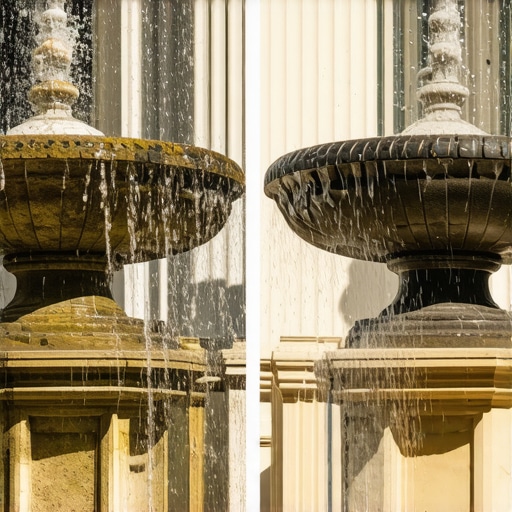
The Ghost in the Garden: A Forensic Look at Masonry Fountains
I’ve spent forty years listening to the language of stone. While most people see a masonry fountain as a static piece of landscape art, I see it as a living, breathing structural challenge that is constantly under siege. The homeowner thought it was just a hairline crack. But when I put my scope inside the secondary basin, I saw the structural steel was rusted to dust. The internal skeleton of the fountain was expanding, pushing outward with enough force to snap three-inch thick granite slabs like they were dry crackers. This is the reality of masonry forensics: the most dangerous damage is the kind you can’t see until the luster is long gone and the structure is a hair’s breadth from collapse.
The Physics of Saturation and the ‘Wicking’ Nightmare
Fountains aren’t like chimneys or garden walls. They face a unique existential threat: constant, pressurized water exposure. When we talk about commercial masonry maintenance, we aren’t just talking about scrubbing off moss. We are talking about the capillary action where water is pulled into the micro-pores of the brick or stone. If you used a dense, non-breathable Portland cement on a historic fountain, you’ve essentially trapped that water. In the masonry trade, we call it ‘choking the stone.’ When that water can’t escape as vapor, it remains liquid until the temperature drops. As water freezes, it expands by approximately 9%, and that internal pressure is what causes spalling—where the face of your beautiful stone simply pops off, leaving a raw, crumbling wound. This is why understanding fiber-reinforced mortars is critical; these modern mixes provide the tensile strength that traditional ‘mud’ lacks, allowing the structure to resist those internal expansion forces without fracturing the unit itself.
“Water penetration is the single greatest threat to masonry durability, particularly in water-retaining structures where hydrostatic pressure is constant.” – BIA Technical Note 7
The Restoration Reality: Why Your DIY Tuckpointing is Failing
I see it every weekend: a well-meaning DIYer with a bag of ‘all-purpose’ mortar and a cheap trowel trying to fix a fountain. They ‘butter’ the joint—slapping a thin layer of mortar over the crack—without realizing they are creating a cold joint. A cold joint is a failure of adhesion where the new material never truly bonds to the old. To do it right, you need the right tuckpointing tools for DIY, specifically a high-quality hawk and a slicker or jointer that matches the original profile. But more importantly, you need to understand tuckpointing cost estimation. A professional job isn’t expensive because of the material; it’s expensive because we spend 80% of our time grinding out the old, failing mortar to a depth of at least twice the width of the joint to ensure the new ‘mud’ has enough ‘tooth’ to grab onto. Without that mechanical bond, your repair will fall out in a single season.
Micro-Zooming into Mortar Chemistry: The Sacrificial Principle
One of the hardest things to explain to a client is why I’m using a ‘softer’ mortar. They want the hardest, strongest stuff available. But in restoration, we follow the sacrificial principle. The mortar must always be softer than the stone or brick. If the mortar is too hard—like a Type S or M Portland mix—the stone becomes the weakest point. When the fountain settles or the temperature shifts, the stone will crack instead of the mortar. I prefer using fiber-reinforced mortars for basins because the microscopic fibers act like tiny rebar, holding the mix together while maintaining the necessary vapor permeability. If you’re dealing with historic fountains, we move toward lime-putty mixes that actually ‘self-heal’ over time through a process of carbonation. This is the difference between a repair that lasts five years and one that lasts fifty.
[image placeholder]
Modern Tech in an Old World Trade: AI Masonry Assessment
We aren’t just tapping stones with hammers anymore. AI masonry assessment is changing how we handle commercial masonry maintenance. By using high-resolution photogrammetry and AI algorithms, we can now map every single fissure in a large-scale fountain to determine if a crack is a superficial shrinkage issue or a sign of deep structural settlement. This technology allows us to provide more accurate tuckpointing cost estimation by identifying exactly how many linear feet of joints are compromised before we even set up the scaffolding. For massive stone pieces, we are even seeing the use of self-leveling masonry lifts to reposition shifting basins without the risk of ‘point loading’—which is when a stone is supported unevenly and snaps under its own weight.
Surface Aesthetics: From Metallic Bricks to Sealants
Once the structural integrity is restored, we look at the ‘skin.’ For modern fountains, I’ve seen a rise in metallic brick colors application, using glazed units that mimic the look of copper or bronze. These require specialized handling to ensure the glaze isn’t ‘burned’ by the acidity in the mortar. After the joints are struck and the masonry is cleaned of ‘efflorescence’ (those white, salty stains caused by water-soluble salts migrating to the surface), we must address the brickwork sealants application. You don’t want a ‘film-forming’ sealer that makes the stone look like it’s covered in plastic. You want a silane-siloxane penetrating sealer. This doesn’t block the pores; it lines them, changing the surface tension so water beads off like a waxed car while still letting the stone ‘breathe.’
“The selection of mortar should be based on the physical properties of the masonry units to be joined, ensuring compatibility in strength and thermal expansion.” – ASTM C270 Standards
The Hardscape Truth: Do It Once or Do It Twice
Whether you are looking for chimney repair services or restoring a decorative fountain, the logic is the same: the base is everything. Many fountains fail because they were built on a ‘handyman special’ slab—four inches of unreinforced concrete over uncompacted soil. No amount of mortarless masonry systems or high-end sealants will fix a fountain that is sinking into the earth. You have to address the hydrostatic pressure. If you don’t have proper drainage behind the masonry walls of your fountain, the weight of the wet soil will eventually push the walls inward. In the masonry world, we say you can’t fight water; you can only lead it where you want it to go. Stop looking for the ‘game-changer’ product and start focusing on the physics of the ‘mud,’ the ‘tooth’ of the stone, and the reality of the freeze-thaw cycle. That is how you restore luster. That is how you honor the craft.